web analytics

power

You are currently browsing articles tagged power.

Because the prostitution controversy is about women who sell sex to men, most of male sex work passes unnoticed. And people who do talk about it often slip into the assumption that it’s a phenomenon happening between men, whether you call them gay or MSM. Consider host bars, which welcome female clients to be treated as men are in Japan’s numerous hostess bars.

The basic work is providing company whilst customers sit in the venue: good conversation, graceful flirting, lighting cigarettes and making sure drinks are correctly poured and always full. The relationship takes place in public but has an intimate quality. Venues differ, and sometimes employees are obliged to meet customers outside the clubs. Wages are low, and employees depend on the commissions they earn on promoting the sale of drinks, whose prices can be very high indeed.

I have read good research about Japanese hostess clubs but not about  host clubs. You can find a lot of media reports that all say the same thing about how they work. They say that even professional Japanese women are supposed to be passive and submissive. They correlate the rise of  host clubs with such women’s desires to have a place where they can be assertive and uninhibited. It is often said that a lot of the customers at host bars are hostesses who arrive after their own wearing shifts.

I’ve been studying the sex industry for 15 years, and I understand that the conflict about prostitution – and therefore about trafficking – derives from the belief that biological women are innately vulnerable to sexual violence. Therefore, information about men who sell sex (or are exploited) is usually marginalised, unless the men are technically boys.

But what about women who buy sex from men? Evidence about that is usually dismissed, too, by those who want to abolish commercial sex. When it’s not dismissed, the women are denounced as ‘acting like men’ – exploitative, objectifying, dominating, selfish. This critique comes up most in treatments of middle-class women tourists in poorer countries, where it’s common for local men to act as guides, advisers, drivers, cultural mediators and lovers. More everyday situations of women paying men are said to be few and exceptional, except for cheerful accounts of places like Chippendales.

Photo by Yevgeny Kondakov

At the end of last year I said I want to begin to think more purposefully about where the idea of Gender Equity has taken us. This will not take the form of a statistic war, because, as I always have to explain, there can’t be meaningful statistics where activities are stigmatised, illegal or simply occur in the informal sector of the economy. We don’t know how many of any sort of person buys what kind of sex from whom. What we have is a patchwork of information, a lot of it unreliable. Some of it, like the piece about a Kenyan man I posted the other day, is what’s called anecdotal. So is this piece from Der Spiegel about Bobby, who entertains women in Moscow.

Why aren’t women like those above seen as realising their desires? Why aren’t they seen as victims? Why isn’t this equity? What’s going on?
 

Share

Tags: , , , , , ,

The simplification of complexity is well illustrated by the idea of putting physical obstructions at national borderlines to keep people out. The stereotype of illegal migration imagines three clear roles: the migrant trying to cross, the smuggler or trafficker helping to flout the law and the police officer attempting to stop them. The reality is often much more complicated. The other day a story from Moldova pointed to corruption as a major problem in controlling migration there, and now here is a more tightly focussed account from the Mexico-US border.  I understand corruption to mean, in both cases, that those on the police and government side of the equation – who are paid to prevent people from getting in – take money in exchange for making entry easier. This can happen whether the activities in question are labelled smuggling or trafficking.

The below excerpts are from a news report about Lowell Bergman’s documentary on smuggling; his comments were made during a recent briefing at the University of California.

Corrupt U.S. Agents Aid Human Smuggling at Border

New America Media, Annette Fuentes, 6 Feb 2009

‘Building a fence and wall at the border and putting more border agents down there creates a bigger pool of potential corruption targets.’

The build-up of security agents on the border, especially since Sept. 11, 2001, hasn’t slowed illegal migration . . . Those who would have tried crossing alone are more likely to pay a smuggler to shepherd them across. ‘If people try to get across the border, they eventually get across . . .  Part of the fee to the smuggler is the guarantee that they’ll get you across. If they fail the first time, they’ll try again.’

. . . Proponents of the militarization of the border have used the threat of terrorist attacks in the wake of Sept. 11, 2001 to justify the build-up. But Bergman noted that there is no evidence that terrorists have ever entered through the Mexico-U.S. border. Of all those apprehended at border crossings, there is no record of non-Mexicans. . .

. . . there has been no effective internal oversight of border agents since the creation of the Department of Homeland Security. Multiple agencies, each with some responsibilities for immigration, customs and law enforcement, have meant no coordinated approach to investigations. ‘They completely lost any idea of what was going on . . . Only now are they beginning to find out, and they are overwhelmed by the number of leads and cases to follow up on.’

The FBI . . . now has about 200 open cases of human smuggling involving corrupt border agents. But the agency is swimming against the tide. ‘People coming through checkpoints . . . is still a growth industry.’

Here the whole black and white, law-and-order idea loses ground, and we see instead a multi-national social setting. Placing people at a border to enforce it provides them with opportunities to make money doing exactly what their formal job pays them to prevent. This is, of course, a widespread phenomenon amongst police of all kinds. Many people take law-enforcement jobs not out of an inspired devotion to the State but because they can get those jobs.Maybe they perform many aspects of their jobs correctly, but they don’t believe in ‘the law’ enough to resist opportunities to freelance. 

Here are three more examples of specific cases where those with power were paid to smooth crossing the border: a Dominican diplomat in New York, a filipino in New Jersey and a US customs officer and Chinese smuggler of people via Ecuador.

Share

Tags: , , , , , , , , , ,

The following story comes from Moldova, a country whose citizens are often said to be more likely to be trafficked or traffickers than others in Europe. Given that stereotype, it is interesting that this news, while brief, is more nuanced than most coming out of richer countries.

Human trafficking cases decline as illegal migration expands
Info-Prim Neo, 16.12.2008

The number of cases involving persons actually being trafficked tends to decline in favor of an increase in the number of illegal migration cases, according to the Board of the General Prosecutor’s Office of Moldova, Info-Prim Neo reports.

The Office said in a press release there have been recorded 510 trafficking-related offenses in 11 months of this year; of them, 209 were cases of trafficking of adults, 28 cases of trafficking of children, 152 cases of sexual exploitation, 106 cases of illegal migration, and 15 cases of child smuggling.

The prosecutors remark an alarming trend of trafficking cases where relatives and acquaintances have complicity. Cases where previously trafficked persons became traffickers represent another alarming trend. These cases are particularly difficult to investigate and examine in court.

According to the prosecutors, an element that facilitates human trafficking is corruption among persons in positions of authority. Trafficking and corruption are mutually reinforcing as they foster bribery and undermine the efforts made to counter these phenomena.

In the course of December the General Prosecutor’s Office is to finalize a series of acts that will make a priority to find criminal links between traffickers and persons in posts of authority.

The first good thing here is the absence of the abhorrent term sex trafficking : This authority is not making the fact of selling sex into a particular evil category. Next, the term illegal migration is used in the same breath as trafficking. Finally, they distinguish between child trafficking and child smuggling. I don’t believe it’s easy to make such distinctions, but I’d rather see them than the usual vast, reductionist statements.

Then these authorities mention, which everyone who studies migration knows very well, that relatives and friends are very often those who facilitate migrants’ journeys and jobs, whether those turn out happily or not. What outsiders decry as exploitation are often family strategies to get ahead. Are families often repressive instruments that punish girls more than boys? Yes. Should we lump all such family members into one messy bag called trafficking? It doesn’t help anyone. Migrants who’ve been selected as the most capable of being able to help the family as a whole do often suffer, but their greatest consolation can be knowing that they are helping their family. So dividing an exploited person from those she identifies with and loves is not kind. I would like to see things change, but not by imposing an idea about gender equality that does not take into account local realities.

The main point the Moldovan authority wants to make is the link between trafficking and corruption. Corruption is another word that can be misused and end up covering way too much, including ordinary local customs. But again, migration scholars know that getting the right papers to allow travel and work depends in many cases on the complicity of officials of all sorts: consider the cases of using false papers described here. And for those interested in some historical perspective, consider what refugees from Germany say about being smuggled in the 1940s, in a book by Dorothy B. Hughes.

Share

Tags: , , , , ,

In 2005 I proposed a cultural-studies framework for thinking about the sex industry. I then disseminated an announcement calling for articles using the new framework, for a special edition of the journal Sexualities, which publishes work from any academic field that ‘describes, analyses, theorises and provides a critique on the changing nature of the social organisation of human sexual experience in the late modern world.’  Which means the exchange of money for sex can be looked at just the way any other activity involving sex can.

The journal also likes ethnographic work, which means using information gathered amongst specific people in actual places rather than purely theoretical, such as whether you consider prostitution to be inherently exploitative or perverted or harmless or any other abstract term.

Although I received many responses to my announcement, most did not venture far from the traditional focus on the meaning and morality of prostitution, even when they used the term sex work.

Soi Cowboy, Bangkok

I chose eight articles, which then went through the usual academic review process, in which specialists in the fields discussed in the work give their opinions about it. All the articles were examined by at least two and sometimes three or four reviewers, people I found by searching high and low all over the globe. I had reviewers working on these articles in Japan, Australia, Israel, France and a long list of other places. For the same article they did not always agree, however, about whether the articles needed to be modified and how.

The best thing about this special edition is the absence of anything like victimising rhetoric or research results that prove anyone’s misery. Hurrah!

Here’s the Table of Contents for Sexualities, Vol 10, No 4, October 2007. If you have access to academic journals, the link to these pieces is here.

  • Introduction to the Cultural Study of Commercial Sex: Laura Maria Agustín, Guest Editor
  • Performance, Status and Hybridity in a Pakistani Red-Light District: The Cultural Production of the Courtesan: Louise Brown
  • Marketing Sex: US Legal Brothels and Late Capitalist Consumption: Barbara G. Brents and Kathryn Hausbeck
  • No Money Shot? Commerce, Pornography and New Sex Taste Cultures: Feona Attwood
  • Rent-Boys, Barflies, and Kept Men: Men Involved in Sex with Men for Compensation in Prague: Timothy M. Hall
  • Sex Work for the Middle Classes: Elizabeth Bernstein
  • Shifting Boundaries: Sex and Money in the North-East of Brazil: Adriana Piscitelli
  • Thinking Critically about Strip Club Research: Katherine Frank
  • Questioning Solidarity: Outreach with Migrants Who Sell Sex: Laura María Agustín

Below is the full text of my Introduction to the Cultural Study of Commercial Sex (Sexualities 2007; 10; 403). Or here is the pdf. (I’m having trouble with this file; if you need it, write to me on the contact form in the sidebar).

Laura Maria Agustín

The articles in this collection explore how the meaning of buying and selling sex changes according to the social, cultural and historical processes in which transactions are situated. Read the rest of this entry »

Share

Tags: , , , , , ,

Fotos de la Conferencia de SIDA en el DF en agosto de 2008. De PJ Starr:


Photos from Mexico (part 1) from PJ Starr on Vimeo.

Tiene otros en inglés sobre reducción de daños, como se define el daño etc. Y no se olviden del performance genial de esa conferencia que se ve aqui.

Share

Tags: , , , , ,

HIV and Disease – Violence and Exploitation – Crime and Punishment – Moralising and Ranting: This is what most writing about prostitution and the sex industry come down to. A few years ago, in the name of just plain knowing more about what so much debate and conflict is about, I proposed a new field of study to be called The Cultural Study of Commercial Sex. All sorts of sex businesses, from regulated brothels to street work, are included in the idea of the sex industry, and all participants are included: clients and workers (whether escorts or in brothels and massage parlours or lap dancers or street hookers). Also managers, madams, pimps, ‘traffickers’ and owners of businesses, as well as vendors who sell to workers in the venues, and so on.

Elena Jeffreys of Australia’s Scarlet Alliance of sex workers has sent me her contribution to an issue of the Journal of Australian Studies called Parading Ourselves (#89, 2006). That title is what first caught my attention. The issue is about the different meanings of public protests, marches and processions – anything that can be called a parade – and includes items on military masculinity, indigenous people’s revolt against whiteness, mardi gras and, in Jeffreys’s case, Contemporary Sex Worker Cultural Practice in Australia: Sex Workers’ Use of Sex Industry Skills in Public Protest and Performance. Here’s the link to the article, but I’m afraid only academics can get access to it without paying.

Jeffreys notes:

Dominant social mores demand that sex workers are invisible. Discussion, disclosure, recognition and visibility of the sex industry is perceived as evidence of a ‘slight’ on society, at best impolite and, at worst, to deserve micro-management on the visual landscape with criminal penalty for non-compliance. The stigma and discrimination sex workers experience when their sex-work status is known is a punishment for their ‘indiscretion,’ however it is hard to know if it is the act of sex work that is challenging to mainstream society, or the first-person telling of such acts, by sex workers in particular.

Examples of performance/protests described:

Christmas Eve Demonstration outside Northbridge Police Station 2002

Dressed in red and green, and wearing identity-concealing fluffy white beards and face masks, the sex workers approached the Northbridge Police Station as a group . . . carrying armfuls of large boxes wrapped in glossy Christmas paper and marked with large labels. . . A song had been penned by the sex workers, titled ‘Silent Whores’ and sung to the tune of Silent Night, telling of police corruption and sex worker objections. The new laws were outlined in bold letters on the gifts, reading ‘Strip Search Without Charge,’ ’Enter Premises Without Warrant,’ ‘Move On Notice‘ and ’Restraining Order‘ framed by the message, ‘To the Police, Love from Michelle Roberts xx’.

Lamington Ladies Stall at Dumas House 20th June 2003

The West Australian sex worker community fought back by adopting what is recognised in Australia as a modern archetype of wholesome family goodness, a character you can trust with your money and what you put into your mouth – the Lamington Lady. Dressing as Lamington ladies challenged the over-sexualisation of the issue in the West Australian media and refocussed on the issue of community services. . . Pastel pink and blue tunics made the basis of the transformation, with cream and white stockings, sensible shoes, frilly aprons and catering caps. Standing behind lace topped card tables with plates of lamingtons, the activists smiled for the cameras and explained that they had lost all of their health and advocacy services

Debby Doesn’t Do It For Free, a group of performers all named Debby.

In February 2004 they performed their first full length cabaret show, complete with mock national anthem: “Advance Australia Fear” . . . and ‘Olympic Whore’, which involved performing feats of gymnastic capability while demonstrating sex on a massage table . . . Other aspects of the performance included Mr Big Pants, a politician who claims to be ‘helping’ sex workers while trampling their rights . . . and live vaginal fisting on stage whilst reading poetry . . . These performances use archetypal characters to convey little-heard messages about sex work and its complexities, from a purely sex worker perspective.

Congratulations are due to sex workers in Australia for their cultural creativity and actions that blur the supposed lines between suffering and pleasure and injustice and power.

And if anyone wants to know what a Lamington is:

:

Share

Tags: , , , , ,

The word help is very misleading, like rescue and save and rehabilitate.  Who decides which people need help and when and how?  That’s the basic problem. If you simply look at another person’s situation and think ‘How awful, I wouldn’t want to live like that, it must be intolerable!’ then you might jump to the conclusion that she or he would be happy to have any help you feel like giving. You might assume, as pointed out in the previous post on Knowing Best that everyone sees the world as you do. But it’s not true, as I discuss in Leaving Home for Sex and The Sex in Sex Trafficking.

Today’s example of failed helping comes from Thailand. Empower, whose anti-rescue poster I published a while back, has written to say that they refused to participate in the development of a ‘training package’ aimed at UN employees dealing with sex workers. They were asked to reconsider their decision. Refusing a second time, they sent the following letter to the United Nations Population Fund (UNFPA) and the Nossal Institute of Global Health at Melbourne University, which got the UNFPA contract to develop the material.

Dear Brigitte,

Empower had a second long joint discussion about the proposed training. Empower has decided to be faithful to our original position and not take part in the training in Bangkok. We would like to explain this position to your team as well as UNFPA.

We understand the point of the training is to decrease stigma and break down sterotypes. However, we see the very process of the development and implementation of this training reflects the prejudices held by UNFPA programmers. It is simply not acceptable to hire a team of non-sex workers to create a training module about working with sex workers. The fact that your team at Nossal contacted sex woker groups to participate in the development is perhaps to your credit, but it does not address the original insult. There are many very capable, very credible, sex worker organizations that UNFPA could have and should have hired directly to create and implement the training module. How would it be if a sex worker organization was hired to develop and implement a training module on Nossal Institute…it would be senseless, yes? Why should it make any more sense in the reverse? We know we were certainly not the only sex worker organization to refuse to take part. We also felt our expertise was being undervalued by the small token payment you were able to offer under your funding guidelines. The project is 27 months long, obviously funded at UN rates, yet from memory you could only afford to pay Empower around $AUS800 to act as advisers. We are sure the UNFPA would not accept such small payments for their staff.

However, the money is a small part of the issue. The greater concern is that UNFPA thinks this is an appropriate process! It says to Empower that the UNFPA does not believe that sex workers are intelligent, capable, valuable partners in the fight against HIV. It says to Empower that UNFPA still sees sex workers as people who are only capable of providing colour…telling some stories and acting as sex tour guides on training field trips. It says to Empower that UNFPA still does not understand concepts like “community participation” or “best practice”. For example you said [name] was helping with your project. She came to us as a young intern to learn FROM us…we are the ones who tried to teach her how to be a part of a commuity organization and now she is better placed than us to design this training!?

When will UNFPA and others see us as educators, trainers not just targets, tools or fools?

All this leaves us wondering what kind of impact can a training that is not owned by sex workers have on the attitudes of individual UN agency staff especially while the stigma and prejudice about sex workers is so obvioulsy entrenched in much of the UN system. We note that the UNFPA and other UN agencies,as late as March 2008, are still using offensive terms like “commercial sex worker” and “high risk group” in some publications despite promises made. That such a small detail as this has proven too hard for the UN to address does not bode well for the outcome of the trainings, does it?

We acknowledge that Can Do Bar is public property so we cannot decide for you whether you include whatever the video is that you made or not. You asked us to approve the script but we cannot. We have no idea where the quotes you have came from but they are not accurate. For example we never use words like “girls” Pornpit is a sex worker too and does not use terms like “they and them” – it’s “us and we”! There are about 50,000 Thai sex workers who have been involved with Empower over 20 years. We have had a handful of westerners over the same period in minor support roles. If you quote Liz instead of us, the Thai sex workers of Can Do and Empower, it encourages people to continue to believe we are stupid and can only do something if a foreigner helps us. It also just doesn’t sound like us or Can Do Bar!

Our position is not meant to reflect in any way on those groups who chose to help you… or any other group’s involvement.

Regards
Empower

Translated by Liz Hilton : On a personal note I was horrified to see my name in the acknowledgements in the Handbook. I have not knowingly or willingly contributed to your process in any way at all. Please take my name off all and any materials associated with this project. Thanks.

I might add that the whole idea of material intended to ‘train’ helpers in how to treat sex workers – or anyone else – is patronising, as though they were not human beings or needed some special psychology or sensitivity. Feh! This contract also illustrates the problem with proposing to do research about people you think are fundamentally different from yourself, often just because they live in a poorer country. This is the idea behind ‘Development’, which I won’t get started on today.  I discussed the contradictions of research in The (Crying) Need for Different Kinds of Research and Alternate Ethics. Of course, when the research subjects are sex workers, attitudes can be even more egregious.

Share

Tags: , , , , , , , ,

The other day I mentioned StuffWhitePeopleLike in a post about Ethnicity and Satire. I wrote Christian Lander to ask if I might reprint in full my favourite of his, #62 Knowing What’s Best for Poor People, and he said yes. As some of you know, I’ve written a lot about Knowing Best: how it all came about with The Construction of Benevolent Identities, that thing called Empowerment and how we should Forget Victimisation regarding what Lander’s calling Poor People.

Lander takes off the way ‘helping’ makes people feel good about themselves and how they assume that if everyone were to live the way helpers do – making the Right choices – then the world would be Good.  

White people spend a lot of time of worrying about poor people. It takes up a pretty significant portion of their day.

They feel guilty and sad that poor people shop at Wal*Mart instead of Whole Foods, that they vote Republican instead of Democratic, that they go to Community College/get a job instead of studying art at a University.

It is a poorly guarded secret that, deep down, white people believe if given money and education that all poor people would be EXACTLY like them. In fact, the only reason that poor people make the choices they do is because they have not been given the means to make the right choices and care about the right things.

A great way to make white people feel good is to tell them about situations where poor people changed how they were doing things because they were given the ‘whiter’ option. “Back in my old town, people used to shop at Wal*Mart and then this non-profit organization came in and set up a special farmers co-op so that we could buy more local produce, and within two weeks the Wal*Mart shut down and we elected our first Democratic representative in 40 years.” White people will first ask which non-profit and are they hiring? After that, they will be filled with euphoria and will invite you to more parties to tell this story to their friends, so that they can feel great.

But it is ESSENTIAL that you reassert that poor people do not make decisions based on free will. That news could crush white people and their hope for the future.

That ending encapsulates how so many commentators talk about women who sell sex, and young people who express sexualities and almost all migrants who leave home to work at less than wonderful jobs outside their own countries. If you just turn the gaze back onto the commentators you see the assumptions undergirding their concern – that everyone should and must want to live the same way, no matter how impossible that goal is.

Share

Tags: ,

The European Conference on Sex Work, Human Rights, Labour and Migration was held 15- 17 October 2005 in Brussels. I was a member of the Organising Committee, which began meeting in January 2004 in Amsterdam, usually at the headquarters of Mama Cash.

The website for the International Committee on the Rights of Sex Workers in Europe is full of resources and can tell you what happened at the conference and what’s happening around Europe now better than I can.

Of particular interest for rights activists is the Sex Workers in Europe Manifesto, the product of a consultation carried out with sex workers throughout Europe.  You can see the Manifesto in English, РУССКИЙ, Deutsch, Français, Español, Italiano, Ελληνικά, Slovensky and Български.

Note the wording: This conference was not about ‘Europeans’ but people working in Europe. Many of the workers who came to the conference were migrants.

Share

Tags: , , , , , , , ,

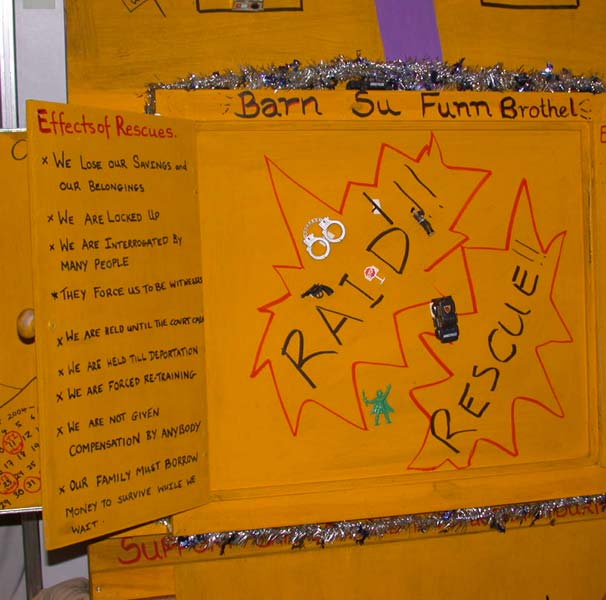
This poster comes from the EMPOWER centre in Chiang Mai, Thailand, where brothel workers gathered to discuss recent raids and rescue operations. On the left they have written a list of reasons why they do not wish to be rescued by police, ngo or charity workers.

• We lose our savings and our belongings.
• We are locked up.
• We are interrogated by many people.
• They force us to be witnesses.
• We are held until the court case.
• We are held till deportation.
• We are forced re-training.
• We are not given compensation by anybody.
• Our family must borrow money to survive while we wait.
• Our family is in a panic.
• We are anxious for our family.
• Strangers visit our village telling people about us.
• The village and the soldiers cause our family problems.
• Our family has to pay ‘fines’ or bribes to the soldiers.
• We are sent home.
• Military abuses and no work continues at home.
• My family has a debt.
• We must find a way back to Thailand to start again.

Only one side of the list is visible in the photo, but we are lucky to have any photo at all. Thanks to people from the Asia-Pacific Network of Sex Workers.

Share

Tags: , , , , ,

« Older entries § Newer entries »