
web analytics

helping

You are currently browsing articles tagged helping.

Receiving Help

One of the basic principles of my work has been respect for what people say about themselves. Before I emerged from the streets into academic rooms where people use big words and are considered Important Members of Society, I did a hundred different jobs, including manual labour, which in many ways I like best. I did community organising, aids-prevention and literacy (alfabetización is a better word) in the Paulo Freirean tradition of educación popular, which is why, when I decided to go back to school after decades away, I did a master’s degree in education (whose practitioners are not considered Important Members of Society).

My original question from what academics call the field was: Why is there such a big difference between how migrants who sell sex talk about themselves and how outsiders talk about them? It didn’t take long to encounter the postcolonial idea that marginalised people’s voices were silenced. At the same time, I had always known expressive, noisy activists among all sorts of marginalised groups. I thought, the problem is not that people are not allowed to speak but that no one listens. In the following piece, published 12 years ago, I speculate about educational activities that might work among migrants that would not look like outside authorities choosing how to ‘help’ them. The ideas are not out of date all these years later, when I might also call them Naked Anthropology.

They Speak, But Who Listens?

Laura María Agustín

In Women@Internet: Creating Cultures in Cyberspace, ed. W. Harcourt. London: Zed Books, 1999, pp 149-161.

A Parable of Connexion

Scene: A small room with a bed and a washbasin.
Characters: A man and a woman.

It’s the third time this man has paid to spend time with this woman. She only speaks a few words of his language, but he seems kind and she decides to take the risk. She tells him she is being held prisoner and wants to get out. Will he help her?

The man is sympathetic but he doesn’t want to get too involved, certainly not to take charge of this woman. So he takes out his cellular phone and says: “Make any call you want.”

The woman hasn’t used a telephone in months. The only number she knows by memory is her sister’s, back in the Ukraine (…or Paraguay….or Burma). She has trouble dialling, doesn’t know any of the codes, but the man helps her. They have to hurry, because he’s only paid for a short time, and they have to whisper, because there are people in rooms on both sides of them.

The call goes through! Her sister answers. The woman can only say, “Help! Get me out of here! I’m being held prisoner!”
“Where are you?” asks her sister.
“In Israel (…or Holland…or Thailand)”.
“But where exactly?”
“I don’t know.”

Stories like this have made headlines all over the world. In the usual version, the faraway recipient of the call begins a long, arduous search for help through hotlines to embassies and international police. In the end, there is a raid and the woman who made the call is liberated. The police, who knew about the brothel all along, are not the heroes of the story. Neither is the client, who took no risks. In fact, the hero of the story is the small cellular phone that enabled the prisoner to connect to the world and be heard. The story does not end perfectly, however, because the woman is deported, and this is not what she wanted.

When I consider the possible uses of new technology for migrant women, I begin with stories like this one. Here, people are enabled to communicate vital pieces of information. Here, there are processes and chains of events and people help each other. Before we can move to the question ‘How will the Internet benefit migrant workers?’, other questions must be considered, for these are not simple or straightforward situations.

Geographical double-think

Although commercial sex is now recognised as a global, multi-billion dollar industry, its workers–in their millions–are only referred to as ‘illegals’, as victims of ‘trafficking’ and as potential ‘vectors’ of HIV/AIDS–when they are referred to at all. The same London newspaper that runs the story of ‘liberated sex slaves’ in Malaysia never mentions the problems migrant Chinese women have finding childcare (or fish sauce) in London. It is the age-old technique of ‘disappearing’ people simply by not acknowledging them.

To be deemed worthy of recognition and of help, where you are is all-important. The same person identified as ‘indigenous’ in the Andes and included in projects of traditional aid is viewed, if she migrates to the North, as a job-stealer, welfare bum, ghetto resident, drug dealer and addict, candidate for deportation and firmly outside the scope of traditional development aid. Unless she puts on some kind of native dress and plays pan-pipes, whereupon she may qualify for ‘cultural’ funding and will probably be left alone by the police–that is, if she plays well enough to gather audiences.

Those who seek to correct this geographic double-think–whether they are involved in battles for fairer immigration law or for better working conditions for domestics, dancers or prostitutes–often talk about rights: the right to communicate, the right to health care. Similarly, when possible uses of new information and communication technologies are mentioned, we hear about the right to access. But access is a tricky thing with people who are being watched and controlled, don’t have much money and are itinerant. Migrant labourers, whether women or men, whatever their labour, have difficulty finding and using the benefits of settled society. Migrants who don’t enjoy ‘legal’ status or whose status depends on a certain amount of fraud or deception, must be extremely cautious about requesting and using services. Migrant prostitutes have the added problems of having to navigate a labyrinth of laws concerning their work. The problems here are logistical and the need is for wireless, rapid and discreet connexions.

The literacy myth and the new information culture

Beyond questions of access lie dreams of educational growth, spiritual expression, ‘liberated voices’ that media like the Internet offer. Again, advocates often mention rights: to education, to ‘life-long learning’, to ‘self-expression’ or ‘self-realisation’. The ‘rights’ argument, however, sets the discussion firmly within First World norms, where citizens not only already have better access and service but more citizens are prepared to take advantage of them. To use the WorldWideWeb and even the simplest e-mail programme, after all, requires a very high level of literacy.

Classic ‘Development’ projects, whether applied to populations located in the Third World or to migrants who have left it, have assumed that Progress happens in stages, of which literacy is the first. Read the rest of this entry »

Share

Tags: , , , , ,

This is a long academic piece but useful to understanding the beginnings of what I came to call the Rescue Industry. The links between reference numbers and endnotes go via the original publication’s website (rhizomes). If you use them you just need to click the back button to return to this page.

Helping Women Who Sell Sex: The Construction of Benevolent Identities

Laura María Agustín, rhizomes.10, spring 2005

Abstract: Social interventions aimed at helping the group positioned as most needy in Europe today, migrant women who sell sex, can be understood by examining that time, 200 years ago, when ‘the prostitute’ was identified as needing to be saved. Before, there was no class of people who viewed their mission to be ‘helping’ working-class women who sold sex, but, during the ‘rise of the social,’ the figure of the ‘prostitute’ as pathetic victim came to dominate all other images. At the same time, demographic changes meant that many women needed and wanted to earn money and independence, yet no professions thought respectable were open to them. Simultaneous with the creation of the prostitute-victim, middle class women were identified as peculiarly capable of raising them up and showing the way to domesticity. These ‘helpers’ constructed a new identity and occupational sphere for themselves, one considered worthy and even prestigious. Nowadays, to question ‘helping’ projects often causes anger or dismissal. A genealogical approach, which shows how governmentality functioned in the past, is easier to accept, and may facilitate the taking of a reflexive attitude in the present.

This article addresses the governmental impulse to name particular commercial-sex practices as ‘prostitution’ and its practitioners as ‘prostitutes.’ Although it is conventional to refer to ‘the world’s oldest profession,’ the term prostitution has never described a clearly defined activity and was constructed by particular social actors at a specific time for specific reasons. [i] Within feminism, the phenomenon called prostitution is the centre of an intransigent debate about its meanings, one aspect of the conflict revolving around what words should be used to describe women who offer sexual services for sale: prostitute, sex worker, prostituted woman, victim of sexual exploitation. The use of one label or another locates the speaker on one or the other side of the debate, which essentially asks whether a woman who sells sex must by definition be considered a victim of others’ actions or whether she can enjoy a degree of agency herself in her commercial practice. In the prostitution discourse, those who sell are women and those who buy are men; it is a gendered concept, despite the enormous numbers of transgenders and men who sell sex and the transgenders and women who buy it. The anxiety to define and classify concerns the position of women, and this anxious debate should be seen as a governmental exercise carried out by social actors whose own identities are at stake. Academics and other theorists and advocates for one or another vision define themselves as good feminists or caring persons through their writing and advocacy. Being ‘right’ about how to envision women who sell sex is necessary to these identities, which explains the heated, repetitive nature of the debate. At the same time, for most of those who actually carry out the activity that excites so much interest and conflict, the debate feels far away and irrelevant.

Nowadays, much of the discourse targets migrant women who sell sex, particularly in wealthier countries. I have written in other places about the construction by outsiders of these contemporary subjects as prostitutes, sex workers or victims of ‘trafficking’ when their self-definitions are different (2005a), the construction of victimhood in general (2003a, 2005a), the disqualification of other elements of their identity (2002, 2004b, 2006), the obsession with certain of their sexual practices to the exclusion of everything else about their lives (2003b), the difficulty on the part of many feminists to accept the agency of working-class women who sell sex (2004a) and the voluminous quantity of interventions designed to help, save and control them (2005b).

The social sector desiring to help and save women who sell sex is very large indeed. The proliferation of discourses implicated includes the feminisation of poverty, closing borders and immigration law, international organised crime (especially ‘trafficking’ and modern forms of slavery), sexual-health promotion, the control of contagious diseases, debt bondage, non-recognised economic sectors, violence against women, women’s and human rights, social exclusion, sex tourism, globalisation, paedophilia and child labour, as well as policies aimed at controlling the sale of sex. Attendant technologies have also proliferated, including safe houses, rehabilitation programmes, outreach projects, drop-in centres, academic research, harm-reduction theory and a whole domain of ‘psy’ theories and interventions concerning the causes and effects of selling sex on individuals. People positioned as experts on the subject constantly lobby governments, write and speak at conferences on the subject, with the result that women who sell sex are pathologised as victims daily.

All these preoccupations and apparatuses provide employment for large numbers of people, the majority women. These social-sector jobs are considered dignified, sometimes prestigious and may even be tinged with a sacrificial brush—the idea that those employed in ‘helping’ are unselfish, not themselves gaining anything through their work. The fact that their projects are governmental exercises of power is ignored. There is strong resistance to the idea that rescue or social-justice projects might be questionable or criticised in general, and the internecine feminist conflict focussing on whether the activity called prostitution is inherently a form of violence or can be a plausible livelihood strategy distracts from any real reflection on the usefulness of the projects. Yet, despite the abundant efforts carried out on their behalf, there has been little improvement in the lot of women who sell sex since the whole helping project began two hundred years ago. ‘Programmes presuppose that the real is programmable,’ said Nikolas Rose and Peter Miller (1992: 183). In this case, ‘the real’ is too often a woman designated victim who does not want to be saved, so it is little wonder that programming does not work. This article therefore explores the beginnings of the identification of a pathological activity (prostitution) and the labelling of its practitioners (prostitutes), the governmental projects that resulted and the social effects on both groups involved. Read the rest of this entry »

Share

Tags: , , , , , , , ,

Do all Internet websites have a global responsibility just because they are accessible from everywhere? Most people would find that far-fetched, but I’ve received a letter signed by people calling themselves the anti-trafficking community who think so in one case – that of Craigslist. The letter asks the company to close its erotic and adult services sections all over the world, not only in the US, talking about ‘global responsibility’.

The letter demands a meaningful solution of how you intend to guarantee that no children are being sexually exploited on your site. Not only is this a bizarre request but is the same sort of thinking that justifies imperialist actions like invasions of other countries. It reminds me of a speech I heard that explained anti-trafficking campaigns around the world based on principles in the US Constitution.

The signers complain that Craigslist defended themselves at one point by saying that ‘experts’ in the ‘field’ of anti-trafficking approved of what they were doing (this is before they shut down the section in the US). On the contrary, say the signers of this letter, we are the real and only experts. Given the lack of evidence for most claims about trafficking it’s pretty silly to describe it as a field of knowledge, but that is the basis of this letter.

Choosing the right name and good keywords for social campaigns is crucial to success, and claiming to be the anti-trafficking community is not a bad effort. There are several implications to the claim:

  • that there is only one community that cares about victims of trafficking
  • that everyone in it saw this letter
  • that everyone who saw the letter signed it

But, of course, there are many other groups, ngos and individuals who do anti-trafficking work of one kind or another and who were undoubtedly not sent this letter to sign. I object to having the entire project of righting wrongs in this ‘field’ hijacked by a group with a particular ideology everyone does not share.

September 14, 2010
Sent via facsimile to
Jim Buckmaster, CEO
Craig Newmark, Founder
Craigslist, Inc.
1381 9th Avenue
San Francisco, CA 94122

Dear Craig Newmark & Jim Buckmaster,

The experts in the anti-trafficking field who have signed this letter stand together asking you to shut down all the Adult and Erotic Services sections of your website around the world.

We all know that plenty of activity has preceded this letter. There have been meetings, news articles, research studies, protests, letters from survivors, blogs, boycotts, earnings estimates, lawsuits, subpoenas, and plenty of other actions. The voices of survivors, advocates, service providers, local law enforcement, members of Congress, and State Attorneys General have all implored you to do more to fight the sex trafficking of women and girls that occurs on your site.

We thank you for voluntarily closing the Adult Services section of Craigslist in the United States. While this is a positive step, Craigslist is a global company, and it has a global responsibility. More than 250 Craigslist sites exist around the world that still feature “Erotic” sections where trafficked children and women are being sold for sex through your website.

Of particular concern is your repeated statement that anti-trafficking “experts” are supportive of your approach. For example, in one of Jim Buckmaster’s online responses on the Huffington Post, he states, “To the contrary, we are convinced Craigslist is a vital part of the solution to this age-old scourge. We’ve been told as much by experts on the front lines of this fight…”1

There are some who may want you to keep the Erotic Services sections going outside the United States for various reasons. Sex traffickers surely want you to keep the sections going because it helps them make high profits by advertising women and children to large audiences of paying customers. “Johns” who pay for commercial sex want you to keep the section because your site makes it easy and less risky for them to buy women and girls simply by surfing the Internet and perusing the photos on various ads. There may even be some law enforcement officials who see some value in placing decoy ads on your site, or using Craigslist ads as evidence in an investigation. However, we highly doubt that on balance, law enforcement would condone a venue that is a platform for the sex trafficking of women and children. The recent letter signed by 17 State Attorneys General strongly suggests that many law enforcement officials believe the best solution is to close the section, as you have done in the United States.

The signers of this letter are the experts on the issue of human trafficking. Many of us work on the front lines, directly with victims on a daily basis. Some of us are survivors of human trafficking.

p 2
With this letter, we are telling you that on the whole, Craigslist’s Adult and Erotic Services sections continue to be more part of the problem than part of the solution. On the day that Craigslist shut down its Adult Services section in the United States, were the pimps and johns who depend on the site to advance the sex trade happy or upset? The answer to this question should help guide your path forward as you address the remaining “Erotic” sections around the world.

We acknowledge that there are some things that Craigslist has done that are part of the solution. Offering to meet with law enforcement and non-profits is a good thing. The decision to start screening the Adults Services ads was a step forward. Eliminating the blatant nudity that persisted in past years in the United States’ Erotic section was also a step forward. Posting national hotlines, and cooperating with law enforcement when cases are found is useful and laudable. As stated above, voluntarily shutting down the Adult Services section in the United States is also a step in the right direction. Despite such steps forward, these efforts are not enough.

We are deeply concerned that you have not yet taken down the Erotic Services sections across the globe. We are also concerned that it seems that you are not applying the screening techniques that were used in the United States to all the other Erotic Services sections worldwide.

In changing the name of the Adult Services section from “Erotic” to “Adult” in the United States, why did you not implement this change globally across your entire site? Furthermore, for the “Adult Services” pages in the United States, there was a “Warning & Disclaimer” page that discusses human trafficking an sexual exploitation. This disclaimer page is also present for the “Erotic” sections in Canada. Yet, as of the date of this letter, there is no “Warning & Disclaimer” page for the other international “Erotic” pages. Nudity is also still present in the photos associated with some “Erotic” ads in the international pages. The reality that you have not made the same improvements globally across your site reveals a disingenuous and inconsistent response on your part. Moreover, the few helpful actions you have taken do not measure up to the amount of daily harm being facilitated by Craigslist through the thousands of Erotic Services ads around the world each day.

In a recent letter, Jim Buckmaster stated that human trafficking ads are “quite rare” on Craigslist.2 Based on our experience and collective knowledge, we know that the presence of human traffickers on your site is more frequent than you realize. Traffickers have figured out ways to post pictures of clothed women and children that can get past your screeners. The anti-trafficking field has yet to be presented with a meaningful solution of how you intend to guarantee that no children are being sexually exploited on your site. As a result, we ask that you take down the Adult or Erotic sections, wherever they appear on Craigslist.

Another important reality for you to realize is that law enforcement does not currently have the resources to review and conduct an investigation of every single Adult or Erotic Services ad on your site. The sheer volume of ads outpaces law enforcement’s ability to respond to each one. Consequently, maintaining the Erotic Services sections in other countries enables the majority of Erotic ads to thrive without a law enforcement deterrent. Cooperating with law enforcement when a rare case is brought is a short-term solution, not reflective of an overall systemic analysis of the crime problem that you are enabling.

p 3
You have asserted that removing the Adult or Erotic Services sections will not entirely eliminate the presence of sex ads on your site. This may be true, but eliminating the centralized thoroughfares of each designated “Erotic Services” section seriously disrupts pimps and johns who buy and sell women and children on Craigslist. Closing this section of Craigslist across the globe will send a clear signal to sexual predators that you will not stand for them using the site to sexually exploit children and women.

You argue that there are other online sites that advertise sex ads. Yes, the signers of this letter are aware of other sites with adult ads, and we are working to address those sites as well. But frankly, the user volume and name recognition of those sites pales in comparison to yours. They are not a household name like Craigslist.

We collectively feel that if you are seriously committed to ending the site’s use as a platform for sex trafficking of women and children, you will apply the same approach you recently took in the United States and immediately close the remaining Erotic sections around the world.

If you continue to keep the Erotic sections outside of the United States, we ask that you at least be honest and more specific about the reasons why you are keeping them. After receiving this letter, please do not claim that it is because anti-trafficking “experts” agree with you and wholly support your approach. In closing, we note that in one of Jim Buckmaster’s recent letters, he asked the question: “Would it not be a step backward to confine adult ads to venues that don’t cooperate with law enforcement, that don’t care what advocacy groups and nonprofits have to say?”3

This statement seems to indicate that Craigslist does care what advocacy groups and nonprofits have to say, more than other venues. If this is true, then you must care about this letter. Please hear what we have to say, read the signers of this letter, and recognize that the anti-trafficking field is standing with solidarity and unity, and collectively asking you to take down all the Adult and Erotic sections worldwide, completely and permanently.

1 Buckmaster, Jim. “An Open Invitation to Rachel Lloyd.” Craigslist Blog. 11 May 2010. Available at http://blog.craigslist.org/2010/05/ (visited September 13, 2010).
2 Ibid.
3 Ibid.

To see who signed this letter Read the rest of this entry »

Share

Tags: , , , ,

I have objected to the use of the word myth to describe how trafficking is talked about nowadays. Myth implies fabrication, whereas I describe what’s going on as exaggeration, reductionism, over-simplification, stubborn refusal to recognise diversity and victimisation.

Here is a piece of trafficking news in which victims of the crime spoke up and got themselves rescued. Authentic victims who simultaneously acted to take control of their own lives:

Before the raid, one of the seven women had managed to contact the Thai Embassy in Spain and complained that herself and the others were forced into working as prostitutes at the club.

I am not saying this is always possible, but it illustrates how victims can and do act to help themselves. In the terrifying versions of the story told so often nowadays, traffickers exercise total control over sex slaves’ lives. But most sex jobs cannot involve guards remaining beside victims full-time, since the work they are meant to do involves private sex with customers. This Thai-Spanish story illustrates that Great White Rescuers are not always required and that third-world women are not so helpless and ignorant as the rescuers usually imply. Note that the women have also filed complaints against the trafficker back in Thailand.

Spanish sex ring exposed

29 August 2010, Bangkok Post

The Anti-Human Trafficking Division (AHTD) police have arrested a Thai man who is accused of luring seven Thai women into prostitution in Spain. . . allegedly sending seven women to work as sex workers at a night club in Spain’s northern city of Burgos.

The Thai Embassy in Madrid had alerted Spanish police to the suspected forced prostitution at La Boheme, the club, where 20 people, including the seven Thai women, were later rescued in a police raid earlier this year, said Pol Lt Gen Thangai. A Thai woman identified as Jinda Khetwat, who owned the club, fled before police arrived, he said.

Before the raid, one of the seven women had managed to contact the Thai Embassy in Spain and complained that herself and the others were forced into working as prostitutes at the club.

The AHTD investigation showed Mr Noppadon had lured the women to work at the club by telling them they would work as traditional Thai massage therapists. He had arranged their trips to Spain, including finding Thai men to be registered as their husbands to convince officials at Spain’s embassy in Bangkok they were newly married couples on a honeymoon trip to Spain.

Four victims have lodged complaints against Mr Noppadon, and his wife has been arrested in Spain, said the police.

A Spanish newspaper confirmed this story last November, by the way:

Ellas denunciaron: Al parecer, fueron las propias víctimas las que lograron hacer llegar la denuncia de estos hechos hasta la Policía, que desarticuló la parte ‘burgalesa’ de la trama. . . Estos hechos fueron puestos en conocimiento de la embajada del país de procedencia de las mujeres y posteriormente se procedió a la inspección del local. Diario de Burgos, noviembre 2009

My name is not spelled Laura Agustino or Agustine or Augustino or Augustine or Agostino or Augustin or Augustine. Correct is Laura Agustín

Share

Tags: , , ,

En España están hablando de nuevo de prohibir los anuncios de contacto con trabajadores sexuales – o prostitutas/os (y a veces conocidos como avisos de putas). Un artículo desde Tenerife expone los diversos argumentos pro y contra. El 20 Minutos acusa a los demás periódicos del proxenetismo. Malaprensa deconstuye cuidadosamente las cifras enormes siempre citadas sobre el número de prostitutas en España.

La voz de la libertad de expresión dice Partiendo de la base de que ejercer voluntariamente la prostitución no es delito en España, no veo ningún inconveniente en que una persona, haciendo uso de su libertad, se anuncie en un periódico para prestar ese servicio (Leopoldo Fernández Cabeza de Vaca).

Pero claro que la trata sí es ilegal y los que hacen campaña en contra de los anuncios argumentan que no son las trabajadoras sexuales las que se anuncian sino las mafias. El mismo presidente Zapatero se ha pronunciado en contra: no le conviene nada el hecho de que España es el único país de la Unión Europea que todavía permite que los periódicos dominantes-principales publiquen estos anuncios. Atrás está una feminista estatal, Bibiana Aído, ministra de la Igualdad. Es una historia emblemática de la Europa contemporánea.

Al mismo tiempo algo similar está pasando en Estados Unidos pero que tiene impacto para cualquier sitio con Internet – o sea, para todo el mundo. Craigslist, un enorme sitio web de anuncios clasificados, queda acusado del ‘tráfico’ por personas y fiscales estatales que creen que se está utilizando el servicio para explotar a los niños. Escribí sobre esto ayer.

Share

Tags: , , ,

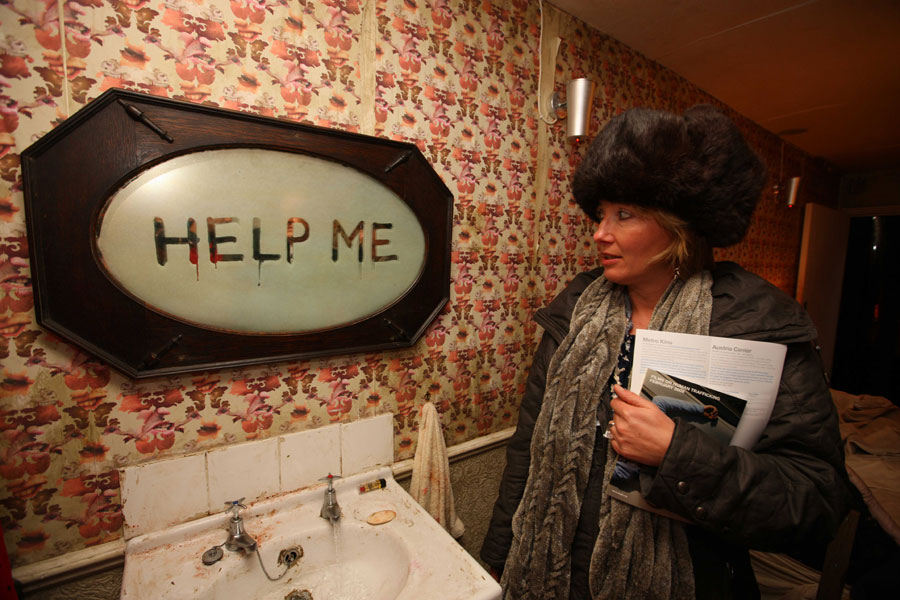
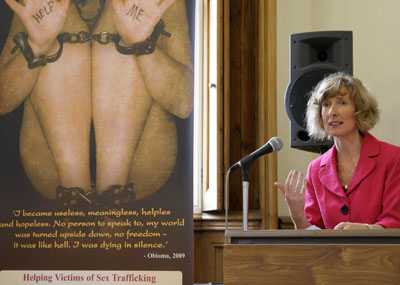
What are we to make of this photograph? Who is saying HELP ME? Is this a men’s toilet or a women’s? Is the victim hidden behind the wall? There’s something fundamentally wrong with the grammar of this warning. And then Emma Thompson – is she identifying with the person crying help? or perhaps a bit nonplussed, or distracted by the dirtiness of the sink.

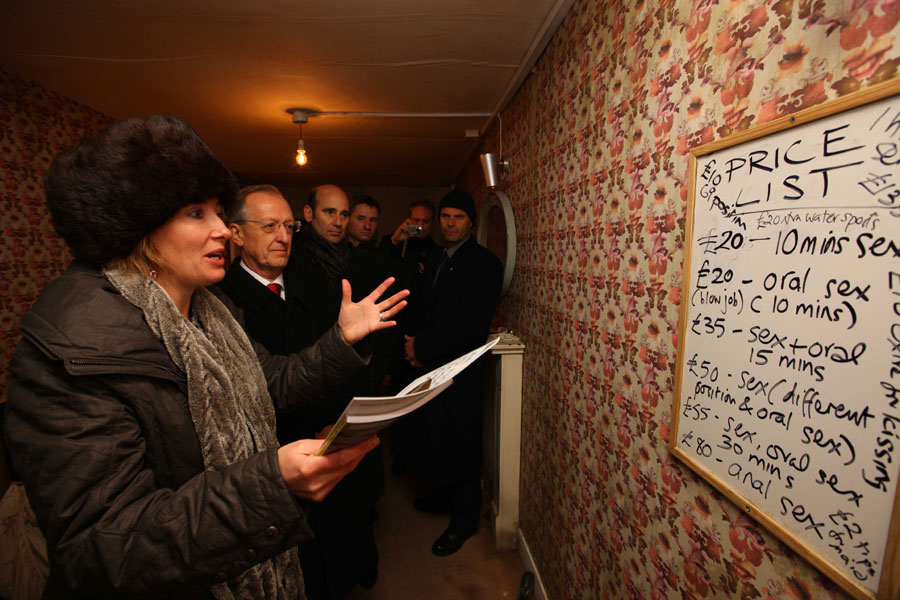
Here Emma is on surer ground: the correct response is dismay and disapproval that sexual acts could be written on a list with prices next to them. Unless it’s the prices that bother her – or the amounts of time. Do the men beside the movie star not look slightly uncomfortable? Of course the menu-price list is a fit-up invented by some intern who didn’t know how these things work.

Emma with Mr Costa of UNODC. Is that an anti-trafficking mural painted on the wavy metal wall? It turns out to be part of a giant installation. The fake bathroom and price list must be inside.

The big letters on top spell JOURNEY.

Here’s that picture from the front. Now it’s clearer that the viewer is being asked Is this sexy to you? At least I think so. But who is meant to answer? And what if some viewers’ response is Yes, in fact, I find it sexy ? Awkward.

My point is not to claim that trafficking is a joke or efforts to stop it always ridiculous but to suggest that many attempts at campaigning (these included) are confusing, non-educational and belittling to real victims. Or is the whole exercise simply meant to demonstrate a set of values for people who already share them?

Share

Tags: , , ,

Efforts to save migrants and prostitutes appear in fiction, too, and some authors have a fine-tuned sense of irony. In Magdalen Nabb’s Some Bitter Taste, Marshal Guarnaccia helps an Albanian prostitute to escape from her pimp, who is sent to jail. After living for a while with a nice ordinary man, Mario, the woman comes to Guarnaccia’s office to tell him his efforts to help her have failed:

-You’re the only person who’s ever been nice to me . . . so I wanted to tell you because if I don’t somebody else will. You’re bound to find out. I’m going back on the game.

- What? You’re what? And Mario?

- Oh, Mario . . . Jesus . . . I mean, he trotted off every morning at a quarter to eight and I was supposed to clean up his crumbs and wipe the floor over and then he’d come trotting back again and I was supposed to have the water boiling for his pasta and then it was one long whinge – there are no clean shirts, have you seen the fluff under this bed? Where’s the other sock to this? You’ve forgotten to get milk again . . . No, no, I couldn’t stand the boredom. So I upped and offed.

- Back to Ilir?

- Why not? He’s out now and he wants me back. Nobody ever earned him as much as me and he kept me in style. We ate in a restaurant every night. I like a good time and I get clients who give me a good time, you know what I mean? I like champagne and a few presents. I’m not spending the rest of my young life washing the floor of some poky little kitchen for a boring spotty clerk who thinks he’s earned the right to have his socks washed for a lifetime because he’s been good enough to save me from the streets.

- But what about when you’re not young anymore?

- Well, it’s all over then, isn’t it? Get it while you can, I say. I just . . . I wanted to tell you myself. It’s not that I’m not grateful to you. I know you meant well. Are you pissed off with me? You are, aren’t you?

-No, no . . .

- You’ve every right to be. I’d better go. I’m sorry. Because of you, I mean, not that little prick Mario, only because of you. I know you did your best.

Carve it on my tombstone, thought the marshal, watching her leave through a skein of cigarette smoke.

p 309

Share

Tags: , ,

A woman who sold sex from home along with colleagues goes on trial in the UK for brothel-keeping. This charge is possible when laws are written to discourage people from exploiting others for gain, living off immoral earnings and a host of other vague conditions. The sex worker in question, Claire Finch, alternated shifts with a couple of colleagues so that no one was ever alone:  ‘My main thing is safety. It’s not safe to work on your own. With two of us you had back up, you had camaraderie.’ Since she was raided she has had to work alone.

So prostitutes must work alone; they may use no management or support services; share no workplace; enjoy no collegial relationships. Only independent workers are to be respected even minimally. The contradictions of such laws are simply bizarre.

The story behind the trial and further comments are from the ECP:

On 19 November 2008, 20 uniformed police officers from Kempston Economic Crime Unit, kicked in Ms Finch’s front door and searched every room in the house including Ms Finch’s personal belongings, taking over £700 from her purse that had been put aside to pay the mortgage. Her laptop computer, mobile phone, driving licence and passport were also taken. No receipt was given.

Brothel-keeping charges were introduced in 1956. Since Proceeds of Crime legislation (reinforced by the Policing and Crime Act), raids and prosecutions against women working from premises have escalated. Police and prosecutors have a vested interest: the police keep 25% of any assets confiscated both at the time and from subsequent prosecutions (50% in some areas); the Crown Prosecution Service keeps another 25%; and the Inland Revenue the rest. Even if no one is charged, the money is rarely returned. Women who have worked for years to put money aside lose not only their livelihood but their home, car, life savings, jewellery, etc.

Finch’s case contradicts the Crown Prosecution Service’s obligation to consider the public interest when considering charge. Public-interest considerations for brothel-keeping charges are:

To encourage prostitutes to find routes out of prostitution and to deter those who create the demand for it

A criminal conviction is the biggest obstacle to leaving prostitution.

To keep prostitutes off the street to prevent annoyance to members of the public

Ms Finch’s neighbours have no complaints and are coming to court to support her. Closing down premises drives women onto the street where it is ten times more dangerous to work.

To prevent people leading or forcing others into prostitution

All the women were working consensually and independently. There was no force, coercion, violence or trafficking.

To penalise those who organise prostitutes and make a living from their earnings.

There was no profiteering. Everyone worked collectively and shared expenses.

Generally, the more serious the incident, the more likely a prosecution will be required

While time and money are going into prosecuting Ms Finch, the investigation of rape and other violence continues to be downgraded. Public opinion opposes women being criminalised for working collectively and consensually.

The age of the prostitute and the position of those living off the earnings will be relevant

All the women working with Ms Finch were over forty, mature women able “to make their own minds up. They’re not being hoodwinked.” Ms Finch has said that as a mother, working with inexperienced younger women “would not sit morally well with me.”

The case is to be tried at Luton Crown Court, 9.30, Monday 26 April to Thursday 29 April.

Share

Tags: , , ,

On the left you see the now common phenomenon of nicely dressed women attempting to save naked Other women from the chains of sex slavery. In England and Wales, the Policing and Crime bill that just came into effect says it will help stop trafficking like this:

On 1 April 2010, it will become an offence to pay for sex with someone who has been forced, threatened, exploited or otherwise coerced or deceived into providing the sexual services by someone else who has engaged in such conduct for gain. If convicted of the offence you could face a fine of up to £1,000, a court summons and a criminal record and risk having your name mentioned in newspapers. It will be no defence for a person to say that they did not know the prostitute was being forced or threatened.

The last sentence is known as a strict liability defence, invoked in situations the law believes to be ‘inherently dangerous’, which is how the British government now views prostitution, in a breath-taking reproduction of all the worst cliches generalised to ‘most’ and ‘many’ women who sell sex (and, as usual, only to women):

Most women involved in street-based prostitution are not there through choice. They are among the most vulnerable people in our society. Nearly all prostitutes are addicted to drugs or alcohol. Many of them have been trafficked into the country by criminals, and are held against their will. Many were abused as children, and many are homeless. Kerb crawlers, on the other hand, have a choice. Men who pay for sex are indirectly supporting drug dealers and organised crime groups, and funding violence and abuse. They are fuelling the exploitation of women by creating the demand for prostitution.

Most commentators object to how the law unfairly affects maids, managers and other conventionally employed people who work in sex venues without selling sex themselves – as well as unfairly condemning sex workers to constant aloneness. The law is also unworkable as a way to stop trafficking, as I wrote in The Guardian at an early stage of the bill:

The police will have to identify the real trafficked victims in order to identify customers at fault – a notoriously difficult enterprise. In a few high-profile cases, self-identified victims name and help find their exploiters, and sometimes these traffickers are successfully prosecuted. But these cases are few and far between. More often it is difficult to point to migrants who knew nothing about their future jobs, who agreed to nothing about their illicit travels and who are willing to denounce perpetrators who may be family or former friends and lovers.

The editors almost instantly hid the piece where it wouldn’t be seen.

Share

Tags: , , , ,

Last year I contributed comments and resources to a UNAIDS paper written to support discussion for their Thematic Segment on People on the Move—Forced Displacement and Migrant Populations. The paper gives basic information on types of movement and links between mobility and HIV vulnerability, including how to achieve universal access to HIV prevention, treatment, care and support. ‘The paper points out that mobile people and international migrants are diverse, ranging from highly educated and high-earning professionals, to low-earning unskilled and exploited labourers. Although very different circumstances may drive migration and mobility, it is not mobility per se, but the conditions under which people move—and the ways they are treated throughout the migration cycle—pre-departure, in transit, at destinations and upon return—that most determine their vulnerabilities, which in turn affect their risks of acquiring HIV.’

This language and tone are to be celebrated, departing as they do from the usual crude separation assumed to exist between a freely-choosing middle class that always travels happily versus a downtrodden, forced poor that ‘migrates’, often unhappily. The paper is available as People on the move – forced displacement and migrant populations

I’m pleased that a boxed highlight in the report called Mobile sex workers reads pretty straightforwardly (no heavy emphasis on victimhood) and refers to clients without demonising them.

Sex workers are highly mobile both within and across national borders. Documented and undocumented migration for sex work often occurs between neighbouring countries, but there is also considerable inter-regional movement. The migration and mobility of sex workers can significantly increase their vulnerability to HIV and sexually transmitted infections. Many migrant and mobile sex workers, especially those who are undocumented, are excluded from basic education, legal and public health-care systems, and are vulnerable to violence and other forms of abuse from customers, criminal gangs and corrupt law enforcement officials, with little or no social or legal support and protection. In addition, migrant sex workers face additional cultural and linguistic barriers that adversely impact upon their ability to access local services and support networks. To reduce HIV risk and vulnerability for mobile and migrant sex workers there are key actions that need to be funded and implemented for all sex workers irrespective of their gender (women, men, transgender) or legal status. These include access to HIV prevention and treatment services, comprehensive sexual and reproductive health services, legal information and advice and necessary social services. To support these services, training of healthservice providers and law enforcement agencies addressing stigma, discrimination and violence needs to be developed along with occupational health and safety standards to make sex work safer.

Clients of sex workers are also highly mobile and their behaviour determines epidemic speed and severity (Commission on AIDS in Asia, 2008). Currently, few programmes target clients directly to promote safer sexual behaviour. Such programmes should: be provided in the workplace (where appropriate); be based on the different settings where sex work occurs; provide clients with information to protect sex workers, their regular sexual partners and themselves from HIV and other sexually transmitted infections; emphasize client responsibility to treat sex workers with dignity and respect; and incorporate approaches to eliminate genderbased violence in the context of sex work.

Share

Tags: , , , , , ,

« Older entries § Newer entries »