In Slammerkin, Mary is a street prostitute in mid-18th-century London. Thrown out of her dismal basement home by a mother absolute in condemnation of Mary’s pregnancy at 14, she meets a friendly whore, Doll, who initiates her into street trading. Mary is in love with nice clothing and comes to see there is no hard line between the Good Woman and the Bad.
[Her mother] Susan Digot wouldn’t likely recognise her child-as-was, all gussied up in a flowered jacket-bodice and a worn silk skirt buoyed out by a pair of improvers. Mary looked like a woman of the town, these days. She smelled different, even, with the mouth-watering lemony reek of Hungary water.
What a fool Susan Digot had been, to think everyone in gold braid her better, and the wider the skirt, the higher the breeding! Mary had seen commoners walk as queens on the stage in Drury Lane. Doll was opening Mary’s eyes to all life’s shortcuts, back alleys, gaps in the walls. In these uncertain times, Mary was learning, a duchess was sometimes just a stroller who’d picked the right honourable cully.
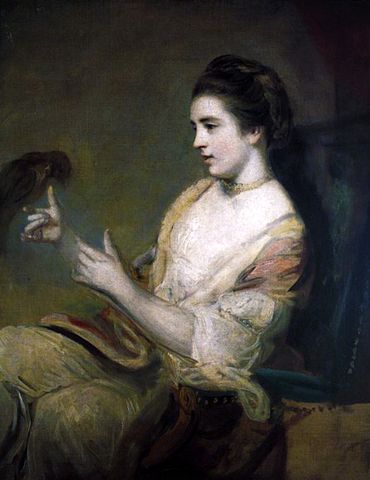
Kitty Fisher by Joshua Reynolds
In a four-story house in Golden Square lived a lady who’d once been known in the trade as Angel Arse. On the corner of Hyde Park was a new mansion the Duke of Kingston was building for Miss Chudleigh, who’d been his mistress for a dozen years already and he still hadn’t tired of her. The famous Kitty Fisher was said to be about to swap all her lordly lovers for a rich husband from the Lower House. A bit of loveliness, a bit of luck; that’s all a girl needed.
On long bright evenings, Mary sat on the grass in Lamb’s Conduit Fields behind Holborn and watched the courting couples meander by. The air was full of the sounds of leisure: the archers’ arrows hitting the target, the click of balls on the bowling green, or the distant roars of a dogfight or wrestling match. She was reading again for the first time since school. She bought crack-backed romances and memorised all the long words, in case she’d ever need them. The History of Pamela Andrews was her favourite. The crafty wench, to fend off her master all those times, then squeeze a proposal of marriage out of him in the end! She’d swapped her maid’s apron for bridal satins and ended up as good a lady as any other, hadn’t she? It all went to show, Mary thought. If a girl had her wits about her, nowadays, she could rise as high as she wanted, as sure as cream through the milk. Anything was possible. – Slammerkin p247 (Emma Donoghue 2002)
About Mary’s interpretation of Pamela – well! Astute doesn’t begin to describe it. No wonder social blowhards began to condemn the reading of novels by gels.
The word for the loose gown, a slammerkin, came to be used for the women who wore them. On the word slammerkin, from one etymological dictionary:
There is a group of North Sea Germanic words in sl- that mean “sloppy,” and also “slovenly woman” and, less often, “slovenly man,” and that tend to evolve toward “woman of loose morals.” Compare slattern, also English dialectal slummock “a dirty, untidy, or slovenly person” (1861), variant of slammacks “slatternly woman,” said to be from slam “ill-shaped, shambling fellow.” Also slammakin (from 1756 as a type of loose gown; 1785 as “slovenly female,” 1727 as a character name in Gay’s “Beggar’s Opera”), with variants slamkin, slammerkin. Also possibly related are Middle Dutch slore “a sluttish woman,” Dutch slomp, German schlampe “a slattern.”
This knowledge came to me during regular posts/tweets entitled Today’s word for a Bad Woman. There are way way way too many of them, and almost any negative meaning deteriorates sooner or later into promiscuity and prostitution – beginning with sl- or not.
Efforts to save migrants and sex workers also appear in ordinary fiction (by which I mean not melodramas produced by moral crusaders) and some authors have a fine-tuned sense of irony. In Magdalen Nabb’s Some Bitter Taste (2002), Marshal Guarnaccia, a policeman in Florence, helps an Albanian woman escape from her pimp, who is sent to jail. The woman goes to live with a nice man, Mario, but after a time she visits Guarnaccia in his office to tell him his effort to help her has failed.
You’re the only person who’s ever been nice to me… so I wanted to tell you because if I don’t somebody else will. You’re bound to find out. I’m going back on the game.
– What? You’re what? And Mario?
– Oh, Mario… Jesus… I mean, he trotted off every morning at a quarter to eight and I was supposed to clean up his crumbs and wipe the floor over and then he’d come trotting back again and I was supposed to have the water boiling for his pasta and then it was one long whinge – there are no clean shirts, have you seen the fluff under this bed? Where’s the other sock to this? You’ve forgotten to get milk again… No, no, I couldn’t stand the boredom. So I upped and offed.
– Back to Ilir?
– Why not? He’s out now and he wants me back. Nobody ever earned him as much as me and he kept me in style. We ate in a restaurant every night. I like a good time and I get clients who give me a good time, you know what I mean? I like champagne and a few presents. I’m not spending the rest of my young life washing the floor of some poky little kitchen for a boring spotty clerk who thinks he’s earned the right to have his socks washed for a lifetime because he’s been good enough to save me from the streets.
– But what about when you’re not young anymore?
– Well, it’s all over then, isn’t it? Get it while you can, I say. I just… I wanted to tell you myself. It’s not that I’m not grateful to you. I know you meant well. Are you pissed off with me? You are, aren’t you?
-No, no…
– You’ve every right to be. I’d better go. I’m sorry. Because of you, I mean, not that little prick Mario, only because of you. I know you did your best.
Carve it on my tombstone, thought the marshal, watching her leave through a skein of cigarette smoke.- p 309
It’s good commentary on the institution of couplehood: the marriage model in which woman has a domestic capacity. Some would say all would change if they were to have children, but, after all, she still wouldn’t be able to eat in restaurants every night. And the presumed debt to saviours sounds awful: a side-effect of Rescue rarely addressed.
Funny how she comes to thank the policeman but calls the husband-man a little prick.
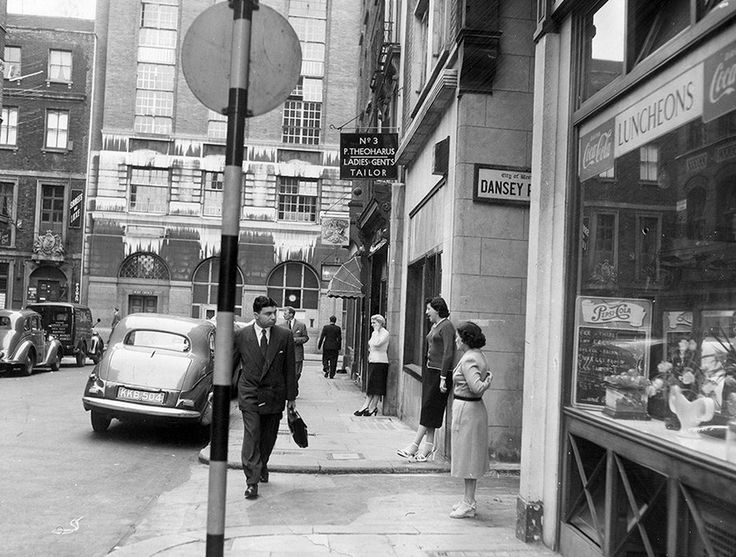
The Four-Gated City was published in 1969 by Doris Lessing. The passage quoted below describes a single young woman walking west on the Bayswater Road in 1950. The woman is Martha Quest, recently arrived in London from southern Africa, a migrant from colonies considered peripheral observing life in the presumed cosmopolitan centre. Her route takes her from a middle-class dinner held east of Marble Arch to a poor squat in Notting Hill. The photo above shows another part of London at the same period; the photo below the young Lessing.
Note the absence of moral comment and that the job of the police is to make sure the marketplace functions peacefully.
Now she slowed, almost stopped in surprise at a cool hard getaway look from a young woman who stood with her back to a hedge. Of course, she had passed another invisible boundary. From here until Queensway, the pavements were lined with prostitutes, standing singly or in pairs, dozens of them, along the pavements. But Martha was freer here than she had been in that other territory she had only just left, whose boundary was simply a bisecting street. She was protected precisely by the line of girls for sale, who knew she wasn’t one of their trade union and because their hostile warning faces that said go away, you shouldn’t be here, kept her safe from being accosted. Three kinds of animal here. The women, standing with their backs to the hedges, on sale. The ordinary traffic of the pavement – but a slight traffic, mostly couples hurrying past the marketplace, keeping close under the lights, looking embarrassed, as if they were here by mistake, yet glancing furtively at the buying and bargaining.
The customers, men of all ages, walking slowly past the women, or standing under the trees smoking, making choices. And across the street, policemen, spaced out with twenty or thirty yards between each couple, not looking directly at the haggling and dealing, but observing it sideways to make sure that it went on without incident. Martha walked more slowly than she had had to walk in the part of the street she had left. All the way down the street, by lit airy trees, they stood. Although it lightly drizzled, they wore summer dresses, bare necked, bare shouldered; and high thick sandals with bared insteps; and sometimes they held a jaunty umbrella. But there was no elegance here either. They weren’t well-dressed. They shared the national disposition towards gracelessness.
There has been a war on. Suppose one of these men who was making up for the starvation of the war… approached one of the girls saying: I’d like you to wear … whatever was his fantasy, would she snap back: There’s been a war on, you know? Yes, very probably … Martha found herself imagining rooms where furniture, curtains, objects had charm, had flair, and a girl with charm, flair, undressed slowly to show off wittily charming underclothes – a man’s fantasy? Perhaps in all this city it was only these girls’ rooms where there was anything attractive, gay, rightly made? Well, not from the way they were dressed as they stood on the pavement.
Two bloggers have interviewed me on the occasion of publishing a new book. First I’ll show you Maggie McNeill’s, because it’s written; after that I’ll give the link to Johnny Lemuria’s listenable podcast interview.The Honest Courtesan has kindly given permission for me to reproduce the full conversation here.
Dr. Laura Agustín, author of the blog The Naked Anthropologist and the book Sex at the Margins, the seminal work on “sex trafficking” hysteria (in which she coined the term “rescue industry”), has written The Three-Headed Dog, a novel dramatizing the problems faced by migrants. It’s another way of introducing readers to the issues the “sex trafficking” paradigm attempts to paper over, which Dr. Agustín has studied for over 20 years and understands in a way very few others do. I recently read the novel, and Dr. Agustín graciously agreed to answer some questions about it.
MM: Sex at the Margins has been and continues to be a work of major importance to the sex workers’ rights movement; I know it really helped me to shake off the dualistic thinking about “willing” vs “coerced” sex work, and it’s invaluable in getting people to look at their preconceptions around why people (especially women) leave their original home countries to work. So why did you decide to write fiction instead of a 10th-anniversary edition?
LA: The essence of Sex at the Margins doesn’t need updating, by which I mean women’s migration to work as maids or to sell sex, the use of smugglers, the rise of the Rescue Industry. Someone else can document the growth and proliferation of that last, if they can stomach it, but the core ideas haven’t changed. I wanted to write stories to reach people who don’t read books like Sex at the Margins and who only hear about the issues from mainstream media reports. The Three-Headed Dog provides a way to learn about social realities and be gripped by stories at the same time.
MM: I write fiction myself, so that makes sense to me. But what made you choose the crime genre? Why not do a “straight” novel?
LA: Crime seemed like the right frame, because everyone thinks smuggling and undocumented migration are at least technically crimes – leaving the idea of trafficking out of it. I am a fan of some kinds of mystery writing, and the formula of a detective who searches for missing migrants provides infinite opportunities for all sorts of stories and characters.
MM: I think you just started to answer one of my questions! At the end of the book several questions are unresolved, and I would have liked to know more about Félix, the detective. Is this the first of a series?
LA: I’ve got too many stories to tell for one book. The Dog was getting long and complicated, so I decided to make it the first in a series. In the detective genre it’s common for some questions to remain dangling, and readers know they can learn more in the next installment. If I’d been writing 150 years ago I might have done weekly installments in a magazine, as Dickens did with The Pickwick Papers. In the next book, which I’ve started, Félix’s search takes her to Calais and London.
MM: I was very intrigued by Félix, and it seems to me that she might be based on you. Would I be correct? And are any other characters based on people you know?
LA: The characters created themselves in my mind out of the many thousands of migrant friends and acquaintances I’ve had in my life. Including myself. But they sprang forth and told me who they were. I identify with much of Félix’s character, but I identify with much of the smuggler Sarac’s character, too.
MM: I like that Félix has some history of sex work, and that she still seems to be comfortable taking gigs that dip into the edges of sex work.
LA: She certainly was a sex worker during the European tour she did when younger with her friend Leila, who now lives in Tangier. I think she still takes sexwork gigs when it suits her. I expect she’ll tell us more about that in the future.
MM: Not many novels have well-developed and nuanced sex workers as major characters, and when we appear as minor characters we’re mostly there to be rescued or murdered. But these characters, even the minor ones, are much more developed than that. There was one character, Marina, who was clearly intending to do sex work, but what about the others? I couldn’t be sure.
LA: This is Marina’s second time sexworking in Spain. Félix looks for two other characters in spas (massage joints) in Madrid, and one of those is adamant about not intending to be a maid. They’re Latin Americans who belong to a long tradition of working in indoor businesses like bars and flats, or sometimes in the street. They arrive with contacts and some prior knowledge of what they’re getting into, so it’s a serious problem when the smuggler makes them de-plane in Madrid instead of Málaga. Of the other characters, Promise, the Nigerian, planned to sexwork in the street, and Eddy, the boy who goes missing, doesn’t intend anything but is moving in that direction.
MM: It seemed to me that their ending up in Madrid was a very big issue, even beyond the lack of connections. Is Madrid so very different from Málaga?
LA: Yes, Madrid is a harder place, a capital city and centre of echt-Spanish culture. Málaga is on the Costa del Sol, crossroads for many kinds of migration, smuggling, tourism and crime. It’s a long stretch of coast that ends in a point only 32 kilometres from Africa across the Mediterranean Sea. Nowadays many non-Spanish Europeans from colder climates have homes there in quasi-closed communities. The coast is by no means a piece of cake, but it’s not a cold, self-important northern city. Personally I feel a great sense of history there and lived in Granada during the years I worked on Sex at the Margins.
MM: So it’s a good place to find jobs that aren’t strictly legal?
LA: This is about informal economies that exist in parallel to formal ones (which means they’re included in government accounting). Informal economies are even larger than the formal in some developing countries. In Spain it is not illegal to sell sex, but undocumented migrants have no right to be in the country at all, much less work there. The same is true when they get jobs in restaurant kitchens, on construction sites, picking fruit and working as maids and cleaners. The informal economy rolls along, the jobs are available and migrants are more or less glad to get them despite the clandestinity.
MM: And as you discussed in Sex at the Margins, it’s this informal economy that’s depicted as “trafficking” nowadays, even when there’s no coercion involved per se.
LA: The group that arrives by plane at the beginning are undocumented migrants. They’ve got papers to show at the border: passports and tourist visas. Fakery was involved, and these young people are planning to get paid work, so they’re going to misuse the visas. A guy who’s part of the smuggling travels with them. The project is based on the migrants getting jobs and income so they can pay back debts they or their families took on when they bought travel-agency-type services (known in crime-circles as smuggling). Technically they’re all committing crimes, but to the migrants they feel like minor crimes, given the well-known availability of jobs when they arrive. Everyone knows people who’ve done it and sent money home. Do smugglers sometimes resort to nefarious practices? Of course; it’s an unregulated economy. But if smugglers want to stay in the business they guard their reputation. Word spreads.
MM: I’m sure the rescue industry folks would find fault with the fact that the book isn’t about people “rescuing” these migrants from their smugglers.
LA: I wrote this book out of love, not as polemic. I’d have to get paid very well to devote myself for long to analysing moral entrepreneurship; I don’t find crusader-figures interesting. I don’t see the world in black-and-white, I like ambiguity and shifting ground. In Félix’s interior life, questions of helping and saving play a part, but she refuses the rescuer-role.
MM: And really, even the villains aren’t the mustache-twirling cardboard characters so beloved by those who promote the “sex trafficking” narrative. I’m thinking about Sarac, the smuggler, and Carlos, the sex club owner.
LA: The smugglers are squabbling amongst themselves and not very appealing, but they aren’t monsters or driving anyone into bondage. They charge for their services. Sarac worked as a soldier/mercenary, now does “security” and is involved in people-smuggling. He wants to do something new, but not pimping. Carlos operates hostess clubs in Madrid. Those are not illegal, but he may employ illegal migrants. He’s part of an established tradition, and he makes good money on the women’s work.
MM: I think American readers have some very confused ideas about the sex industry and migration in Europe. Do you think The Three-Headed Dog will appeal to them and help clear up some of those misconceptions?
LA: Undocumented migration and working in underground economies are worldwide phenomena no matter what local culture or national laws prevail. Ways to earn money by selling sex vary in the details, but sex workers recognise each other across national borders and talk about the same problems and solutions everywhere. Sometimes places where laws are uglier provide more opportunities. Since the migrants are working illegally in Spain they have a lot in common with all sex workers in the USA, right?
MM: True; all of us are illegal here, whether we were born here or not. Is there anything else you’d like to tell the readers that I haven’t thought of?
LA: Yes, I want to point out that even if you don’t own a Kindle, you can still buy the Kindle version of The Three-Headed Dog and download a free reading app right there. And you can read more about sex industry jobs here at the Naked Anthropologist.
This is a project of author and artist John L Robinson, aka Johnny Lemuria, whose introduction says This is a decadent podcast; if you can’t handle that you should go elsewhere. Actually I didn’t say anything decadent, though some abolitionists think I’m one of Satan’s handmaidens.
Or listen here:
Thank you, Johnny and Maggie. Anyone else interested in an interview? Contact me on the form to your right.
In February I was interviewed by RadioAva (DIY sexworker radio, a project of x:talk) about The Three-Headed Dog. When I arrived at the pub in mid-afternoon a fight was blowing up in the back room, glass splintering and chairs crashing to the floor. Soon the place was full of cops and two clutches of drunken young white men were being moved out the door while shouting out epithets: Knackers! Travellers! The perfect setting for an interview.
In this interview I talk about creativity and pleasure, about my own likes and dislikes. The interviewer describes her feelings about the characters, surprising me by saying she found sexworker Marina ‘too perfect’. Here I confess to identifying not only with the detective narrator, Félix, but also with a villain of the story called Sarac. What are they supposed to do? I say, referring to men reared in tribal and national wars who now may turn to people-smuggling. I talk about cultural relativism as a way of understanding lives unlike our own.
I hear my self in this interview. I hear myself saying more than once I wanted to put it out there, referring to a sense of urgency, that stories of migrants who sell sex are so rarely heard that The Three-Headed Dog can exist as an historical document to be discovered by future historians – like this interview, which is located on the wonderfully-named mixcloud.
Listen to it while doing some chore. Note the bar-clinking in the background. On the same show: Pandora Blake and the ECP. Good company. Thank you, all.
Note: there are musical interludes interspersed with segments of me and Carmen talking. They are all migration-inspired and most were provided by me. They aren’t identified on the podcast, so I’ll do a separate piece about them soon.
In the popular imaginary a pimp is a mean man engaged in pushing a few prostitutes around and taking their money. Usually portrayed as black or foreign, he is made out to thrive on dressing up and showing off. Pimping is sometimes placed as part of gang business and competition, again with racist and xenophobic overtones. In these stereotypes street prostitution is usually assumed, though that is changing.
In anti-prostitution and anti-trafficking crusades and policy the word pimp is used to cover every case of a man benefiting from prostitution, whether by taking a percentage of sex workers’ earnings for work done (as a driver, or web-page tech, for example) or for living with sex workers, giving advice, providing back-up.
Some want to distinguish clearly between those genuine helpers and the bad things ‘real pimps’ do, but I have learned over decades that trying to draw that line is a futile exercise. Sometimes sex workers love the men who push them around. Sometimes women pay men back in ways not visible to outsiders bent on seeing only one thing. Often the relationship is temporarily convenient and may be fluid, drifting back and forth between desired and consensual and not.
Rarely do we get a sense of pimping as a job in an organisation, the sort of ‘organised crime’ that anti-trafficking police forces and the UN go on about. As with so many aspects of the sex industry most people know absolutely nothing about how it can work. When I suggested a field called the Cultural Study of Commercial Sex I said policy (prostitution law, sex-venue licensing, red-light districting, employment rules) would benefit from knowing more instead of staying on the ignorant outskirts. Moralising is very often a form of ignorance. This applies to the world of mediators, facilitators, agents, smugglers, madams and pimps.
The narrator of Jo Nesbø’s Blood on Snow is explaining how he came to be a fixer (hit-man) for a villain. There were various jobs available, and he tried several: driving get-away cars, robbery, drugs-dealing and pimping. In the following story he was on a low rung in the pimping business where Hoffmann is the top boss and Pine his second man. The place is Oslo.
Prostitution. I don’t have a problem with women earning money whatever way they like, and the idea that a bloke – me, for instance – should get a third of the money for sorting things out so the women can concentrate on the actual work. A good pimp is worth every krone they pay him, I’ve always thought that. The problem is that I fall in love so quickly, and then I stop seeing it in terms of business. And I can’t handle shaking, hitting or threatening the women, whether or not I’m in love with them. Something to do with my mother, maybe, what do I know? That’s probably why I can’t stand seeing other people beating up women either. Something just snaps. Take Maria, for instance. Deaf and dumb, with a limp. I don’t know what those two things have got to do with each other – nothing probably – but it’s a bit like once you get started getting bad cards, they just keep coming. Which is probably why Maria ended up with an idiot junkie boyfriend as well. He had a fancy French name, Myriel, but owed Hoffman thirteen thousand for drugs. The first time I saw her was when Pine, Hoffmann’s head pimp, pointed out a girl in a home-made coat and with her hair up in a bun, looking like she’d just left church. She was sitting on the steps in front of Ridderhallen, crying, and Pine told me she was going to have to pay back her boyfriend’s drug debt in kind. I thought it best to give her a gentle start, just hand-jobs. But she jumped out of the first car she got into after barely ten seconds. She stood there in floods of tears while Pine yelled at her. Maybe he thought she’d hear him if he shouted loud enough. Maybe that was what did it. The yelling. And my mum. Either way, something snapped, and even if I could see what Pine was trying to get into her head I ended up decking him, my own boss. Then I took Maria to a flat I knew was empty, then went to tell Hoffmann that I was no use as a pimp either. Blood on Snow, pp 6-7, Jo Nesbø
In my own The Three-Headed Dog, a strongman working for an organisation is looking for a new job. Sarac’s career has included soldiering as a very young man and a range of jobs lumped together as Security, in different parts of Europe and in the Caribbean. He is told his next job will be in West Africa, but he doesn’t want to go, feels comfortable on the Costa del Sol and is now looking for a way to stay. He is approached by a man with a job offer.
In this photo at least a man’s head and body are cut off, not only a woman’s (the usual practice).
‘You have to specialise according to what work the people travelling are going to do. You have to use contacts specific to the sector. For instance, it might sound strange, but I have no good contacts in construction on the coast, or in property development. Those are competitive areas it would be stupid to try to get into. But I do know someone with long experience in the flats. Apartments where women work. You understand. And that’s just here. In the region we can call home I have a few powerful names. The operation would be high-quality, and there are different directions to take. A wide range of businesses, no need to deal with the low end.’ He paused. Sarac betrayed no reaction. Tarts, he thought. Bloody pimp-ing. The very last thing he was looking for. The Three-Headed Dog, Laura Agustín
If you’re interested in fiction’s genre labels: Nesbø’s book is placed as Nordic Noir; the Dog as Mediterranean Noir. Noir is about moral ambiguity, as when a pimp can’t stand abusing women so becomes a hard-boiled killer instead. Sarac is looking for something else to do, and has to get there using strong arms. What else does he have, after all? When police and moral entrepreneurs rant about putting criminal men in prison I often think: What jobs do they imagine to be available for men and boys cut out of the mainstream, with no access to anything but the lowest-class, worst-paid work, no expectation of social mobility or respect? Perhaps those thinking about ‘root-causes’ of prostitution and trafficking might consider that, rather than figuring them all as evildoers to be imprisoned for long terms, in prisons that only teach them better techniques for crime.
Reader reviews of The Three-Headed Dog Reviewers of The Three-Headed Dog have been showing they get it: The detective-narrator is a woman with a complicated and...
I gave a talk called Thinking about sex work as work on 6 April 2013 at the Dublin Anarchist Book Fair. Local abolitionists and anti-prostitution folks were attacking my being there, which is reflected in my introductory remarks. I wrote about wanting the opportunity to talk about sex work without -isms (theory, ideology, rules of thought).
Later I found out the sound deteriorated in the recording I uploaded to my little Youtube channel, and I don’t have a handyperson to fix things like that. Then the other day, while searching for something quite different, I found a clear recording and the person who made it: Aubrey Robinson (@andyazi on twitter). He kindly sent it to me and I’ve uploaded it to the channel.
I haven’t listened to it again and make no claim to be definitive. This is maybe a good case of the personal being political. More rigorously I wrote Sex as Work and Sex Work for The Commoner.
Photo Ahmad Nimer
When I sent this recently to a facebook-man who seemed curious his reply was No, wrong, you can’t talk about sex work without addressing the stigma. I said he should consider before launching into mansplaining in a place where sex workers themselves exchange ideas. He said Fuck that (subject-status doesn’t give knowledge priority, and so on). I said I understand. I don’t think he grasped the nuance – that he had confirmed the mansplaining. Point is, in 30 minutes the plate is full just trying to talk about sex work as work, without the reams of Other Prostitution Issues including stigma, moralising, poverty, agency and everything else on the planet.
I uploaded this video only a while ago and boom, the first comment asks Where are their parents? What do they think? See last line, previous paragraph. Jeez.
I wrote The Three-Headed Dog to get away from the straitjacket of a debate where one side is always moralising and the other reacting with rational debunking. In terms of academic discourse I long ago proposed The Cultural Study of Commercial Sex, with the aim of expanding topics of interest from a narrow (but still vague) idea about prostitution, with its attendant moral baggage.
I don’t know how long improvements might take, either to the debates or academic production, but I stick by my assessment of many years back that In 200 years the situation has not improved for women who sell sex, but the social sector to help them has grown exponentially. I mention 200 years because that is when the contemporary idea of prostitutes as victims needing to be saved began (I did historical research for Sex at the Margins).
Most people never hear or see useful, complicated or interesting information about jobs in the sex industry. They don’t realise how common it is to work there; their friends that do don’t tell them. How can they learn anything new if all they see are ‘debates’ and screamy trafficking headlines? Reading fiction is one possible way.
In The Three-Headed Dog the search for a missing boy takes the detective-narrator into a number of sex-industry businesses.
* Bars with hostesses and beds available in back: Félix, the narrator, goes dancing with Carlos, who runs several hostess bars in Madrid. At the end of the night Félix persuades him to take her to one, despite his conviction that she is the wrong kind of woman to be there.
* Residential flats where a number of sex workers are available at the same time to clients who make appointments. Marina has worked in the past in flats in Torremolinos, but inexperienced managers have taken over, causing havoc.
* Large sex clubs on highways where workers live for a few weeks at a time: Marina decides to go on this circuit in northwest Spain after several bad experiences in flats.
* Bars with dark rooms for sex and pick-ups: Eddy gets a job washing dishes in a gay bar in Madrid.
* Spas/massage parlours: Businesses of varying quality and style where sex is on the menu alongside health treatments. Félix investigates two in Madrid.
* Cruise ships: Marina considers taking a stewardess job.
* Streets: Promise works with a few friends close to Málaga’s centro histórico. Eddy makes friends with a rent-boy who works in Madrid’s Puerta del Sol.
These are of course not all possible venues; I did a basic typology some years back of the sex industry in Spain.
None of the characters talks about doing completely independent escorting. That’s not significant, just not part of this particular story. Most here are migrants who have gotten into debt paying smugglers and false-papers makers and who expect to work in businesses where managers organise a workplace and workers do shifts. We don’t know the details about anyone’s street-work.
The sex industry is represented in other ways in the book. Félix’s friend Carlos has long experience employing chicas de alterne, but another migrant man wants to start a smuggling and pimping network. Eddy takes up with a ‘sex tourist’ (perhaps, it’s a pretty useless concept). There are sentimental clients and an outreach worker angry about disruption to provision of health services in flats caused by managers’ turf wars. There are various employees in the spas, and migrant maids considering going into sex work. A couple of men are seen arranging photos of women on a webpage in a cybercafé.
For readers steeped in reductionist media discourse to read a story where these are the characters and jobs might help understand better. For more on why I wrote a piece of noir on sexwork and migration, see Sexwork and Migration Mystery and Melodrama and Archetypes.
Despite how it might look to those who’ve known me only since Sex at the Margins, I’m not making a sudden switch to fiction. It’s one of the things I used to write before the Internet, before doing postgraduate degrees, before social media. I began this story, in my head and scribbled notes, not long after starting those degrees in the late 90s. This I now understand to show how quickly I grasped the limitations of academic work. There’s nothing left of that first version but the concept: a searcher for missing migrants in economic and social undergrounds, multicultural and hybrid settings, job markets that routinely include sex. In general such stories are not published unless the migrants are portrayed as passive victims needing rescue by much straighter and more comfortable characters.
The Three-Headed Dog is about undocumented migrants in Spain and their smugglers. A lot of them work in different segments of the sex industry. The incidents portrayed would be labelled trafficking and the migrants victims by anti-prostitution and anti-migration campaigners. I don’t see things that way. Just as I strove to show in Sex at the Margins that many migrants don’t perceive themselves as inert objects of cruel fate and evil men, here a few of them act out their stories, trying to find ways to get ahead and stay out of trouble.
Fiction is not the opposite of fact; truth is glimpsed in different ways. The characters here are neither real nor unreal but created themselves in my imagination out of my long experience of travelling on my own and talking with people. I’ve seen everything that happens in this book. I’ve known people who thought and acted these ways. But all migrants don’t experience things the same way, and they may change how they feel over time. The fact they share is not having legal status to be and work where they are living (under constraints and duress). Falsehoods are fundamental. My intention is not to romanticise but pay attention to lives nearly always shoved out of sight.
About genre labels
To publish is to choose categories for databases. The Three-Headed Dogis a mystery, a crime story, a (hardboiled) detective novel short on gore and violence. A noir. Noir signifies a dark, morally complicated mood (the opposite of a clear struggle between good and evil). That doesn’t make it amoral (an accusation often thrown at me). The detective’s moral compass shifts as a result of introspection. Good is often tinged with bad, and attempts to do right go wrong. Exploitative characters can be sympathetic. It’s shadowy in noir; the lighting is low. But in low light you see things you don’t see in the bright.
The style is terse: that’s really me. Pithiness works to suggest meanings rather than lay them out. Mine is a rather anti-Enlightenment endeavour. You get glimpses of truths and they contradict each other.
See what you make of The Three-Headed Dog. I published it on Amazon Kindle, but you don’t have to own a kindle device to read it. Links to free apps are right there. If you leave a few lines of review when you finish you make it likelier Amazon’s search machine will find and show the book to new readers.
I will be musing more about why and how I wrote this book. Leave questions here and I’ll try to answer them.
If you want to read more, subscribe to email notifications at the bottom of the right-hand column. If you were already subscribed, I’m sorry to say the earlier software broke and your address was lost, so take a few seconds to subscribe anew. The RSS feed is still A-okay.
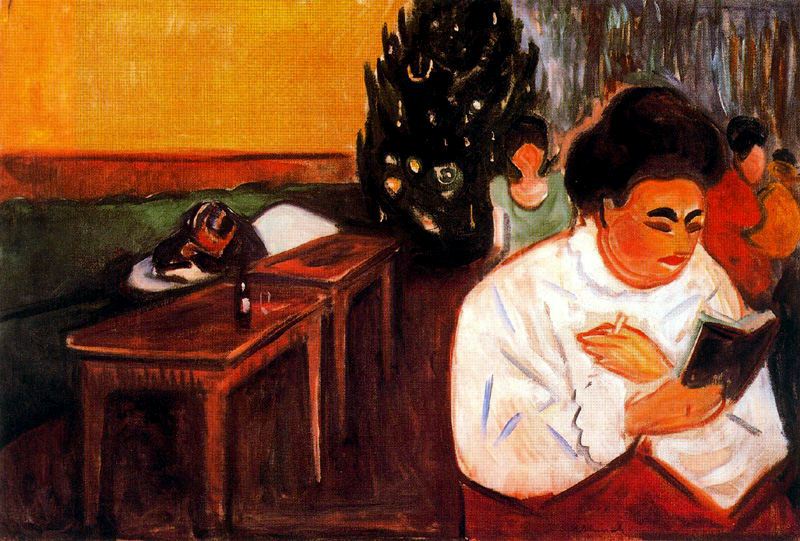
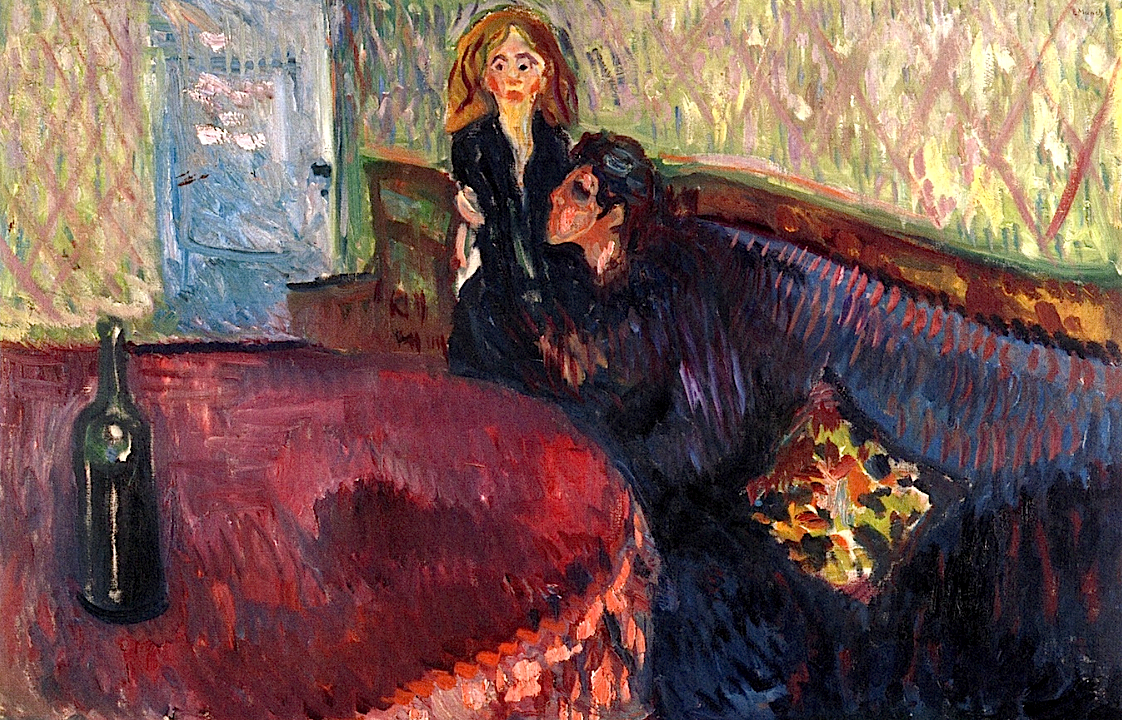
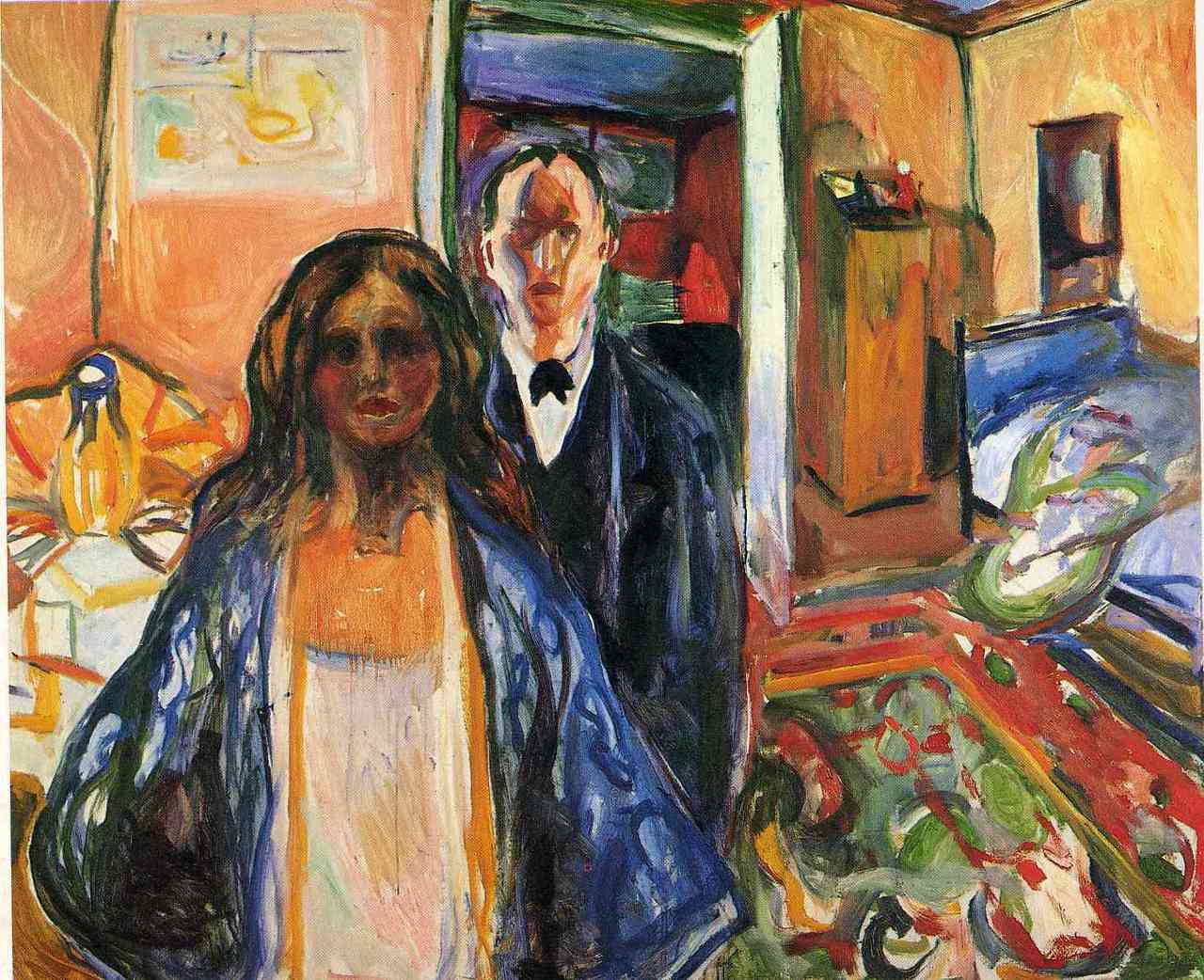
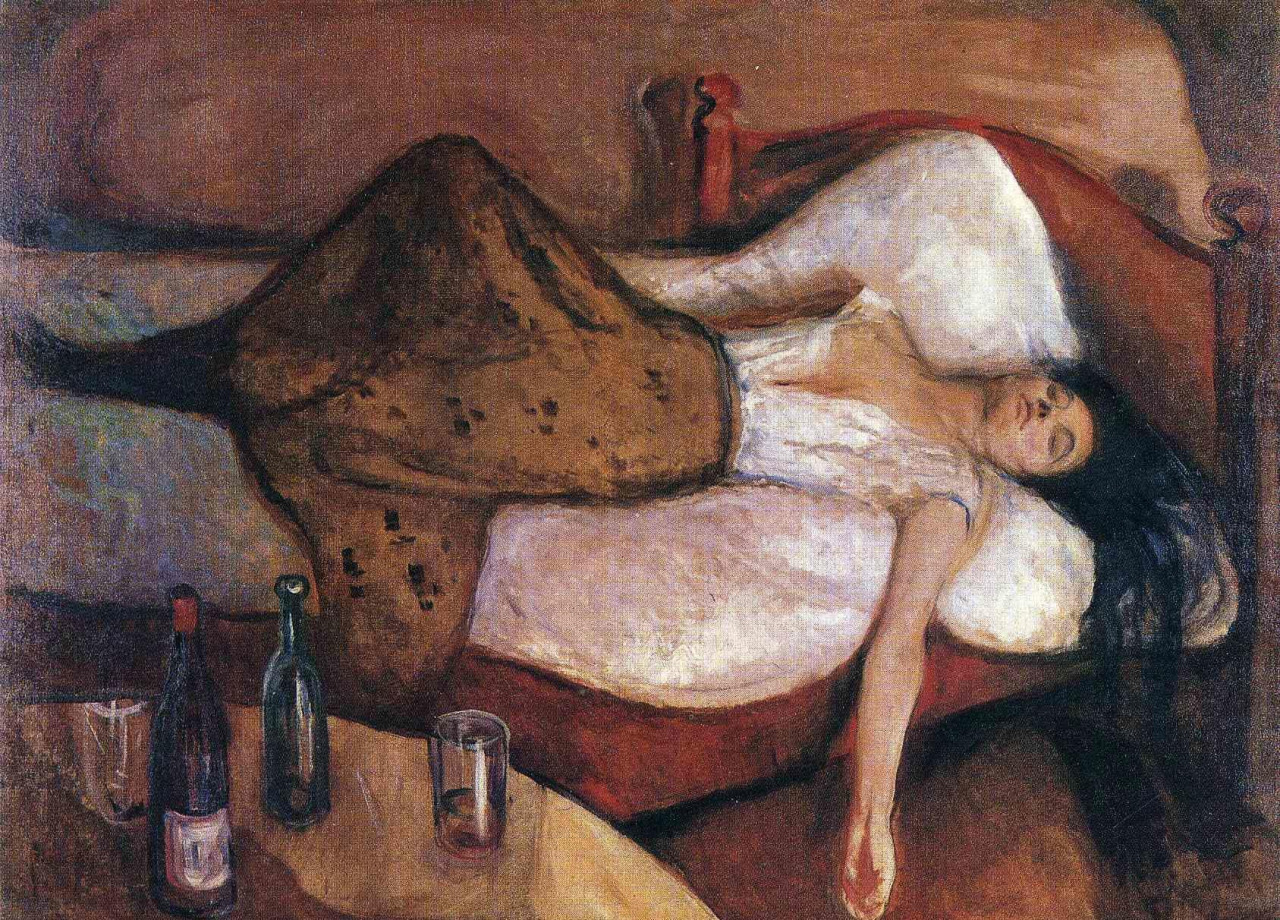
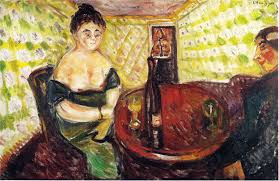
Christmas in the Brothel is from 1905. There’s a tree, a woman with little black book and pencil, a man reading, figures in the background and empty space. To me it shows ordinariness, everyday life. The word brothel is in the title, but it could be any bar. If you like Christmas you may like that they celebrate it in the brothel, too. Or if you feel unhappy at Christmas you may like to know there was a place to go and be alone with other people.
Munch painted other pictures that don’t have such a keyword in their names but represent brothel scenes.
Viewers may read anything they like into these depictions: Whether the characters are happy or sad, whether they drink too much, whether the venues are nice or nasty. Munch frequented them, that much is clear.
I am looking forward to being in Hamburg, Germany, in August, for this unusually interesting event. My own talk is called Disqualified: Why sex workers suffer social death and will focus on how representation of women who sell sex as damaged victims disqualifies them from rights and justifies a whole Rescue Industry devoted to pushing them around. Some of this was covered in Prostitution Law and the Death of Whores.
The whole event will take place in English, so if you are near Hamburg, consider a visit. Venue: Kampnagel, Jarrestraße 20, D-22303 Hamburg. Write to tickets [at] kampnagel.de to reserve a place. Or you may show up at the box office and hope tickets are available on the day(s).
Alice Schwarzers Aufruf zum Verbot von Prostitution hat in den deutschen Medien eine rege Diskussion entfacht. Jenseits der moralischen und politischen Frage, wie mit Sexarbeit umzugehen sei, ist dabei auch deutlich geworden, dass die Debatte von Projektionen, Fantasien und Mythen dominiert wird. Verlässliche Informationen zur Sexarbeit gibt es auch deshalb nicht, weil dieses Berufsfeld immer noch stark stigmatisiert ist und Sexarbeiterinnen und Sexarbeiter selbst kaum an der öffentlichen Repräsentation ihres Berufs teilhaben. Gemeinsam mit dem Missy Magazine veranstaltet das Internationale Sommerfestival eine Konferenz auf der Bildwissenschaftlerinnen, Sexarbeiterinnen, Künstlerinnen und Medienmacherinnen in Vorträgen, Diskussionen und Performances die Bilder von Sexarbeit untersuchen, die – nicht nur die aktuelle – Diskussion dominieren. Was erzählt das Bild, das sich die Gesellschaft von Sexarbeit macht, über ihr Verhältnis zu Frauenarbeit, Sexualität und Sexualmoral, Gender, Migration und Armut?
DAS PROGRAMM:
[Fr] 08.08.
18:00 ERÖFFNUNG und BOSOM BALLET (Annie Sprinkle) /// p1
Nach einer kurzen Eröffnung der beiden Konferenz-Gastgeber Margarita Tsomou (Kulturwissenschaftlerin/Missy Magazine) und Eike Wittrock (Theaterwissenschaftler/Internationales Sommerfestival) zeigt Annie Sprinkle zur festlichen Eröffnung der Konferenz das BOSOM BALLET (Brüste-Ballett) – eine ihrer legendären Performances.
18:15 IMAGE_WHORE_IMAGE. THE POLITICS OF LOOKING AND LOOKING BACK Vortrag von Antke Engel (D) /// p1
Antke Engel, Leiterin des Instituts für Queer Theory (Hamburg/Berlin), eröffnet die Konferenz mit einem Vortrag zu künstlerischen Bildern von Sexarbeit und betrachtet die Politik der Repräsentation im Spannungsfeld von Fremd- und Selbstbild. Engel ist freie Wissenschaftlerin im Bereich feministischer und queerer Theorie und hat seit den 1990ern maßgeblich das Feld queerer Geschlechter- und Sexualitätenforschung im deutschsprachigen Kontext wie auch auf internationaler Ebene geprägt.
19:30 BAISE MOI Gespräch mit Filmausschnitten mit Coralie Trinh Thi, Drehbuchautorin, und Stefanie Lohaus, Missy Magazine Herausgeberin /// p1
BAISE MOI (Fick Mich!) schockte 2000 das Kinopublikum mit einer schonungslosen Darstellung von Sexualität und Gewalt, formuliert aus weiblicher Perspektive und vor dem Hintergrund »realer« Erfahrungen mit Sexarbeit. Coralie Trinh Thi, Drehbuchautorin des Films, wird gemeinsam mit Missy Magazin-Herausgeberin Stefanie Lohaus Ausschnitte aus dieser kontroversen filmischen Darstellung von Sexarbeiterinnen kommentieren und diskutieren.
22:00 MACHO DANCER Performance von Eisa Jocson (PHL/B) /// p1
Für ihr Solo MACHO DANCER hat sich die bildende Künstlerin und Choreografin Eisa Jocson eine Form des erotischen Tanzens, die vornehmlich in philippinischen Schwulenbars praktiziert wird, angeeignet. Zu Powerballaden und Soft Rock bewegen sich junge Männer in einer hyperstilisierten Form von Männlichkeit, lassen langsam ihre Hüften kreisen und präsentieren ihre Muskeln. In der Übertragung auf ihren (weiblichen) Körper verschwimmen dabei Geschlechterbilder, und die Mechanik dieser ökonomischen Körper-Performance wird sichtbar.
[Sa] 09.08.
11:00 PROSTITUTION PRISM REFLECTIONS: FROM FACT TO FANTASY Vortrag von Gail Pheterson (F) /// p1
Gail Pheterson hat mit ihrem Buch »Huren-Stigma«, das im Original bereits 1986 erschien und das als internationales Standardwerk gilt, einen wesentlichen Beitrag zur feministischen Debatte um Sexarbeiterinnen geleistet. Die Autoren des Klassikers zum Stigma ist seitdem für ihre Publikationen zu Prostitution international bekannt – sie ist Dozentin und Forscherin am Centre de recherches sociologiques et politiques, Paris CRESPPA-UMR 7217, CNRS und der Université Paris 8 und wird über die Thesen ihres letzten Buches Le prisme de la prostitution (Paris, L’Harmattan, 2001) vortragen.
12:00 BREAD AND ROSES: RETHINKING SEXUAL AND ECONOMIC JUSTICE Vortrag von Nikita Dhawan und María do Mar Castro Varela (D), anschließend Gespräch mit Luzenir Caixeta (AUT) /// p1
Nikita Dhawan ist Juniorprofessorin für Politikwissenschaft mit Schwerpunkt Gender/Postkoloniale Studien an der Goethe Universität Hamburg, im Rahmen des Exzellenzclusters »Die Herausbildung normativer Ordnungen«. Maria do Mar Castro Varela ist Professorin an der Alice Salomon Hochschule für Angewandte Wissenschaften, Berlin. Sie beide gehören zu den innovativsten Denkerinnen der intersektionellen Verschränkung von Migration und Feminismus im deutschsprachigen Raum. Zusammen werden sie über die Frage der Repräsentation migrantischer Sexarbeit referieren. Anschließend findet ein Gespräch mit Dr. Luzenir Caixeta, Mitbegründerin und Koordinatorin des Forschungsbereichs von maiz (Autonomes Zentrum von und für Migrantinnen, Österreich) statt, das für seine Arbeit mit migrantischen Sexarbeiterinnen über Österreich hinaus relevant ist.
14:30 DISQUALIFIED: WHY SEX WORKERS SUFFER SOCIAL DEATH Vortrag von Laura María Agustín, anschließend Gespräch mit Camille Barbagallo (GB) /// p1
Laura María Agustín ist Soziologin, arbeitet zu undokumentierter Migration, Menschenhandel und der Sexindustrie und hat mit ihrem einflußreichen Buch »Sex at the Margins: Migration, Labour Markets and the Rescue Industry« (Zed Books 2007) neue Thesen zur Rolle von NGOs und Hilfsorganisationen in der Sexarbeit in die internationale Debatte gebracht. Nach ihrem Vortrag wird sie mit Camille Barbagallo, Forscherin an der Goldsmiths Universität London, diskutieren warum die Stimme bzw. die Versuche von Selbstrepräsentation seitens der Sexarbeiter_innen in der Öffentlichkeit entweder nicht gehört oder disqualifiziert werden.
16:00 ZOOM IN: PROSTITUTION/POLITICS HAMBURG Gespräch mit Ulrike Lembke (HH), Undine de Rivière (HH) und Gerhard Schlagheck (HH) /// p1
Das Panel wird sich mit der konkreten Situation in Hamburg – der »Stadt der Huren« – beschäftigen sowie die Debatte um das deutsche Prostitutionsgesetz aufnehmen. Ulrike Lembke ist Juniorprofessorin für Öffentliches Recht und Legal Gender Studies an der Rechtswissenschaft der Universität Hamburg – sie soll unter anderem auch der Frage nachgehen wie geltendes Recht gesellschaftliche Verhältnisse widerspiegelt, d.h. warum etwas als rechtmäßig gilt oder nicht. Undine de Rivière ist Sexarbeiterin in Hamburg, Sprecherin des Berufsverbandes für erotische und sexuelle Dienstleistungen und wegweisendes Mitglied des »Ratschlags Prostitution Hamburg«. Gerhard Schlagheck leitet das »Basis-Projekt«, die einzige Anlaufstelle für männliche Stricher in Hamburg. Sie beide sollen konkret über ihre Auseinandersetzungen mit der rechtlichen Situation in Hamburg sprechen.
18:00 WATCH ME WORK Performance von Liad Hussein Kantorowicz /// k4
Liad Hussein Kantoworicz ist Performerin (UDK Masterstudiengang SODA), Sexarbeiterin, Autorin, Queer-Aktivistin und Gründerin der ersten Gewerkschaft für Sexarbeiterinnen im Mittleren Osten. Darüber hinaus arbeitet sie für eine israelische Erotik-Chat-Webseite, bei der die Kunden für intime Gespräche und persönliche Live-Performances pro Minute zahlen.
In der Performance WATCH ME WORK ermöglicht sie einen Echtzeit-Einblick in diese Cyber-Sexarbeit und lässt sich aus verschiedenen Perspektiven bei ihrer gleichsam intimen wie höchst theatralen Performance beobachten.
20:30 MY LIFE AS A METAMORPHOSEXUAL SEX WORKER. ALWAYS RECREATING MY SEX WORKER SELF Performance von Annie Sprinkle (USA), mit Beth Stephens und Gästen /// p1
Die legendäre Pornodarstellerin, Künstlerin und Sexarbeitsaktivistin der ersten Stunde, Annie Sprinkle, kehrt für eine ihrer Lecture Performances nach Hamburg zurück. Sprinkle ist eine der bekanntesten Vertreterinnen des sexpositivem Feminismus und eine Ikone der sexuellen Aufklärung in den USA und darüber hinaus. Sie hat Sexualität praktisch und theoretisch erforscht, vom Heiligen bis zum Profanen. Ihre Arbeit an der gemeinsamen Emanzipation von Frauen und Sexarbeiterinnen ist international wie historisch von großer Relevanz. Ihre Performance »Post Porn Modernist« tourte durch mehr als 19 Länder und wurde zu einer wichtigen Intervention im Sex-War innerhalb der feministischen Bewegung der 80er Jahre in den USA:
Auf dem Sommerfestival wird sie anhand von Videos, Fotografien, Mini-Performances und einem Ritual der heiligen Eco-Hure aus ihrem ereignisreichen Leben und von ihren politischen Aktivitäten berichten, die sich derzeit auf Liebe, Beziehung, Brustkrebs, Altern und den Schnittpunkt von Ökologie und Sexualität – Sexecology – konzentrieren.
[So] 10.08.
12:00 COLLATERAL DAMAGE Mithu Sanyal im Gespräch mit Carol Leigh AKA Scarlot Harlot
Carol Leigh AKA Scarlot Harlot ist nicht nur, weil sie den Begriff Sexarbeit erfunden hat, eine der international wichtigsten Figuren der Sexarbeiter_innen Bewegung. Sie gilt als einer der »Muttern« der Sexarbeiter_innen-Bewegung, sie ist Autorin, Sexeducator, Produzentin, Filmemacherin, hat mehrere Veröffentlichungen, mehrere Festivals gegründet und leitet nun das San Francisco Sex Worker Film and Video Festival.
Während der Konferenz werden durchgehend Auszüge als Preview ihres neues Dokumentarfilms COLLATERAL DAMAGE: SEX WORKERS AND THE ANTI-TRAFFICKING CAMPAIGNS als Installation gezeigt.
Über die Arbeit an dem Film spricht sie mit Mithu Sanyal, der preisgekrönten Journalistin und Autorin des mehrfach übersetzten Buchs über die Kulturgeschichte des weiblichen Genitals »Vulva – Die Enthüllung des unsichtbaren Geschlechts« (Wagenbach Verlag, 2013).
12:30 SELFREPRESENTATION: SEX WORK AND ART WORK Abschlussdiskussion mit Liad Hussein Kantorowicz, Coralie Trinh Thi, Eisa Jocson, Annie Sprinkle und Carol Leigh AKA Scarlot Harlot /// p1
Das Abschlusspanel der Konferenz bringt die Medienmacherinnen und Künstlerinnen der Konferenz zusammen, um über die eigenen Strategien von Selbstrepräsentation im Spannungsfeld zwischen Selbst-und Fremdbild zu reflektieren.
PERFORMANCES IM RAHMEN DER KONFERENZ:
Eisa Jocson: MACHO DANCER (08.08. / 22:00)
Liad Hussein Kantorowicz: WATCH ME WORK (09.08. / 18:00)
Annie Sprinkle: MY LIFE AS A METAMORPHOSEXUAL SEX WORKER. ALWAYS RECREATING MY SEX WORKER SELF (09.08. / 20:30)
Nicht alle empfinden das Gleiche über Sex Tim Stüttgen. 2008. »Nicht alle empfinden das Gleiche über Sex.« Im Gespräch mit Laura Maria Agustin über MigrantInnen, die Sex...
At a conference on Sexual Citizenship and Human Rights the other week, I binned the talk I had prepared and instead gave a version of Sex at the Margins: Migration, Labour Markets and the Rescue Industry. It turned out both the other speakers on the panel were to address trafficking, one as a straightforward Rescue-Industry member, and I’m not capable of watching an innocent audience listen to that stuff without speaking up.
My new talk was called Denial of Consent, because previously at this event consent was mentioned continuously as a key human-rights concept in European sexuality law. How telling, then, that European specialists declaim adolescents’ right to consent to have sex at the same time that other Europeans declaim ever more often that most adult women and trans who sell sex have not consented. In anti-trafficking campaigns the claim is very often that these victims cannot speak/have no voice giving an excuse for others to ‘speak for’ them.
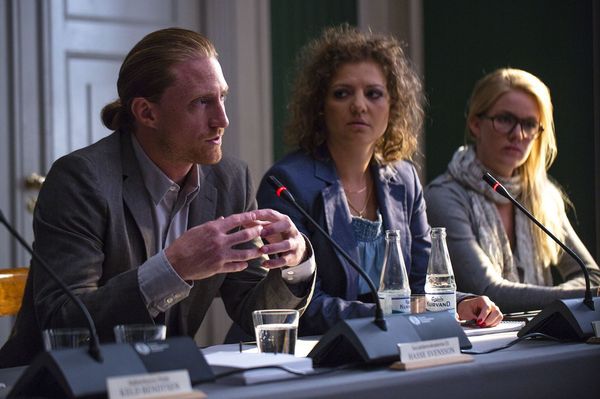
In Prostitution Law and the Death of Whores I focussed on the mechanism by which Rescuers – feminists, social workers, politicians, police – discredit what adult women say about their experiences of selling sex, thus disqualifying them as subjects in a discussion about their own fates. What they say varies widely, of course, but rather than engage in seeking policy that would allow individual experiences to become central and rather than listening with interest to what sexworker activists say and finding migrants to talk to, they claim to Know Better how they should think and feel. The mainstream television series Borgen included a scene in which the non-sexworker experts on a Copenhagen panel discussion of prostitution interrupt and scoff at the sole sexworker participant, demonstrating how well-known the mechanism of disqualification has become (photo above from Season 3, Episode 25). Refusal to believe in the consent of women who sell sex also contradicts widespread anti-rape campaigning that puts consent at the core of sexual relationships.
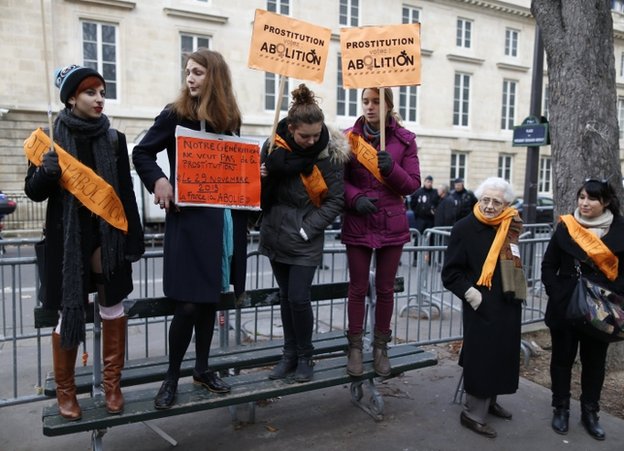
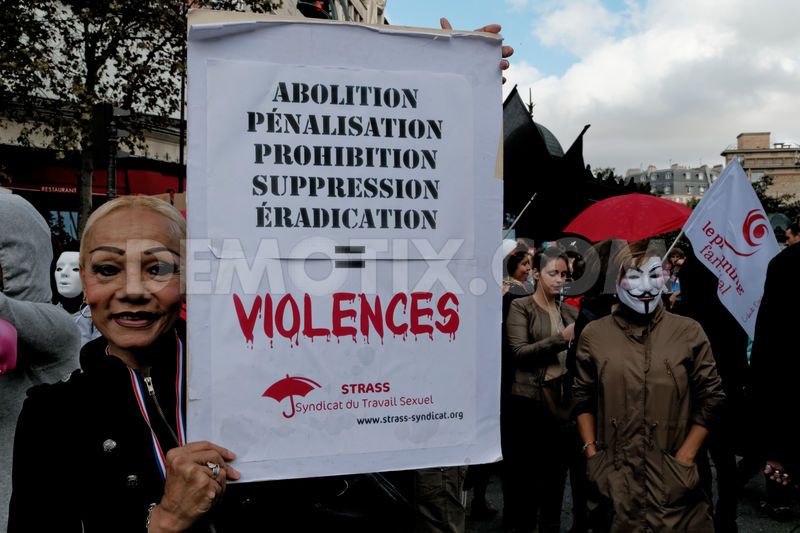
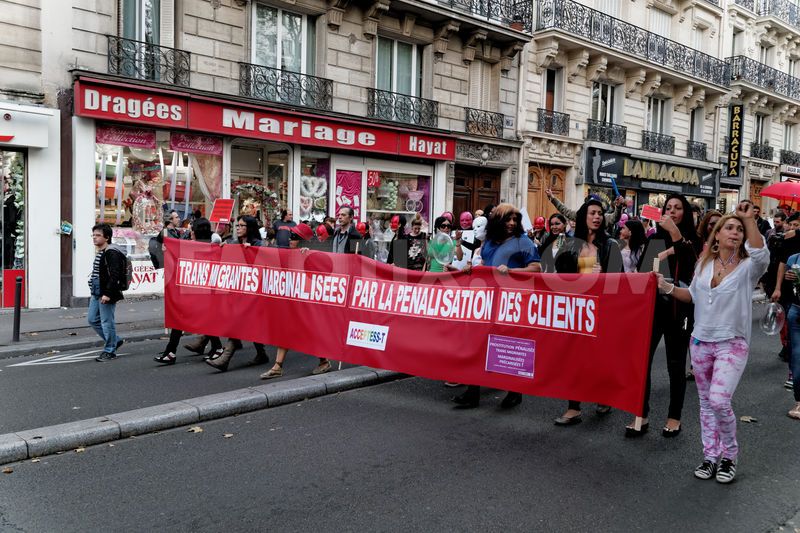
The law to be voted in France’s Assemblée today (4 December 2013) is the product of years of process and politicking, not only in France but in certain feminist networks in Europe. In April 2011 I wrote Europe’s anti-prostitution initiatives multiply: EU itself and now France, linking developments to the European Women’s Lobby campaign for A Europe Free from Prostitution. Last month I wrote, with Thierry Schaffauser, about how the testimony of sexworker activists have been deliberately disqualified from consideration by politicians and certain feminists in France. This is accomplished by claiming these activists are a privileged elite selfishly putting their own interests above those victims of sex trafficking said to be ‘voiceless’ and requiring others to speak for them. Alice Schwarzer, currently campaigning against Germany’s law regulating prostitution, referred to them recently as ‘a few cheerful prostitutes’, of no consequence compared to the miserable 95%.
It’s now 20 years since I first wondered how this refusal to listen operates, at a time when I lived far from Europe amongst very poor women, many of whom were thinking about travelling to Europe. Some already sold sex at home, many were thinking of doing it abroad, others did not want to sell sex but work as live-in maids. This means that my first thoughts and feelings were attached to a specific real-life situation in which I had no axe to grind, no interest one way or the other. In terms of research on women who sell sex I even had what can be called a control group – women of the same cohort who didn’t sell sex. I was unaware a conflict existed within feminism on the topic, I hadn’t read books about prostitution. I was just as interested in what women said about being maids, and I still am. I’ve commented frequently on how my original research question, before I knew what research was, really, concerned the presumption by middle-class women that they Knew Better than sex workers what they should do with their lives. When I studied for a Master’s and then a doctoral degree my focus was never on migrants but on people wanting to rescue them, and after some six or seven years I felt I had answered my original question in several ways. Read Sex at the Margins for details.
I have followed events closely in Europe now for 15 years, living in several different countries and visiting many others, sometimes for extended stays. France is a country I have known since a first school trip from London to Calais, maybe in 1961, and since then I have spent a lot of time there. So i closely watched the action in France’s Assemblée last Friday – not the rhetoric, which I know by heart, but the tones and nuances of speech by the proponents of the law. The auditorium was nearly empty, but all politicking was over; what happened on the floor was not debate but the formal rhetoric of presenting a proposition. Any suggestion from the opposition that the law was sloppily conceived was rebutted with arch-seriousness about how long and carefully proponents had worked on it. The media were accused of missing the point, said to be not penalising clients but protecting women who sell sex.
I do understand what Najat Vallaud-Belkacem, France’s Minister for Women’s Rights, wants to do. I’ve studied in depth what this one kind of feminism wants to achieve, i see how marvellous it sounds – a world without prostitution, a France in which State Feminism takes a daring step towards Gender Equality. Vallaud-Belkacem herself is a very different face for abolitionism from the more embittered and older radical feminists we’ve become used to: Gunilla Eckberg, Melissa Farley, Janice Raymond, Alice Schwarzer and others in every country. She is younger, prettier and was born in a colony, Morocco. French campaigneers have not leant on anti-trafficking rhetoric but on the classic idea that prostitution is a patriarchal institution that must be abolished – the arguments I read when I first started my formal studies in the late 90s. Unfounded numbers of trafficking victims are thrown out, yes, but I read the French effort as being more serious than that. The thing is neither slapdash nor hysterical but part of a sober attempt to change the European panorama, to shift the gaze from small-population Nordic countries never seen as important European players to the continent, to France – to the heart of real Europe. I see this shift as game-changing.
On the other hand, the reason i wrote Sex at the Margins still holds; nothing has improved for sex workers or for people called trafficked or for undocumented migrants in Europe. The anti-trafficking movement has diverted attention and money into everything but benefiting the women pitied in the first place. Campaigners have yet to comprehend how migrants, and a lot of other women, feel about doing high-stigma, risky, better-paying jobs – especially when the other options are practically non-existent. Rescuers’ fundamental project insists on the need to force people into leading lives considered better. It would appear they are incapable of imagining that others are different from themselves, that migrants perceive their options on the basis of their own life experiences and goals. The question is much bigger than Do you like selling sex? rather it is how the range of an individual’s needs, from sleeping patterns to children’s school schedules and the desire for consumer goods may lead them to prefer selling sex to everything else Rescuers can offer. In fact they offer little, which victims and non-victims alike understand.
Few sex workers are attracted by ‘exit strategies’ or ‘diversion programmes’. They hate being low-paid, disparaged, disrespected cleaners, nannies and maids. They don’t want to return to their countries as failed migrants. They don’t want to be poorer again. The sex act may be something they adapt to, learn to enjoy or close their eyes and endure, but if doing it provides more freedom, autonomy, flexibility or hope then it can be preferred, whether people were born in France, China, Nigeria or Brazil. The majority have consented to sell sex, somehow or other, to some degree. Insisting that they leave the milieu when there is so little to offer them is the opposite of kind. In the Rescue Industry protagonists are those who appoint themselves to ‘accompany’ victims out of the life, not those being saved. The consent of adult women is denied en masse.
The French law, apart from the fine of 1500€ for clients arrested the first time, is all about Rescue. The frame is France does not welcome prostitution, meaning prostitution must cease to exist there. It’s estimated at least 80% of sex workers in France moved there from somewhere else, some with the right to remain and look for other jobs. Other migrants are offered 336€ a month for six months if they promise to stop selling sex; since this is far from enough to live on it’s obviously hoped they will leave more quickly, moving to someone else’s country, putting the proposition in the NIMBY tradition – Not in My Back Yard. Street soliciting, outlawed by Sarkozy in 2003 but for many years tolerated or enforced unevenly in different cities, would be permitted again. The law’s backers claim this to be a kind step, but street sex workers say clients will only insist on going to less accessible, more dangerous places to have sex. Besides, local ordinances against street soliciting can be and have been passed at the city level; Lyon is an example.
Logistically the law was informally voted on last Friday. Today is the formal vote. If it passes it is sent to the Sénat, where two scenarios are possible: It passes and goes into effect or it is rejected and sent back to the Assemblée with amendments. In the latter case, the Assemblée vote on a new version that goes back to the Sénat. If the Sénat reject that, a commission paritaire would be named, half from the Sénat, half from the l’Assemblée. The version produced by this commission would then be voted on by the Assemblée, who have the last word. (Thanks to Morgane Merteuil of STRASS for clarifying this process. See their website for other information).
I have loads of links to videos and articles I’ll try to put up soon.
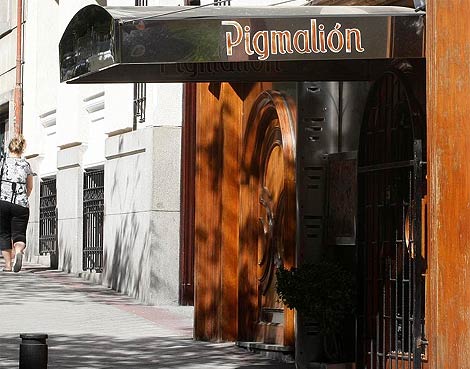
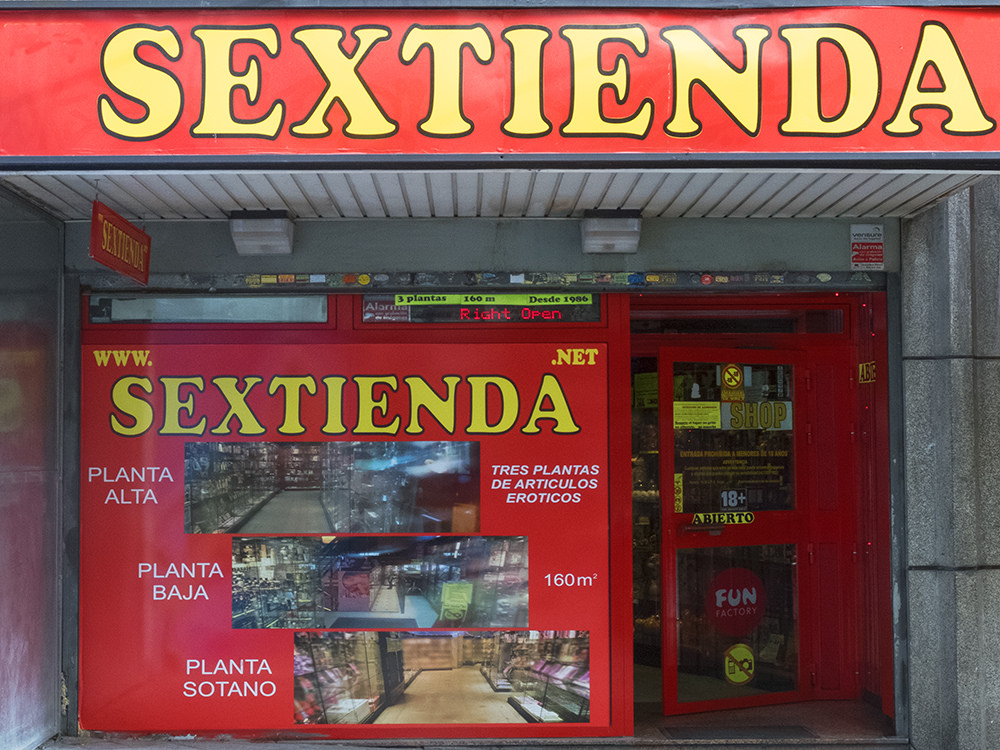
See this perfectly ordinary building? Most sex is sold here, out of conventional flats and apartments, anywhere in the world. The photos of women on the street beloved of dull editors teach that sex work is in the street, and the other photos editors use, of women sitting on barstools, teach that whatever’s not in the street is in brothels or sex clubs. On the contrary, of the many millions worldwide who sell sex of all kinds, most undoubtedly operate discreetly via telephone from their own residence or someone else’s, in the conventional housing we all live in. The photos here are European examples because a conference I’m speaking at speculates about Europe. From the website:
22-24 November 2013
University of Texas at Austin Law School
Eidman Courtroom, Room 2.306
727 East Dean Keeton Street Map
The conference will focus on several difficult issues at the intersection of sexual self-determination and human rights, including same-sex marriage and family, the potential and limits of anti-discrimination laws, transgender rights, sex work and trafficking, youth sexuality, pornography as it affects minors, and the regulation of sex offenders. Individual papers will explore European and American attitudes and practices on each of these issues, with the goal of presenting new conceptual paradigms for future reform efforts. The conference brings together academics, practicing attorneys and therapists, state policy makers, and activists from various points of view.
Attendance is free but registration is required. Full programme
Saturday 23 November
5:15-7:00 p.m. Session Six: Sex Work, Migration and Trafficking
Laura Agustín
Contentious and Contradictory: Prostitution-law Campaigns in Europe (30 min)
Despite the sex-industry’s proliferation into areas where prostitution laws hardly apply, Europeans quarrel tirelessly over which law is correct. Notions of how to protect and serve women compete: 1-the Swedish/Nordic model, which prohibits buying sex whilst allowing its sale, holding that prostitution is violence against women and an absolute impediment to gender equality; 2- regulationism (partial legalisation), which favours allowing middle-class commercial establishments (clubs, bars, brothels) and prohibits street prostitution; 3-decriminalistion, which demands removal of all laws that penalise sex work and favours independent work. Ill-informed campaigns about sex trafficking obstruct pragmatic discussion of now dysfunctional migration laws. Essentialist notions of national sexualities compete with Europeanist proposals, and academic claims about ‘evidence of harm’ muddy the waters. The result is a constant barrage of contradictory messages.
I am not a habitual conference-goer. I do not like to sit passively all day or listen to short versions of deep topics and I have never found the kind of socialising that happens enjoyable. I also hate flying in, living in a hotel and flying out, seeing and feeling nothing of the location but university halls, hotel salons and predictable tourist sights. (I’m going to this thing because I can stay a week, so if you are in Austin…) And now that the law penalising men who buy sex is going to pass in France, I’ll have even more to say than I planned when I wrote that abstract.
I reject reductionist ideas about national cultures and have long thought of myself as a sort of anthropologist of Europe. I believe the move of the law to continental Europe changes the game. I personally am not surprised, perhaps because I’ve lived and spent lots of time in France, Spain and Italy and experienced the same feelings and arguments on the subject of prostitution everywhere. Particularly I’ve experienced the same feminist battles in the same tedious war for coming on to 20 years, so I don’t subscribe to the idea that a few Swedes caused all this client-hating. Once in Valencia I was asked by a renowned Socialist lawyer if I was in favour of torture and arms-trafficking, given my opposition to the present sex-trafficking crusade. I moved away from Madrid because the abolitionist feminists there not only drove me round the bend but made me nervous for my own safety at one event. That was the one where a French woman boomed out We don’t have to talk to prostitutes to know what prostitution is. When I was evaluating anti-violence projects for the European Commission, a Belgian at the European Women’s Lobby denounced me to the director as morally inappropriate, losing me the job. All these attacks took place ten or more years ago, long before Sex at the Margins came out.
After Italian media picked up last week’s story about France, an Italian abolitionist published an attack on me and Thierry Schaffauser entitled Negazioniste della tratta e attori porno smemorati because, as Mira Sorvino’s pals said, I am a Holocaust Denier. Someone seeing the recent attack wrote Questa Augustin è una criminale, in poche parole. [Other Italians responded with defence immediately, more on that another time.] Some educated, feministically-inclined women and men have deplored sexworker-rights ideas in every culture, and others oppose them everywhere as well.
Swedes developed this particular law, but other laws, other ordinances, other police rules have attempted to destroy prostitution before, and not only because it is a social nuisance in the eyes of some but because it is considered wrong. Women who sell sex are often now talked of as victims rather than criminals, increasingly even in the USA, where they are actually criminals by law. The whole premise of the Rescue Industry is to save innocent people from sex-exploiters, with actions that make sense inside all sorts of religious traditions. Schools to re-educate and intimidate clients, fines for kerb-crawling, posting of men’s photos on websites to shame them are descendants of late 19th-century campaigns that had activists running after prostitutes and their clients in the streets. The law can win in the Irelands and France as well as Norway, Iceland and Sweden because the concepts being promoted resonate amongst moral crusaders in all these societies. When the law doesn’t win somewhere in one parliamentary vote it may win on another occasion, because campaigners certainly do not give up just because they did not win the first time.
Last week I mentioned feeling we were moving into a period of Social Purity, which some objected to. A week later I still feel that way and have gone back to re-reading some texts on the subject I first read more than ten years ago. Will report back.
Not so long ago the French would shrug and sigh about prudish societies where sex could still provoke scandal, scoffing at melodramas acted out in the USA by politicians caught doing something opposed to so-called family values. Dominique Strauss-Kahn used this tradition with his claim to be engaging in ‘libertine activity’ when he paid for sex at parties. Now this is changing, not only because of Strauss-Kahn’s continuing saga but because the French parliament is set to pass a law against buying sex that was previously associated with countries to the north.
A couple of years ago I wrote Europe’s anti-prostitution initiatives multiply, discussing France in the context of the European Women’s Lobby campaign for a Europe Free from Prostitution. UN Women National Committee Sweden recently called this ‘an issue that divides the world, and where the Northern European and the global women’s movement fight for recognition of fundamentally different values.’ Perhaps now France will feel more northern than southern Europe.
In networks of activism for sex workers’ rights and better commercial-sex laws, the bill set to pass in France has been a focus of campaigning for some time. Many unfamiliar with the subject cannot believe their ears when told about the contradictory law known as the Swedish or Nordic model, which prohibits the buying of sex while allowing it to be sold. In Prostitution Law and the Death of Whores I said:
Yes, it’s illogical. But the contradiction is not pointless; it is there because the goal of the law is to make prostitution disappear, by debilitating the market through absurd ignorance of how sex businesses work.
Although a lot of activism now takes place via social-media websites, sometimes an email is better. Thierry Schaffauser sent the following ideas in a message about the current situation in France to an activist list. I have added links he provided and edited so that outsiders to these conversations may understand. The full text of the proposed French law can be read here: Proposition de loi renforçant la lutte contre le système prostitutionnel.
Dear all,
I think what we fear is going to happen.
The Socialist party introduced the bill, which was co-signed by all other parties affiliated to the Socialists as well as the Communist and Left parties, so there is already a majority in favour of the law. The right wing might vote with them as well. Even MPs who are against the law will probably vote for it, out of party discipline and to avoid being labelled as sexist, pro-pimp and pro-prosti-killers by feminists (prosti-tueurs is the new name they give to men who buy sex).
In parliamentary hearings two former prostitutes were invited to speak, both affirming the shame, degradation and self-destruction of prostitution. Current sex workers were not asked to testify; one of us spoke along with the health organisations. We have held many demonstrations and shown all the evidence, but we are ignored. The sponsors use flawed evidence and anonymous testimonies; they don’t care about NGOs or research.
Sponsors of the bill claim all the time that 90% of prostitutes are victims of trafficking. This percentage may be their estimate for non-French sex workers, not trafficking victims, but abolitionists don’t distinguish between the two. No source is given for the figure. All migrants are defined as trafficked.
Sex workers who oppose the bill are accused of being a non-representative and privileged minority, so selfish that we defend our own interest and those of pimps and willing to sacrifice the majority of poor victims of trafficking and rape. They insist they will not pass a law on behalf of sex workers who claim to consent to prostitution. They say that our consent is flawed due to poverty and other constraints, and believe that if we were to leave prostitution and go into therapy we would recognise that we had lied to ourselves and that prostitution is, in fact, harmful.
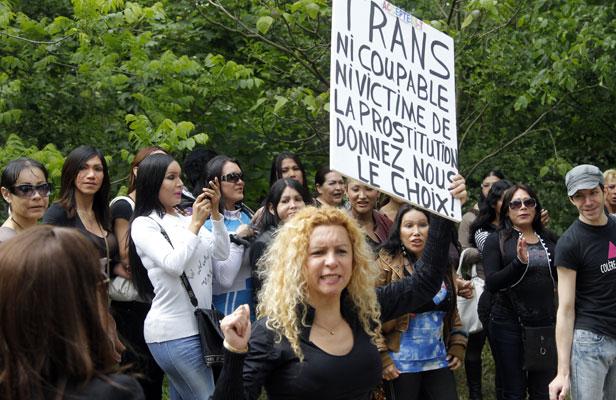
Migrant sex workers from all parts of the world increasingly join the sexworker union STRASS, but they don’t participate in public debates because of the language barrier and the stigma. During our last demonstration there were many migrants, but they were ignored by mainstream media. The bill would make it possible for migrant sex workers to get a six months’ residence permit on condition they agree to stop prostitution.
Sponsors of the law don’t care that only 22% of the French population are in favour of fining clients 1500€, because they say in Sweden the law succeeded in changing people’s minds about prostitution. They share the same goal to educate people in France. The bill would mandate school programming to teach that buying sex is like rape and that prostitution is degrading.
The bill says street soliciting will be permitted, but local by-laws can be passed to maintain public order, so sex workers would not even be decriminalised.
The bill would instruct Internet Service Providers to alert authorities and give power to block access to websites suspected of profiting from prostitution, which means even escort advertising could be targeted. One MP said it would be possible for police to use our phone numbers, which we fear means they could listen to conversations in order to identify and arrest clients and lead to forced entry into our homes and workplaces.
A few days ago a group of reactionary right-wing men started defending the right to buy sex in a very sexist manner. They are being widely reported in the media, and sex workers who oppose the bill are made to look as if we side with them, which is terrible for us.
Many of Thierry’s comments illustrate how certain social actors are disqualified from participating in debates, including when their own welfare is at stake. The most peculiar idea pushed by abolitionism is that there must be a single interpretation for the act of selling sex, that all who do it must agree about the experience. In the case of sex workers who do not want their clients penalised, crusaders give a range of excuses for why their opinions are not relevant, appropriate, serious or believable, allowing their exclusion from debate. Somehow prostitution has come to be a subject where disqualification and discrediting are major tactics for winning political campaigns, where crusaders aggressively dismiss women, men and transgender people from attempting to tell their experiences. The most extreme disqualification goes to the voice of anyone currently selling sex:
Aucune personne prostituée pendant qu’elle exerce la prostitution ne dira jamais qu’elle est contrainte, jamais. Tout le monde effectivement dit que ‘je le fais volontairement’. Ce n’est qu’au moment où la prostitution s’arrête que les personnes disent en fait ce n’était pas ce je disais. – Danielle Bosquet
This authoritarian trump card permits anyone claiming autonomy in selling sex to be dismissed on non-provable ‘brainwashing’ grounds. See Prostitution Law and the Death of Whores for more on how disqualification works.
The turning of all migrants who sell sex into victims of trafficking is what drove me into reading and research in the late 1990s. Sex at the Margins: Migration, Labour Markets and the Rescue Industry is the result of that research, along with articles in academic journals that opened the door to a new field of study. Moral entrepreneurs disqualify this work, too, as exceptional and irrelevant.
The French legislation is highly repressive in many ways. That it is sold as morally righteous confirms my feeling that we have moved into a period of Social Purity, the name given to a movement in Anglo countries in the late 19th century, in which the pursuit of prostitutes and their clients was a principle activity. The difference now can be seen in clauses to the French bill that would increase police power by allowing more surveillance of telephones and possible blocking of Internet sites where sex is offered for sale. The Rescue Industry now propose to save us from even the sight of advertisements considered to foment prostitution; we are all to be re-educated and rehabilitated for our own good.
As everyone knows, I don’t play around with isms. I thought in the 60s that feminism might work but by the early 70s had already realised there were multiple versions – feminisms – which perhaps negates the whole point of an ism, which is a doctrine, theory or philosophy that Explains Things. It turned out that feminism(s), while useful and fascinating, could not provide a whole thought-system to explain how all women feel – or What Women Want, as Freud complained.
I didn’t even think about feminism and prostitution as a ‘problem’ until decades later, when I went back to school. And after reading dozens of books and hundreds of articles and essays on the subject, I realised that this ‘problem’ would never be solved. Many people find it endlessly interesting to hammer at each other about the meaning of prostitution and/or sex work, with the goal of winning, but I don’t. So I began trying to avoid talking about feminisms just to keep things interesting for me, but it is very hard, as some kind of tidal force relentlessly pulls conversations back to that argument. None of which means I don’t think of myself as a feminist – I obviously am one.
I did write Sex as Work and Sex Work in a marxian way for The Commoner, whose editors requested I depart from a post-argument position – as though we’d already accepted that sex can be work, paid or unpaid. It’s been republished several times, by Jacobin and libcom.org, which both can encompass both marxist and anarchist ideas, at least sometimes (and also by Arts & Opinion). I used the term marxian rather than marxist for my own contribution precisely because it doesn’t address all the key factors in marxism. There’s no such thing as marxianism.
Now, I’m doing two talks in Dublin a few days apart in April. At the first, at University College Dublin I’ll take an hour and describe how migration, trafficking, sex work and the Rescue Industry are related. This is the time needed to join these ideas up so that people aren’t confused and frustrated when I stop talking. Then we’ll have a half hour for questions – not for statements of protest and ideology. Then we’ll have respondents – abolitionists and sex workers among them.
At the Anarchist Bookfair I’ve got 30 minutes to talk, followed by 30 minutes of discussion, so I won’t be talking about all that. I was asked to talk about Feminism and Sex Work, so I’m going to talk about how feminism(s) are interesting but perhaps not essential to a discussion of sex work, or at least don’t have to be granted determining status of outcomes. I’ll expect questions afterwards not to try to pull the topic back to the classic, closed-circle debate. I know – Good luck with that. I also won’t be modelling a perfectly coherent view according to marxism, anarchism or any other ism. Ha! someone on the facebook page for the Bookfair has accused me of liberalism, after reading approximately 25 words of my work.
All I ask for is a moderator – and if there isn’t one, I’ll get tough.
6 April 2013, 1220-1320
Thinking about Sex Work as Work with Laura Agustín
at the 8th Anarchist Dublin Bookfair
Doors open at 10am and first meetings start at 1130. The venue is Liberty Hall, Eden Quay, next to the River Liffey, shown here on a map. Enter on the ground floor and go up one flight for the talk. The bookfair itself – the books – are underground!
Other events in the Bookfair include an evening in The Pint pub, Eden Quay, on Saturday and a walking tour on Sunday at 1400 focussing on the Irish Banking industry (catalysers of economic collapse). These events are organised by Workers Solidarity Movement (Ireland).
For those who cannot conceive of a sex-work conversation without nattering endlessly about feminisms, try Sex as Work and Sex Work. It can be done.
I’ll be doing two talks in Dublin the first week of April, one at University College Dublin and another at the Anarchist Bookfair. Since Ireland is currently the scene of a lamentable government investigation into prostitution for the purpose of making a new law, I’m glad to be part of two events that will resist the general victimising of women who sell sex, particularly since I had to formally object to a report the Justice Department produced last year that lifted many of my statements without attributing them. After time-consuming backs and forths with them, the report was re-released with attributions in place. And then when they held an event last October they pointedly excluded me.
4 April 2013, 1600-1830
Sex at the Margins: A talk by Dr Laura Agustín on Migration, Trafficking and the Rescue Industry
After my talk, questions and a break there will be a panel of 5-6 respondents, including sex workers. There has been bitterness about government hearings that have refused to allow any active sex workers to testify – while they have listened to some self-identified victims.
The event will take place at the John Hume Institute for Global Irish Studies Centre, in the Clinton Auditorium, pictured above and on this map. This is near Stillorgan Road in Belfield, Dublin 4.
The Clinton Auditorium is located near the main entrance to the campus, five minutes from a bus stop used by several buses. The 39a bus actually terminates within the Belfield campus at a stop near the Auditorium and can be boarded in the City Centre from Bachelor’s Walk or College Street. The bus runs every 10-15 minutes. Bachelor’s Walk is on the North Quays, facing the River Liffey, just to the right of the top of O’Connell Street if facing the river. College Street is to the right of the main entrance to Trinity College if facing the main entrance. For more details see the campus website. Questions may be addressed to Anne Mulhall (anne.mulhall[a]ucd.ie).
then
6 April 2013, 1220-1320
Thinking about Sex Work as Work with Laura Agustín
at the 8th Anarchist Dublin Bookfair
Doors open at 10am and first meetings start at 1130. The venue is Liberty Hall, Eden Quay, next to the River Liffey, shown here on a map. Enter on the ground floor and go up one flight for the talk. The bookfair itself – the books – are underground!
Other events in the Bookfair include an evening in The Pint pub, Eden Quay, on Saturday and a walking tour on Sunday at 1400 focussing on the Irish Banking industry (catalysers of economic collapse). These events are organised by Workers Solidarity Movement (Ireland).
For those who cannot conceive of a sex-work conversation without nattering endlessly about feminisms, try Sex as Work and Sex Work. It can be done.
Alas. Ordinarily I would quickly click away or delete nonsense-news like this of a ‘consultation’ on prostitution law run by politicians. But since I am assured that its results will indeed be taken seriously by mainstream government, I have to suggest people especially in the UK and especially those who can claim to be a ‘group’ do respond. So-called consultations are going on left and right in the this area of the world, in both Irelands and Scotland, so this adds England and Wales. They are all started by people who want to bring in criminalisation of clients, and in such a conflict-ridden field it’s better to claim to be non-partisan.
You may look at the official registry page for this group called the All Party Parliamentary Group on Prostitution and the Global Sex Trade (APPG for short); their names unsurprisingly include Fiona Mactaggart. The group have launched an online Call for Evidence, a misnomer as they are just asking for opinions and feelings – no evidence at all. The stated goal of the group is
To raise awareness of the impact of the sale of sexual services on those involved and to develop proposals for government action to tackle individuals who create demand for sexual services as well as those who control prostitutes; to protect prostituted women by helping them to exit prostitution and to prevent girls from entering prostitution.
The All-Party Parliamentary Group on Prostitution and the Global Sex Trade is launching an inquiry to assess the current UK legal settlement surrounding prostitution, and to identify how legislation to tackle demand could safeguard those in danger of sexual exploitation and abuse.
I hardly need point out that this is not the way to make a serious inquiry or hold a consultation.
The online questionnaire is not long. Skip if you want to from the introductory palaver to where the questions begin. You may answer anonymously. You may answer as an individual. You may be anywhere in the world.
The deadline for response is Monday 4 February at 16:00. No responses considered after that.
Please note that despite sounding like a government group, this whole project is financed by CARE (Christian Action Research and Education): a well-established mainstream Christian charity providing resources and helping to bring Christian insight and experience to matters of public policy and practical caring initiatives, according to themselves.
Note that the addition of Global Sex Trade in their name indicates an anti-trafficking agenda. They don’t address it in this questionnaire, but the door is obviously open.
A few weeks ago a flurry of Swedish media articles purported to ‘reveal’ that the national development agency, Sida, gives money (3,611,092 euros) to Mama Cash, a Dutch foundation that, among many women’s causes, supports sex workers’ rights and has funded Rose Alliance, a sex-worker group in Sweden. This wasn’t even new news, but some anti-prostitution folks tried to whip up indignation and manufacture a scandal.
The first story appeared on a news site hosted by Sida itself on 4 December. The same day, another article repeated the news, with a headline saying the money goes to lobbyists for commercial sex. Still on the same day one of Sweden’s delegates to the European Parliament, and a member of the abolitionist European Women’s Lobby, demanded excitedly that Sida stop giving the money (she’s holding up the Say No to Prostitution sign in her photo). The next day saw replies from RFSU (Sweden’s big sex-education organisation) and Louise Persson, defending the financing of groups supporting vulnerable women/prostitutes/sex workers. Then there was another piece from the parliamentarian, followed by another on the Sida site. Neither Mama Cash nor Sida made any reply.
At Rose Alliance we decided to write a short statement acknowledging the flurry and, instead of defending or counter-attacking, presenting the basic facts about the organisation on a news site called Newsmill. It got delayed in the pre-Christmas rush and was published 23 December as Vi sexarbetare kan föra vår egen talan. Here is the English version, just as dry and unexcited as the original Swedish.
Sex Workers Can Speak for Ourselves
Annelie Eriksson, Pye Jakobsson and Laura Agustín
Rose Alliance was recently in the news when it was reported at OmVärlden that Sida gives money to a foundation that has given us two grants. Rose Alliance (Riksorganisationen för sex- och erotikarbetare i Sverige) is an organisation for current and former sex workers in Sweden. We began in 2001 but started expanding about three years ago.
The most important things to know about Rose Alliance are:
We promote economic, labour and individual rights for people of any gender identity who sell sex.
We recognise that sex workers have a wide variety of experiences and value all of them.
We believe in the theory and practice of harm reduction.
We assist and advise each other on legal and self-employment issues and dealing with social and police authorities, on a voluntary basis.
We received our first core funding in 2011, from Mama Cash, to strengthen our internal organisation. We now have funding for two more years, which we will use to
Publish printed resources for both internal and external use
Some Rose Alliance members blog and publish articles as individuals: Greta Svammel, Petite Jasmine, the Naked Anthropologist are examples. Some members receive invitations to visit, speak and consult both inside and outside Sweden. Host organisations reimburse the usual expenses for this travel.
Political lobbying is not our main focus. But for the record, we advocate self-determination and rights for sex workers – the right to sell sex as well as the right to stop selling sex. The law criminalising the purchase of sex aims to deprive sex workers of the right to run their own lives, so we oppose it.
Annelie Eriksson, Pye Jakobsson och Laura Agustín för Rose Alliance
23 Dec 2012, Newsmill
Rose Alliance var nyligen uppmärksammade i media när det rapporterades på OmVärlden att Sida ger pengar till en stiftelse som har gett oss två verksamhetsbidrag. Riksorganisationen för sex- och erotikarbetare i Sverige (Rose Alliance) är en intresseorganisation för nuvarande och före detta sexarbetare i Sverige. Vi startade 2001 men började växa som organisation för ungefär tre år sedan.
De viktigaste att veta om Rose Alliance är:
Vi arbetar för att främja ekonomiska, arbetsrättsliga och individuella rättigheter för alla sexarbetare, oavsett könsidentitet.
Vi inser att sexarbetare har en stor variation av erfarenheter och värderar alla lika mycket.
Vi tror på skadereduktion, både i teori och praktik.
Vi stödjer och rådgör med varandra i juridiska frågor, frågor kring egenföretagande och hur man hanterar kontakt med sociala- och polisiära myndigheter. Allt på en volontär basis.
Förra veckan deltog vi i World Conference of ILGA (International Lesbian, Gay, Bisexual, Trans and Intersex Association) i Stockholm, och vi har haft en egen lastbil i Stockholms prideparad under de senaste två åren.
Vi fick vårt första verksamhetsbidrag 2011, från Mama Cash, för att stärka vår interna organisation. Vi har sedan juli 2012 verksamhetsbidrag för ytterligare två år, som kommer att användas till att:
Göra vår hemsida till en bättre resurs för våra medlemmar
Organisera utbildande workshops för våra medlemmar
Publicera tryckt material för internt och externt bruk
Vissa Rose Alliance medlemmar bloggar och publicerar artiklar som individer:Greta Svammel, Petite Jasmine, the Naked Anthropologist är några exempel. Vissa medlemmar blir inbjudna att besöka, föreläsa och konsultera såväl inom som utanför Sverige. Värdorganisationerna ersätter då kostnader i samband med dessa resor.
Politisk lobbyverksamhet är inte vårt främsta fokus. Men för tydlighetens skull: vi förespråkar självbestämmande och rättigheter för sexarbetare – rätten att sälja sex såväl som rätten att sluta sälja sex. Sexköpslagen bidrar till beröva sexarbetare rätten att styra över sina egna liv, därför är vi emot den.
A German sex box: passenger side provides space for escape
Sex boxes are not boxes. And they are not Dutch-style prostitution windows, either, as a lazy reporter at Spain’s ABC egregiously wrote. In English these are called booths or boxes and even garages, but they are parking spaces with walls on three sides. Germany and the Netherlands have used these for sex-money transactions for years: This is not Big News.
The announcement from Switzerland was Zurich regulates sex industry: this is a story about regulation, city planning and social welfare. In the announcement on a new policy, Michael Herzig, whom I met when giving talks in Zurich, said:
We want to regulate prostitution because until now it was the law of the jungle. . . It was the pimps who decided the prices for instance. We want to as much as possible the city to regulate prostitution, the city to define what we have in Zurich. . . but we are trying to go to a situation which is better for the prostitutes themselves, for their health and security and also for the population which lives in Zurich.
The purpose is to screen the sight of people having sex in cars; the pictures here show examples of boxes in other places; we haven’t seen the design for Zurich. The spaces will be located in an industrial area of the city. Herzig said
The big difference is that until now prostitution has been in the public space. Now we are going to change this, move it from the street to a private space in an old industrial area, which belongs to the city. This gives us the possibility to define the rules of prostitution in this area.
The policy is also about harm reduction, as the spaces/boxes include features intended to increase safety for sex workers and avoid condom rubbish in the street. Sex workers will be required to buy medical insurance and a licence to use them, and put five Swiss francs into a roadside ticket machine each night when they clock on. This is pragmatism at the highest level; thus the absence of moral outrage on anyone’s part in the announcement – not about AIDS, trafficking, crime or victims.
What isn’t mentioned however is that, whenever this sort of plan arises, anywhere, numerous street workers simply refuse to transfer their activities to the regulated zones, which are always far away from bustling areas if not in downright deserted ones. Instead, they move into some other commercial/residential neighbourhood, where the cycle begins again. Clients in cars may well be willing to drive to the new zones; it’s the sex workers that don’t like them.
The other side of this regulation means prohibition of street walking on the Sihlquai, where residents have long been complaining for the usual reasons: too much noise and mess, too close to children. In this report from swissinfo.ch, an increase in numbers of sex workers is attributed to migrants from eastern Europe; in Zurich they have largely come from Hungary.
Note on the legality of selling sex in Switzerland: The official line is that only completely independent sex work is permitted (windows that look like this on ordinary houses are common). There are, of course, scads of businesses providing workplaces for workers, but the owners call the workers sub-contractors, which supposedly means the owners are not employers and thus not capable of ‘exploiting’ anyone. Typical city-father contradictoriness where commercial sex is concerned.
For anyone interested in the background to this policy-change, I published the following news story a couple of years ago, when sex boxes were also in the news.
After encouraging results in Germany, Zurich city officials are considering the installation of “sex boxes”, fenced parking areas, where prostitutes and their clients can conduct business away from the public eye. In a city where prostitution is on the rise, the measure could help protect residents and prostitutes alike. The drive-in “sex boxes” resemble makeshift parking spaces, surrounded by three tall metal fences to provide more privacy for prostitutes and their clients.
Already in use in some German cities, such as Cologne and Essen, the “sex boxes” are the latest idea suggested by Zurich city authorities after receiving thousands of complaints over the hordes of scantily clad prostitutes (and their actions) who patrol the main financial hub of Switzerland’s largest city.
Prostitution in Zurich increased by some 20 percent last year, according to some reports, which said that police had recorded more than 3,700 sex workers, mostly operating in the former red-light district in Zurich West, around Langstrasse, known as a busy multicultural melting pot and for occasional petty crime. The women generally gather on the artery of Sihlquai – a busy road along the river, behind Zurich’s main station – and wait in small groups for drivers to stop at pretty much any time of the day. The district is heavily populated and the area around the Sihlquai is also a common meeting point for students and families.
Reto Casanova, a spokesman for the Zurich police, told Swisster that the situation was “tolerable, but not as we want it”. He said the sex boxes have proved successful in Germany and could be an option for Zurich as well. “We are looking for an acceptable solution for everybody, with the goal of maintaining people’s safety and dignity,” he explained. Casanova said the ultimate decision on whether to adopt the boxes remains with the city council. However, he added, a police delegation is planning to travel to Germany in the fall to gather more first-hand details about the practice. In Cologne, social workers have reported encouraging results from the installation of the boxes. “In the past, the street girls were often chased by police. Now the officers are even protecting this legal street sex activity,” Sabine Reichard told Deutsche Press.
Further protection for sex workers is also built into the boxes’ design, which provides a handy alarm for the passenger within easy reach, while the parking set-up allows the prostitute an easy escape but blocks the driver’s door. So far it’s unclear whether using the enclosures will require a “parking” fee .
The rise of prostitution, with most women coming from Eastern European countries, is a worrisome problem for the city and its authorities who try to control the trafficking of women behind it, especially when individuals of 16 can legally sell their services in some parts of the country. Politician Luc Barthassat has called for the legal age to be raised to 18 and told Swissinfo recently that “Switzerland risks becoming a major sex tourism destination.” Zurich resident, Giuseppe Spina told Swisster he did not understand how big the phenomenon was until he found himself driving along the Sihlquai one recent night. “It is a different world, somehow connected to ours, but still hidden in obscurity,” he said. “I had a problem with the car and had to stop one metre away from two prostitutes who were waiting there. I couldn’t help but pity them.”
Don’t ask me what his pity has to do with anything.
As everyone now knows, speculation about the relationship between big sports events and sex trafficking continues despite evidence that no such relationship exists. Seemingly endless reports before the Olympics began in late July worried about what might happen, justifying all manner of awareness-raising and misleading rhetoric (from the EWL, from Stop the Traffik and of course from the police).
We at x:talk have made a questionnaire for those who worked in London during the games (including the Paralympics). The purpose is to find out from those directly involved: Was business better or worse? Did people travel to London to do business? Did they see anyone forced to do sex work? What experience with the police did they have if any? The survey, called Did the Olympics affect London’s sex industry? can be found right here: Do please disseminate far and wide, but don’t participate unless you actually worked in London during the Olympics. Here’s the description at the start of the survey:
Help give a voice to London’s sex workers and adult-entertainment businesses
Xtalk Project Limited, a co-operative led by sex workers in London, would like to know if and how the Olympics affected your business. If you worked in the sex industry – in any kind of adult-entertainment business – in any capacity, whether as employee, independent, owner or manager from 27 July to 10 September 2012, please take 10 minutes to answer some brief questions.
* We are not asking your name, address, age, gender or any other personal details.
* We will not record your ISP in order to track your computer or where you were when you filled out this questionnaire.
We will be reporting how many respondents answered questions and what they said, in order to contribute to ongoing debates about sex work and adult entertainment in the UK and abroad.
Everyone who worked is invited to complete this questionnaire: people who sell sex or erotic services, people who have support roles in or provide professional services to adult-entertainment businesses, managers and owners. If you had any of these roles in London during the Olympics you are eligible to do this questionnaire.
Please do not answer this questionnaire if you did not work in London’s sex industry during the Olympics. We want to provide unbiased information about what happened.
If you have any questions, please contact us at xtalk.olympics [at] yahoo.co.uk or visit xtalkproject.net
No more sex-industry jobs via UK Jobcentres? Not long ago I wrote about advertisements for sex-industry jobs in UK government-funded (un)employment offices called Jobcentre Plus. The other day,...

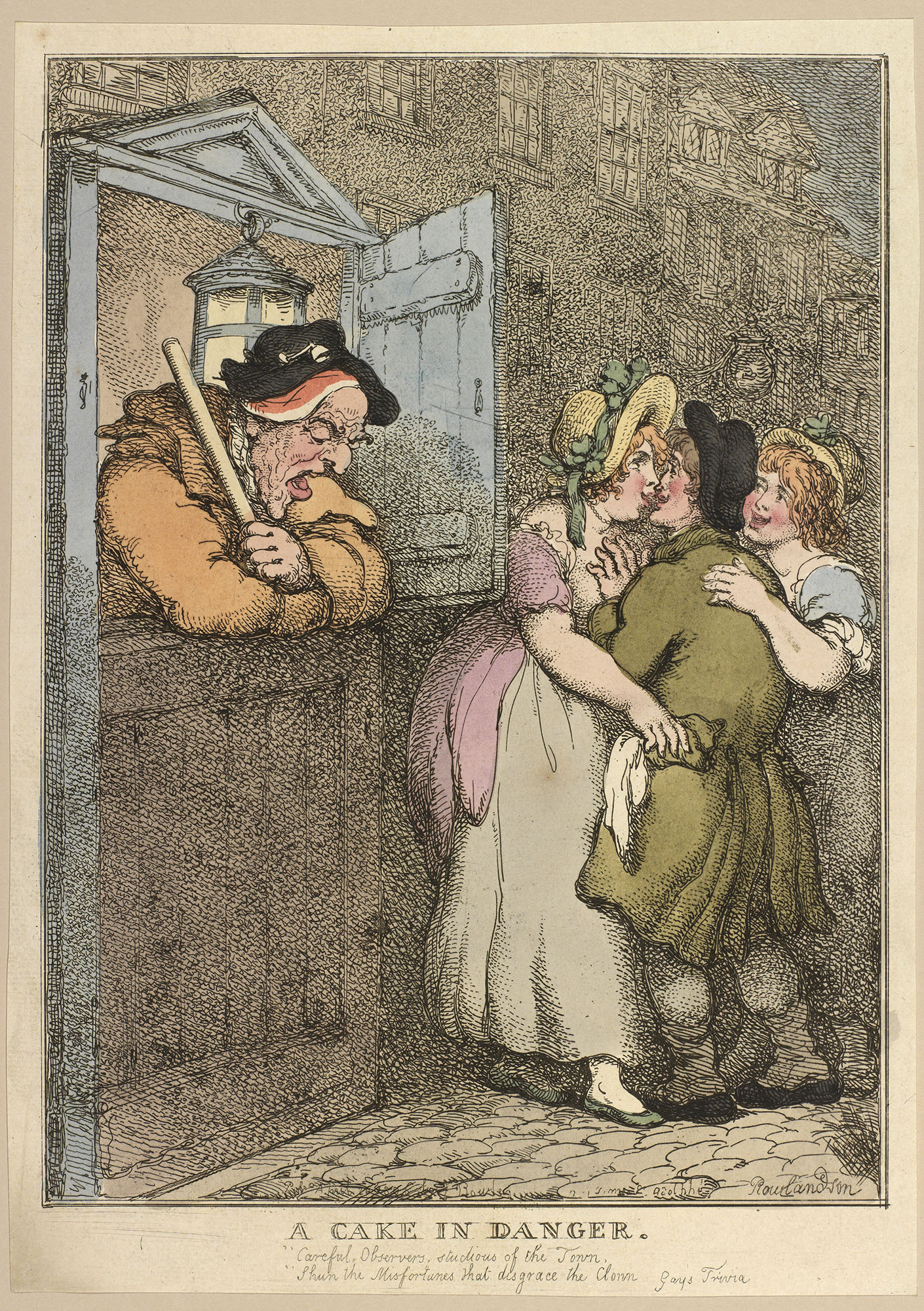 In Slammerkin, Mary is a street prostitute in mid-18th-century London. Thrown out of her dismal basement home by a mother absolute in condemnation of Mary’s pregnancy at 14, she meets a friendly whore, Doll, who initiates her into street trading. Mary is in love with nice clothing and comes to see there is no hard line between the Good Woman and the Bad.
[Her mother] Susan Digot wouldn’t likely recognise her child-as-was, all gussied up in a flowered jacket-bodice and a worn silk skirt buoyed out by a pair of improvers. Mary looked like a woman of the town, these days. She smelled different, even, with the mouth-watering lemony reek of Hungary water.
On long bright evenings, Mary sat on the grass in Lamb’s Conduit Fields behind Holborn and watched the courting couples meander by. The air was full of the sounds of leisure: the archers’ arrows hitting the target, the click of balls on the bowling green, or the distant roars of a dogfight or wrestling match. She was reading again for the first time since school. She bought crack-backed romances and memorised all the long words, in case she’d ever need them. The History of Pamela Andrews was her favourite. The crafty wench, to fend off her master all those times, then squeeze a proposal of marriage out of him in the end! She’d swapped her maid’s apron for bridal satins and ended up as good a lady as any other, hadn’t she? It all went to show, Mary thought. If a girl had her wits about her, nowadays, she could rise as high as she wanted, as sure as cream through the milk. Anything was possible. – Slammerkin p247 (Emma Donoghue 2002)