sex work refers to a wide range of activities involving sex in exchange for money or benefits. to call it sex work is to acknowledge it can be experienced as a job, livelihood, occupation
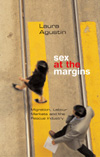
I’ve been invited to speak at the Human Trafficking Center of the Josef Korbel School of International Studies at the University of Denver, Colorado. The talk is called Sex at the Margins: Beyond Binaries in Trafficking & Sex Work. In the 10th-anniversary year of Sex at the Margins I’ll be reflecting on the oceanic changes that have taken place since I first thought about the issues. Beyond Binaries is right: Flee from all attempts to reduce migration and sex-work questions to black and white. What I say is pretty much the opposite of everything seen and said now on the subjects in the media, by politicians and by Rescue Industry participants.
The event, entitled the Monica Petersen Memorial Lecture, is open to the public, taking place on Wednesday 10 January 2018 from 12-2pm at Sie Center Maglione Hall (5th Floor), on the campus at 2201 South Gaylord Street: further details and a link to RSVP here on eventbrite . There is also a facebook page.
Later that day I’ll be reading from Sex at the Margins and The Three-Headed Dog at the University Library, Anderson Academic Commons Room 290, 2150 East Evans Avenue from 17:00-18:00. There’ll be a discussion and Q&A afterwards.
I’d love to meet anyone in person I’ve chatted to online, so do identify yourselves. And I’ve got a couple of days partially free to wander the town, so let me know if anything interesting is happening.
By Laura Agustín, was published in Jacobin Magazine 6 December 2017. I wrote this after reading Julie Bindel’s new book but my thoughts are about the whole anti-prostitution movement as it stands today, whether formulated by so-called radical feminists, Christian missionaries, lawmakers or Rescue Industry social workers. Many others have commented on specific falsehoods and distortions in this book: especially see social media. Links were added by Jacobin. I begin with
__________________________________________________________ Entry for an encyclopedia of feminism: The Sex Work Wars: Decades of acrimonious debate about the meaning of exchanging sex for money. Near-total disagreement about terms, definitions, causes, and effects, and how to measure the involved phenomena. Mutual incomprehension on cultural meanings of sex, sexual identity, and gender relations. Laws backed by politicians based on the supposed truth of one or the other view. Little improvement for those being discussed. Outgrowth of the Lesbian/Feminist Sex Wars of the 1980s.
_________________________________________________________
A new shot has been fired in the Sex Work Wars. Julie Bindel’s The Pimping of Prostitution calls for a return to more authentic beginnings, when, as she tells it, everyone involved in the 1960s women’s liberation movement was in thrall to a few shining leaders.
This version rings no bells for me. We were revolting against 1950s domestic ideology that told women to be quiet, feminine, and satisfied with making homes for men. The meaning of liberation was to figure out how to live on our own terms, and if we did read mimeographed newsletters from activists, we didn’t think we had to agree with them. We didn’t feel anyone was our leader. We talked together on the streets, in classrooms, in cafés. Everyone’s experiences counted.
In those conversations, prostitution was considered neither a central issue nor a terrible thing — or not more terrible than everything else we were coming to recognize as oppressive. We wanted to know why housework wasn’t paid and women were supposed to do all the childrearing. We wanted to define our own ways to enjoy sex. We used a new word, ”sexist.” I don’t recall attending a single formal meeting, but I have identified since that time as a feminist.
In this book, Bindel offers two things: cheers and brickbats. Those who agree with her get cheers, everyone else gets brickbats. Less subtle than boxing commentary that recognizes all good punches, this is a bitterness born of thwarting: Prostitution still exists. Millett and Dworkin have been betrayed. Someone must pay.
Nowadays in conversations about women’s rights, there’s widespread agreement about the need for more education, equal salaries, and better job opportunities. But bring up women’s physical bodies, and ideologies of femininity and patriarchy flash like wildfire. Intransigent conflict pursues contraception, abortion, surrogacy and, perhaps above all, how women can and may consent to have sex. For radical feminists like Bindel, the insertion of money into a sexual relationship signifies no women can ever consent, even when they say they do.
News about women who sell sex has changed tone since publication in 2000 of the UN Protocol on Trafficking, although legal definitions are even now not fully agreed on. Media reports routinely confuse or use all available terms. Human trafficking is not distinguished from people-smuggling, borrowing money to migrate is called debt bondage, awful working conditions and child labor become modern slavery, and selling sex is renamed either sex trafficking or sex slavery. All sociocultural contexts are eliminated in favor of universalizing definitions. No interest is shown in considering how to improve working conditions. The result is to define women as victims in need of rescue, especially when they are selling sex.
In this context it’s not surprising that abolitionism should reemerge into the mainstream. Bindel calls hers the new abolition movement, misleadingly linking to Josephine Butler’s nineteenth-century campaigns to abolish government regulation of prostitution (not prostitution itself). Bindel rejects the aforementioned proliferation of terms: “Trafficking is merely a process in which some women and children are prostituted. Prostitution itself is the problem.” Which at least confirms a long-standing activist complaint regarding anti-trafficking campaigns: that the real object is prohibition of any woman from selling sex, anywhere, anytime.
Fear of trafficking is now used to justify a variety of repressive prostitution-policy regimes, including a law that bans the purchase of sex. First called the Swedish model, then the Nordic, this law, according to Bindel, can now be called the abolitionist model. The idea of this ban is to “End Demand,” on the theory that, if men were stopped from buying sex, women could not be exploited and would never sell sex. It is a ludicrously simplified market theory of supply and demand. Abolitionists claim the law decriminalizes the sale of sex by women (appropriating the central demand of the sex workers’ rights movement), failing to address what would happen to women’s income if there were no clients.
The book’s subtitle, Abolishing the Sex Work Myth, suggests it will prove there are no sex workers. Bindel names many countries she visited. She details the personal sufferings of women who hated selling sex: these are her heroes, and they come across as individuals. Representatives of the “pro-prostitution lobby,” on the contrary, are treated as a series of puppets, quoted to demonstrate their cynicism. Those who recognize the concept of agency as one reason to accept the existence of voluntary sex work are ridiculed as “choice” or “fun” feminists. We hear nothing from women who may not like sex work but continue doing it for their own good reasons.
Mud is slung at escort-agency managers, queer academics, gay libertarians, HIV/health NGOs, migration scholars, Amnesty International, and sex worker-led groups. The greatest wrath is reserved for funders like George Soros’s Open Society Foundations for daring to try to strengthen sex workers’ rights. Because she wants to obliterate all differences and discredit every conceivable source of opposition to radical feminist ideology, variety in types of sex work, degrees of management control, perceptions of autonomy, and amounts of money are dismissed out of hand. Canned summaries of a few moments in sex-worker-rights history are thrown in, but the entire international social movement is dismissed as a pimping “lobby.”
I am capable of reading works whose worldview I don’t like for research purposes, but this book defeated me. The table of contents looks rational, but each chapter consists of many short subsections that appear almost randomly placed. The style is bumpy and awkward, suggesting multiple writers and no editor. There’s no depth, nuance, or engagement with ideas.
And I found very little that might be called new, neither facts nor ideas. If the international abolitionist movement hoped this would be a new heavy weapon against enemies or a way to convince non-experts that sex work is an illusion, they will be shaking their heads in disappointment.
The worst of the contemporary abolitionist project is its failure to confront the question of options for women. Bindel feels Josephine Butler would be on her side? I feel she’d be on mine. At mid-nineteenth century Butler saw how few alternatives women had to achieve economic independence and did not advocate they should be deprived of the possibility of selling sex to survive.
As a scholar in the field, my question has never been whether selling sex is acceptable in moral or feminist terms. Instead I’ve focused on the fact that women everywhere have limited job options, and, when they are not well-educated or connected socially, those options generally reduce to low-paying, low-prestige work: street vending, home sewing, caring, cleaning, retail jobs, sweatshop labor, and selling sex. When the women are undocumented migrants the feasible options reduce to two: living in others’ families as maids or selling sex.
Given the low earnings of these occupations, it is hardly surprising that women who feel they can tolerate it do sex work instead. Less time spent working for more money means being able to support oneself, help others and still have time to take a walk or read a book. Sometimes sex workers get into relationships that don’t look good to outsiders. But what do abolitionists imagine women with few options will do if they are forced to stop sex work?
The old Magdalene Laundries and lock hospitals envisioned nothing better than domestic servitude for ”fallen women.” Is the proposition still that being a servant for pennies and a scant private life is better because it is more dignified? Or is it superior simply because it is notsex work? Either way, to focus always on the moral aspects of sexual labor means forever sidelining projects to improve working conditions and legal protections.
Bindel’s need to manifest indignation at the slightest deviance from a simplified ideology means readers get no distinctions between dastardly procurers, human rights groups, independent escorts, academic researchers, workers in massage parlors, and Hugh Hefner. We’re all the same thing. It’s the textbook definition of fundamentalism.
Sexbuyer laws: War on clients, says Israeli MP Sexbuyer laws now exist in eight countries at the national level: Israel, France, Canada, Ireland, Northern Ireland, Iceland, Norway, Sweden....
On the International Day to End Violence against Sex Workers, 17 December, I’ll be in Skopje, Macedonia, invited to speak and march by the Coalition ‘Sexual and Health Rights of Marginalized Communities’ in association with the Institute for Ethnology and Antropology at Saints Cyril and Methodius University.
My public talk Sex at the Margins will be held at Public Room, which describes itself like this:
PUBLIC ROOM – Centre for design and innovation: Mezze bar, music, free co–working space for freelancers, concept store, prototyping room, library, commercial bazaars, fine arts and photo exhibitions, professional presentations, workshops for children and adults, business meetings, seminars and celebrations. Public Room is urban, multifunctional place open for all companies, organizations and enthusiasts from all generations… It is a pure hybrid space that abounds with opportunities, creative potential, programme for all tastes and people with positive attitude. You are welcome to realize your ideas in Public Room.
Pure hybrid– sounds like my sort of space. Mixed use, open to all, I’m in favour.
On Saturday 16 December, STAR STAR, a sex workers organisation, will do a Red Light District performance in Skopje city centre at 1700-1900 and 2000-2200 (Boulevard St Kliment Ohridski).
On 17 December at noon there is a march on Macedonia Street to mark the Day to End Violence against Sex Workers. Many sex worker groups hold events around the world on this day, and I’m happy to be in Southeast Europe, perhaps even in some sunshine.
Report from Macedonia: Balkan Noir Last December I was in Skopje, the capital of Macedonia, on the occasion of International Day To End Violence against...
I know many folks who relate to the idea of sex work as one of their jobs and to sexworker as one of their identities. But I have known many more who sell sex and don’t feel like this. Of course it’s possible to ask questions that appear to prove interviewees always feel it’s a job: many social scientists study occupations and need everyone to have a clear label. Those of us who’ve sat and listened at length to people’s stories know things are a lot muddier than that. But, you might say, hold on, look at what are captioned ‘tools of the trade’ in the photo here: don’t they prove it’s a job for the woman using them?
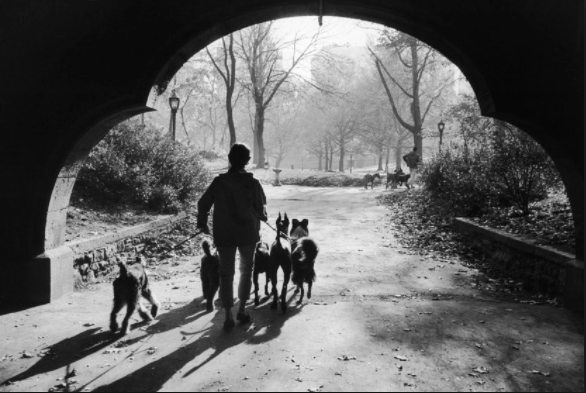
I think back to most of my own jobs: Did I ever feel secretary was my identity? Or dogwalker? (That could be me in the 1967 photo in Central Park though I don’t ever remember walking so few dogs at once.) Even when I had the title Managing Editor I never felt it was who I was.
In China the word xiaojie means Miss or young lady. Many women who sell sex prefer to be called xiaojie to sex worker (with the result that non-sexworking misses don’t want to be called that anymore). Ding Yu, sociologist, talks about why:
Many academics feel that it’s important to respect this community by using a term that classifies what they do as a profession. But in fact many xiaojie don’t really understand or like this name because they feel the term emphasizes sex. The term “sex worker” reduces all their work to sex, which doesn’t reflect the reality of what they do. It doesn’t accurately represent the diverse forms of emotional work and entertainment that they’re engaged in; rather, it highlights the one part that’s stigmatized.
There’s an important class dimension. As migrants coming from the country to the city, they want to be part of this modern, developed world. They want to shed the kind of coarseness that’s associated with the countryside. Most ‘xiaojie’ are very well-informed about the conditions of factory work, and they know they’re not interested. They know other women from their hometowns who are factory laborers, and there are plenty of media reports that show how it is tedious, repetitive, and arduous, how the worker is treated like a machine. They know you’re stuck in dorm accommodation, far from the city center, producing luxury items you can’t afford to buy yourself. They know you are outside the modernity and development as a handmaiden to it. Other options, such as being a waitress or nanny or shop assistant — these positions generally see lower income and worse working conditions than being a xiaojie, which is thus not a particularly poor option.
In The Three-Headed Dog several migrants are selling sex. Marina lives and works in flats with other women and a manager but decides to go onto the club circuit. Promise sells in the street. Eddy is keeping company with a tourist. Isabel tried prostitution and prefers being a cleaner. The detective, Félix, once worked in spas. None call themselves or the work by a professional word. Of course, some activists think this is a problem, that there’d be more chance of successful organising if more women were willing to stand up and call themselves by the term that now sounds more like a worker title than other options. This is possible. The catch is in the stigma.
Militia detectives are at Kazansky Station in Komsomol Square, in Martin Cruz Smith’s novel Gorky Park. Cartier-Bresson’s 1954 photo shows the station at the left and surrounding traffic. Moscow prostitution may not have existed officially in 1977, when the story takes place, but sex work certainly did.
At 6 am entire Turkman families lay head to feet on benches. Babies with felt skullcaps nestled on soft bundles. Soldiers leaned slackly against the wall in a sleep so tangibly deep that the heroic mosaics of the ceiling overhead could have been their communal dream. Bronze fixtures glowed fully. At the one refreshment stand open, a girl in a rabbit-skin coat confided in Pasha Pavlovich…
A young soldier took Pasha’s place with the girl. She smiled through a rouge of vaseline and lipstick while the boy read the price chalked on the toe of her shoe; then, hand in hand, they walked out the station’s main door… Komsomol Square was blue before the dawn, the clicking candles of trams the only movement. The lovemakers slipped into a taxi. ‘Five rubles.’ Pasha watched the taxi pull out.
The driver would swing into the nearest side street and get out to watch for militia while the girl and boy went at it in the back seat. Of the five rubles the driver would get half and the chance to sell a congratulatory bottle of vodka to the soldier afterward; the vodka was a lot more expensive than the girl. The girl would get some sips, too. Then a return to the station, a tip to the washroom attendant for a fast douche, and overheated and giddy, she’d start all over. By definition prostitutes did not exist, because prostitution has been eliminated by the Revolution. Charges could be brought against them for spreading venereal disease, performing depraved acts or leading a nonproductive life, but by law there were no whores. – Gorky Park, 1981, p 151
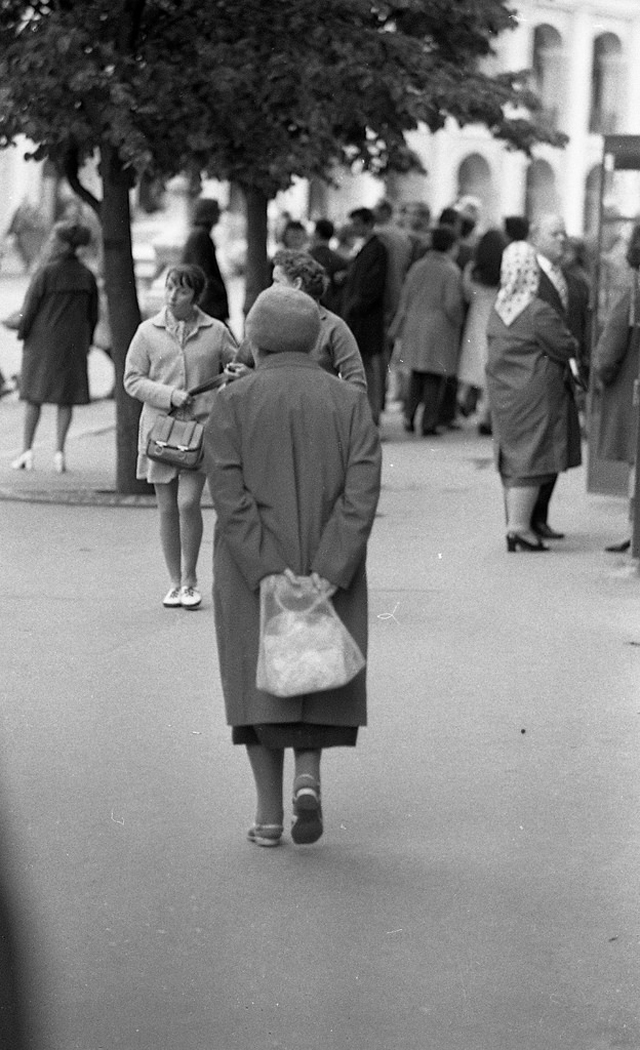
Note there was no street uniform to indicate which women were selling sex: anyone in photos from the period could have been. The shoe marking was new to me. A website purporting to cover ‘sex in the Soviet Union‘ (before 1992) goes on about such identifying marks:
Prostitutes waited on the platforms of large suburban train stations. They sat with their legs stretched out and their prices written on the soles of their shoes, so that any passerby could check it out. There were two price levels for prostitutes in Moscow: either three or five rubles.
The girls usually could be found near the Prospect Mira subway station. They wore rings made of three-ruble or five-ruble bills. One was green, the other was blue, and it was easy to tell the price the girls were asking.
Prostitution politics are symbolic rather than functional: the laws as written do not ever reflect the presence, absence or predominance of commercial sex. This means looking at sex work’s mores (or habitus) can reveal much more. You learn more from good portrayals in fiction than from rote news items. Gorky Park is a perfect example of a book not about prostitution in which sex workers and clients express agency in the face of the law. Another way to think about this is what I call the Cultural Study of Commercial Sex. In this case, a culture of prohibition, secrecy and resistance through codes is shown: perfectly apt for Soviet times.
A combination of titillation and outrage characterise public rhetoric about commercial sex, along with a tone of moral indignation suited to crusaders. A policeman in Cornwall has just warned that paying for sex with an ‘unconsenting’ woman is rape. Poor dullard, as an agent of the law surely he knows that muddling legal terms isn’t good for his job? In UK law paying for sex with a ‘trafficked’ person is prohibited, not defined as ‘rape’. But then think how much easier everything will be when there’s no bothersome distinction to make between trafficking and rape. A single meme to denounce all.
Early on in my studies, when I first was invited to talk to groups, I learned quickly how the temperature went up although I wasn’t saying anything graphic or violent. I thought I was simply recounting how poorer women often decide to take risks to travel via smugglers to rich countries, some of them to work as maids, others to sell sex, many to try both. I thought I was telling good news about curious, determined, brave women.
But those reasonable stories, told in an ordinary tone, caused commotion. Some listeners seemed to feel I’d slapped them, asking Do you think everything is okay? What do you want us to do, not care, not try to help? So I saw there were two problems: First, my tone and emphasis seemed to accept the dire straits some women are in, and, second, my suggestion that trying to make women stay home did them no favours was highly unwelcome.
My tone is key to being able to study in a clear-headed way, plus it is genuinely how I feel. I wasn’t going to take up an indignant, judgmental stance. But I wanted to draw listeners in better, so I tried harder to put myself in the shoes of middle-class audiences, to understand their distress more. To frame my talks with something more familiar to them, some way for it not to sound as though acceptance of reality gets us all off the hook of giving a damn about other’s problems. I got a little better at it.
But I wouldn’t be able to continue commenting unless I felt a sort of calm about it all, a sense of belonging to the great stream of history. Not Progress but a long chain of events surrounding the exchange of sex for money.
In this context I was happy to receive the following email:
I wanted to tell you how much I liked your book The Three Headed Dog. It’s well written and honest. I enjoy your website and think you make a lot of sense.
I used to live in Holland and did from time to time have fun with a sex worker. The house was in a quiet suburb. The locals had no problem with the it. Indeed it was next door to a cafe where kids and adults would eat.
I got to know a few of the women who worked there. None were abused or forced into sex work. Some didn’t like the work, others did. They all were doing it for the money. Strong women not victims.
One lady became my regular. I would enter and be greeted by the Madam who would either ask for her or she would spot me and come over. I would play for her and then to a private room for an hour of fun.
So it’s not the world painted by some people. Thanks once again for your efforts.
The tone is cool and declarative: This is how it was. No rhetoric, few adjectives, no great claims. Just the experience a lot of people have when left alone out of the limelight where politicians and crusaders roar, sex workers and clients alike. Thanks to this anonymous client who wrote to me.
In The Three-Headed Dog, Félix’s partner Marcelo goes in for a bit of bombast about a migrant sex worker who’s started coming to the bar.
‘Yes I know other prostitutes drink at the Dog. But they aren’t coal-black Nigerians in white satin corsets and giant hairdos. They aren’t advertising it like she is.’
Leila finds Marcelo’s conformism intolerable, but I find him restful. A sort of psychological Rotarian who follows predictable lines of opinion, always quoting from the same sources in mainstream newspapers. He even once asked why I never got a job with the police so I could be a Good Guy going after the Bad. I pay no attention.
And I knew he was ashamed even before I replied, because he has limits. ‘Give over, Marcelo. Everyone can wear what they like here, it’s a neighbourhood tavern, not the opera house. She wears a coat over the corset, for God’s sake, but if she ever takes it off I’m not throwing her out, I’m telling you right now. Maybe I’ll wear my own corset here some day – it’s red.’
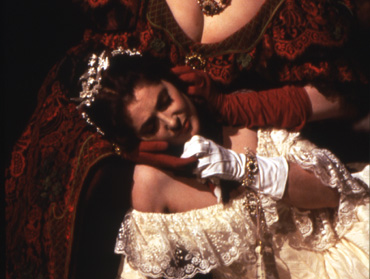
A drinker who was listening said, ‘Hey, I know which opera it is – La Traviata. You know, where the courtesan falls on the floor crying about her sin.’
The Three-Headed Dog is noir fiction, a novel set in Spain, with undocumented migrants as protagonists. Including sex workers who are coping – imagine that. The detective is a now-regularised migrant as well. It’s the first in a series, prepare for more non-scandalous treatment of underground lives. Readable on any device, no kindle required.
Why does it matter where you sell sex? Although most photos attached to media stories show truncated women’s bodies standing in dark streets, the news often concerns indoors: flats where migrants live and sell sex for short periods, ordinary flats rented by someone and hired out to women who fly in and fly out, making money and then moving on. British media like to call them brothels, a stupidity based on laws that prohibit more than one person at a time selling sex in indoor venues (yes, even two friends watching out for each other). Now they’re even called pop-up brothels, a cuteness deserving no further comment.
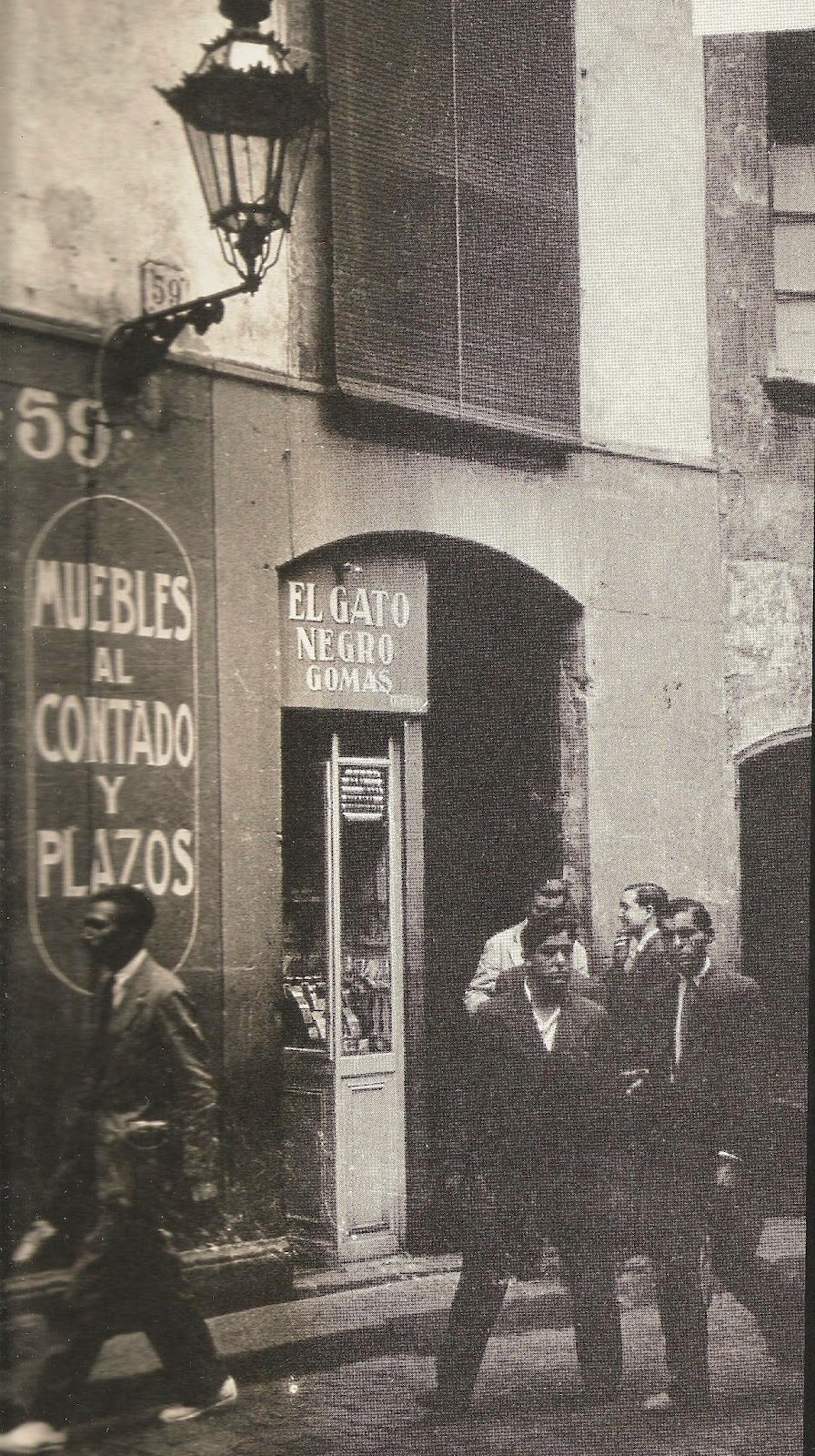
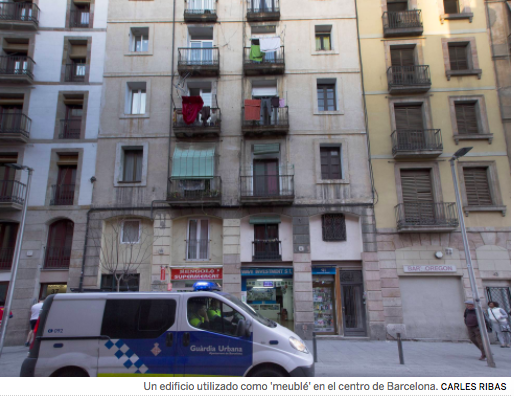
The flats don’t conform to the widely-held idea of brothels as places where clients can drink and socialise at bars and choose amongst a number of available workers to have sex with. Brothels don’t look like residential apartments in anyone’s imagination, any more than they look like clinics, carwashes or hair salons – all disguises that have been used. In old Barcelona photos you see the term mueblé to signify a brothel somewhere inside a residential building. In the photo to the right there is a venue El Gato Negro, which may be a bar or may lead to the mueblé mentioned in the sign at the left, which could be only a room or could be a flat (gomas in the Gato sign refers to condoms). Contemporary buildings are used the same way, with or without signage (see caption in below photo).
It doesn’t take a business-genius to figure out how to rent a house or flat and then sub-rent the space out to sex workers. Independent women do it or they find out about someone else and sub-rent from them. Nor is it difficult to buy budget air tickets online, nor, in the case of Europe and Europeans, to cross borders without showing passports. Some workers even use Air B&B, leading to outrage when homeowners want to believe chaste ‘families’ are enjoying non-sexual tourism in their rentals.
No wonder freelance sex work is a widespread international occupation. But despite this obvious fact, moral crusaders, police and media writers throw up their hands in horror at the supposed ‘traffickers’ who are setting flats up and then luring – that favourite word – unaware women to work in them. The assumptions are spelled out by judges at criminal trials who inevitably refer to women as vulnerable – a present-day version of innocent. In fact it all feels like the performance of a 19th-century melodrama in modern dress. And when the women protest strenuously enough that they set things up on their own, they are deported (even when selling sex isn’t prohibited – there’s always an excuse to toss them out.)
In a story from Singapore a migrant said to a reporter: ‘We have many customers every day and have all sorts of services. But we will be leaving in two days’ time.’ They were there on ‘social visit passes’ or tourist visas, and they indicated other women would be arriving when they left. The photo intends to show the ordinariness of the environment, I suppose – these are public housing units.
In Barcelona a news item relates how police are aware of 20 flats where, ‘without any kind of licence rooms are rented by the hour for sexual encounters. According to sources close to the case it was the same Martínez Bordiu family who found out that the tenant to whom they had rented the flat was using it as a brothel’ (casa de citas is the old-fashioned term used).
In The Three-Headed Dog, the migrant character Marina is working in a flat in Torremolinos, on the southern coast of Spain. When a client collapses she calls Félix Vidal:
It was after midnight when I parked in front of one of the faceless white apartment blocks, near where a couple with a small child were unpacking their car. I buzzed the street door, and a voice said ‘Closed’, but then there was bumping and a clank, and the door buzzed open. The family joined me in the small lift, fiddling with bags and folding up a push-chair.
At the flat, Marina let me in quickly, her hair springing out around her face like a great black halo. She pulled me into a room and closed the door on four young women in shorts and T-shirts huddled together looking scared. It was a bedroom conceived for a child in the original plan, so the double-sized bed that had been installed took up most of the space. A skimpy whip hung next to a red heart on the wall. On the floor beside the bed lay a man. Marina said, ‘He had some kind of attack. He was still conscious when I called you.’ I checked: he was breathing faintly.
The anonymity and ordinariness of houses, flats, apartments is preferred by a lot of workers and clients alike: people who don’t want bars, socialising, dance floors or fancy atmosphere. To call them brothels is to really stretch the imagination of already tired spectators at the Sex Work Wars. Sex takes place in houses anyway, so what difference does it make if money changes hands?
The headline reads Spanish brothel’s “back to school” party sparks outrage in Andalusia. El Bosque is a legal club de alterne where sex workers drink, dance and chat with customers with the option to retire to private rooms for paid sex. The party-poster was called an incitement to paedophilia.
Clubs like El Bosque, known colloquially in Spanish as puticlubs, are legal businesses in Spain; here you can see a typical for-sale advertisement. Activists describe sex work in Spain as alegal: neither expressly prohibited nor permitted by law.
The anti-prostitution movement has long deplored these clubs as sites of violence against women. But in the campaign here, a party-style tolerated for ten years became intolerable to non-campaigners on the ground of promoting paedophilia, despite the obvious age of women (and their clothing) in the poster. The club’s owner removed the posters and cancelled the party.
Why am I interested? To have a ‘field’ of study means keeping track of events over time. Now that I’ve been observing opposition to the sex industry for more than 20 years I clock details, small moments of change. Opposition to paedophilia is not new at all. Outrage about enjo kosai and other kinds of juvenile sex work is also now old. But opposition to commercial-sex parties where adult women wear mock schoolgirl outfits shows a shift in mores about what is offensive. The pictures caused distaste.
But do such parties actually promote sex with young girls? It’s a question impossible ever to answer, like the effect of watching porn or violent movies. For all the palaver about research, most of it carried out about social behaviour can only vaguely intimate effects on one group or another. The neighbours’ feeling offended is palpably real, though neighbours who don’t feel offended are omitted from the story.
My formal study of opposition to the sex industry began with women planning to migrate to Spain, where two paying options awaited them: live-in domestic work or various sex jobs. There’s a wide gamut of these.
The life of migrants who find work in clubs de alterne and other venues is the theme of The Three-Headed Dog, a noir novel set in Málaga and Madrid. One of the characters is a 16-year-old Dominican boy in process of getting into sex work. Eddy is not well-educated but no longer wants to be in school or live with his parents. The detective sent to find him has to choose whether to try to rescue him against his own will.
Migrant sex worker: a term that has arrived I wouldn’t have been surprised if the term migrant sex worker had died out except amongst rights-activists, given the hegemony...
You paid someone to help you leave home, travel across borders or into unknown areas of your own country. You knew you’d be selling sex but probably not much about how it would work. You might not think of yourselves as migrants but as travellers. There’s no need for you to label yourselves based on jobs you take. But others will talk about you and find it convenient to give you an identity-label: Migrant sex workers. Foreign prostitutes. Escorts. Victims of trafficking. Sex slaves.
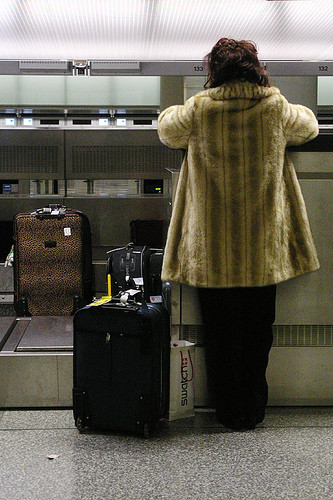
You look like other woman travellers in the airport. Maybe you bought the ticket online yourself, or maybe someone else did and gave you the booking number. You might be using your own passport applied for by you in the normal way in your country. Or maybe you paid someone to get you a passport under another name or age. You may understand that this implies your connivance in committing crime, or you may not.
However things work out for you, there will be stories about how miserable you are. No way out for Almería’s prostitutes relies on the fact that most undocumented migrants, whatever your jobs, take on debt in order to leave home, arrive to another place and get into paying work. The debts often sound outlandish to outsiders, leading them to describe you as enslaved (using the term debt bondage when they don’t ever refer to mortage- or student-loans like that).
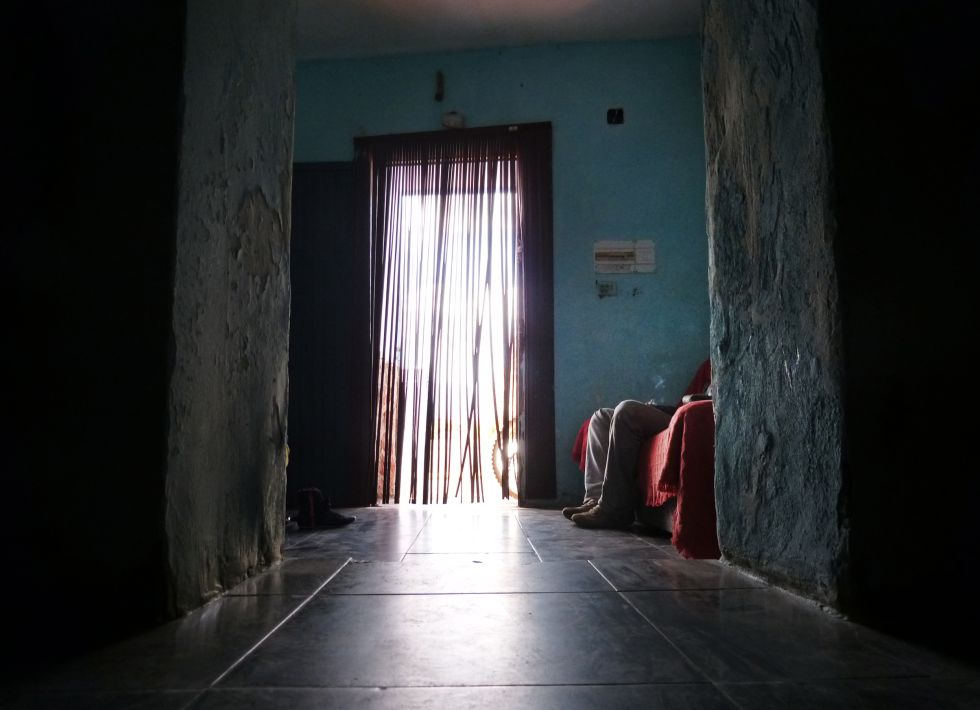
A recent photo series taken at a brothel in Roquetas de Mar purports to show how awful living and working conditions are for migrant sex workers: Infamous Farmhouses (Cortijos de la infamia). But, if you already know from personal experience how poverty and informal or illegal businesses look, you won’t be upset by shots of rubbish in the street. You may even see the bright side of landscapes or interiors, despite their being shot with the purpose of horrifying outsiders. [Note that the caption to this photo describes the women as fleeing inside to escape photographers.]
The disconnect between how outsiders see these scenes and what they mean to migrants is apparently unfixable. I was once challenged, after a speech I’d given, to admit that migrants are, objectively speaking, victims (because of structural inequalities if nothing else, but of course there was a lot else.) I responded that I understood why she, a middle-class educated and avowed Socialist, might view poor migrants as victims. But, I said, if you shift to their point of view then you don’t see things that way. You see yourselves as taking actions to get ahead inside very shitty life circumstances.. That’s what I do, rather than labelling. I look at the situation from the subjects’ standpoint.
There’s no doubt that smugglers often lie and take advantage of travellers who have paid for their services. But campaigns to keep everyone at home in case they might be mistreated by smugglers miss the fundamental point: In the absence of hope for the future people are willing to take risks. In the case of Colombian women hiring smugglers to take them to China, the government campaign aims to ensure that ‘women don’t believe in the offers of easy money to be made abroad.’ But money is made abroad, and lots of it, and no migrant I ever met expected it to be easy. More to the point, everyone doesn’t suffer the same abuse; experiences vary. But what all migrants are doing is taking risks.
It’s not fair, of course it’s not. But insisting everyone is by definition better off staying at home rather than taking risks is crazy in a world where transport is easily available and the adventure of travel is promoted constantly. And without new kinds of flexible migration policies the informal market where smugglers operate will continue unregulated. Putting smugglers in prison will not stop others from entering the field. [Note smugglers are often referred to as travel agents by their paying customers.]
In Sex at the Margins, I avoided labelling women migrants as much as possible. On Twitter I often use the tag #migrantsexworkers for brevity’s sake, but most people don’t label themselves anything. Imagine the term migrant construction workers or migrant kitchen help: they sound silly because it’s understood that they’re not identities. They’re temporary descriptions of folks going through a life-stage. Plenty of women who sell sex don’t call themselves sex workers or prostitutes or anything else. I used to hear women saying I work at night. For that matter, even if you identify as a victim of trafficking, that, too, is a temporary description. Not an identity.
After all, you may have started out doing another job after moving to a new country. For women that’s likely to be some kind of domestic service (as a maid, nanny, cleaner). But if and when that didn’t work out you may have switched to selling sex. Take the recent case of a Bangladeshi migrant in Abu Dhabi and Dubai.
In The Three-Headed Dog, characters are going through migration processes, not taking on job-labels. Yes, it’s a crime novel, but one about ordinary people in common situations. They have names, they talk, and none is either a Happy Hooker or a permanently damaged victim. I began writing fiction about these subjects to escape from tedious, repetitive debate-formats where black-and-white questions make nuance impossible.
I’m now being accused by fanatics of ‘sanitising’ injustice by sometimes using the term migrant sex workers. Thank goodness it doesn’t matter to most of you which language or label I use: call yourself what you like. That’s the point.
Migrant sex worker: a term that has arrived I wouldn’t have been surprised if the term migrant sex worker had died out except amongst rights-activists, given the hegemony...
Anti-trafficking campaigners often single out Nigerian women as the worst case of what they call sex trafficking. I first wrote about this years ago and note that, despite critiques and debunkings, the trend holds. In stories about Nigerian migrant women, ‘rituals’ are usually cited that are supposed to have bound them in a specially sinister way to smugglers. It’s straight-up racist colonialism, the inability and unwillingness to conceive of even the most superficial aspects of a non-western culture. Lurid conclusions are jumped to immediately according to which juju ceremonies are not comparable to Roman Catholic ones, for one example – though promises, petitions and talismans are found in both. As though one sort of prayer for help or success were inherently irrational and the other not.
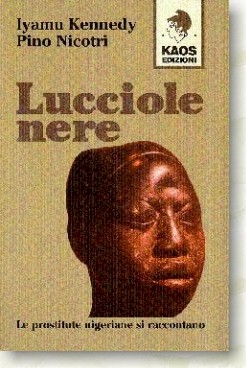
That’s not to say that conditions are not pretty dire for many women and men in western Africa, politically, economically, on the gender front – which means people can be willing to take big risks and assume onerous debts when they travel to work abroad. Early in my studies I learned about how some migrants think about that in Lucciole neri – Le prostitute nigeriane si raccontano (Iyamu Kennedy and Pino Nicotri, editors, 1999), one of my sources of ethnographic research with migrants who sell sex in Europe, for what eventually became Sex at the Margins. These Nigerians were working in Italy. [NB: It’s never clear whether the label Nigerian actually means born in and identified with that country. In the world of migration national identities are shifty.]
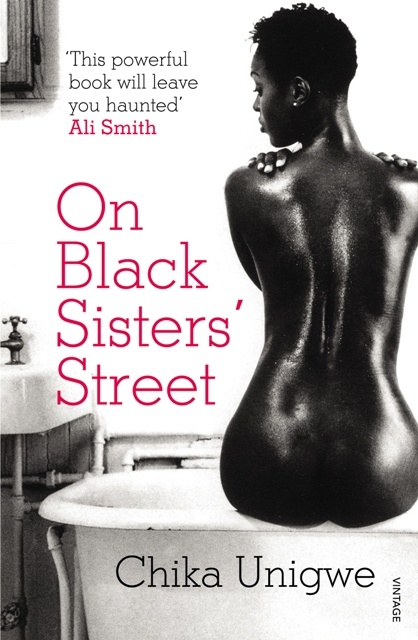
On Black Sisters’ Street, by Chika Unigwe, came out in 2009. I was prompted to read it by This is Africa’s mention of it along with Sex at the Margins. It’s a novel telling the stories of four women’s migrations from Nigeria to Belgium where they work in windows in the red-light district. None of them has had an easy life and none of them sees herself as a victim, despite the presence of a powerful smuggler in Lagos and a controlling madam in Antwerp. They are, the author says, willing to play the trump card that God has wedged in between their legs. Unigwe has said:
If your parents can’t help you out and your government has failed you, these pimps and traffickers have at least given you a chance to leave and make a living. He’s your saviour. It takes someone outside the situation to see these pimps and traffickers as the bad guys.
At the end of the book we are told how three of the women fare in the future. After nine years in Antwerp, Efe became a madam herself.
It would take eighteen months to get her first of two girls whom she would indeed buy at an auction presided by a tall, good-looking Nigerian man in sunglasses and a beret. It would be in a house in Brussels, with lots to drink and soft music playing in the background. The women would enter the country with a musical band billed to perform at the Lokerenfeest. The man in the sunglasses was the manager of the band and as usual had, in addition to genuine members of the band, added the names of the women who had paid him to the list he submitted at the embassy in Abuja. The women would be called into the room one at a time for the buyers to see and admire. They would all have numbers, for names were not important. Their names would be chosen by whoever bought them. Names that would be easy for white clients to pronounce… Efe would buy numbers five and seven. Number five because she smiled easily. Number seven because she looked docile and eager to please, the sort of girl who was grateful for little. Like Madam, Efe would have some police officers on her payroll to ensure the security of her girls and of her business. She would do well in the business, buying more girls to add to her fleet. pp 278-9
Yes, this is an auction where employers bid on women who will sell sex, but beware glossing all nuances and calling it slave-trading. The women in question want to migrate and accept they’ll be selling sex and paying off a debt. Which doesn’t mean they know everything that may happen to them and how constrained life will be in another country. The Three-Headed Dog, my own recent novel, is about the same dynamics, with Latin Americans in Spain but also a strong Nigerian character – Promise.
I first published this post only slightly changed on 22 September 2011 and publish it again now as part of a series on sex work in fiction.
The other day I lightly said It’s a blokey thing to a young person who replied That’s a sexist thing to say! The next day another young person heard me use the word masculine and cried You’re a feminist! I take it ideas about sexism and feminism have extended their contradictory ways into small corners of ordinary life and think it funny I got accused of opposing sins on back-to-back days. Some of us don’t fit neatly into identity-categories, eh?
Most of the discourse about buying and selling sex focuses on the abstract question Is it Bad or Good? in one way or another. More interesting is anything that shows how diverse transactions are, how wide the field, how contradictory the possibilities, how unlikely the goal of an ethical bottom line. In the following vignette from Graham Greene’s The End of the Affair (1951) a commercial transaction is deeply embedded in context: World War II London, Clapham, the narrator’s love for a married woman, his obsessive jealousy. They have an argument and he walks out. It is May 1940.
That evening I was still full of my hatred and distrust when I reached Piccadilly. More than anything in the world I wanted to hurt Sarah. I wanted to take a woman back with me and lie with her upon the same bed in which I made love to Sarah; it was as though I knew that the only way to hurt her was to hurt myself. It was dark and quiet by this time in the streets, though up in the moonless sky moved the blobs and beams of the searchlights. You couldn’t see faces where the women stood in doorways and at the entrances of the unused shelters. They had to signal with their torches like glow-worms. All the way up Sackville Street the little lights went on and off. I found myself wondering what Sarah was doing now. Had she gone home or was she waiting on the chance of my return?
A woman flashed on her light and said, ‘Like to come home with me, dear?’ I shook my head and walked on. Further up the street a girl was talking to a man: as she lit up her face for him, I got a glimpse of something young, dark and happy and not yet spoiled: an animal that didn’t yet recognise her captivity. I passed and then came back up the road towards them; as I approached the man left her and I spoke. ‘Like a drink?’ I said.
‘Coming home with me afterwards?’
‘Yes.’
‘I’ll be glad of a quick one.’
We went into the pub at the top of the street and I ordered two whiskies, but as she drank I couldn’t see her face for Sarah’s. She was younger than Sarah, she couldn’t have been more than nineteen, more beautiful, one might even have said less spoiled, but only because there was so much less to spoil: I found I no more wanted her than I wanted the company of a dog or a cat. She was telling me that she had a nice flat on the top floor only a few houses down; she told me what rent she had to pay and what her age was and where she was born and how she had worked for a year in a café. She told me she didn’t go home with anybody who spoke to her, but she could see at once I was a gentleman. She said she had a canary called Jones named after the gentleman who had given it her. She began to talk of the difficulty of getting groundsel in London. I thought: if Sarah is still in my room I can ring up. . .
Looking at her over my whisky I thought how odd it was that I felt no desire for her at all. It was as if quite suddenly after all the promiscuous years I had grown up. My passion for Sarah had killed simple lust for ever. Never again would I be able to enjoy a woman without love.
And yet surely it was not love that had brought me into this pub; I had told myself all the way from the Common that it was hate, as I tell myself still, writing this account of her, trying to get her out of my system for ever, for I have always told myself that if she died, I could forget her.
I went out of the pub, leaving the girl with her whisky to finish and a pound-note as a salve to her pride, and walked up New Burlington Street as far as a telephone-box. I had no torch with me and was forced to strike match after match before I could complete the dialling of my number. Then I heard the ringing tone and I could imagine the telephone where it stood on my desk and I knew exactly how many steps Sarah would have to take to reach it if she were sitting in a chair or lying on the bed. And yet I let it go on ringing in the empty room for half a minute. — The End of the Affair, pp 57-59
Now try to reduce the narrator’s interaction with a woman he picks up on the street to the question Is it Good or Bad?
This post is part of a series on sex work in fiction. Scroll backwards to May 2017 and see the Related Items appearing below this post. I’ve contributed to this production with The Three-Headed Dog, a noir novel about Latin American migrants in Spain.
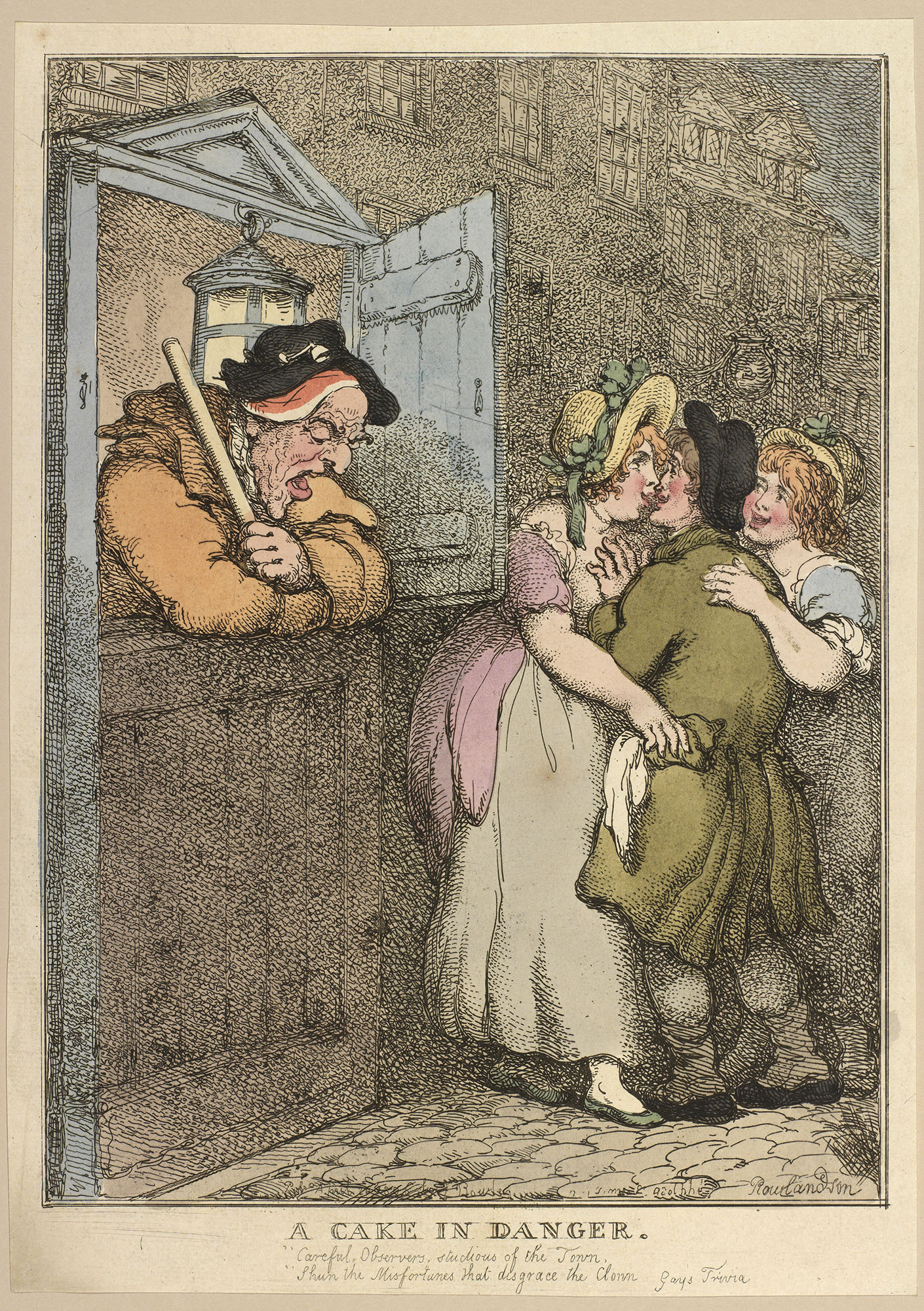
In Slammerkin, Mary is a street prostitute in mid-18th-century London. Thrown out of her dismal basement home by a mother absolute in condemnation of Mary’s pregnancy at 14, she meets a friendly whore, Doll, who initiates her into street trading. Mary is in love with nice clothing and comes to see there is no hard line between the Good Woman and the Bad.
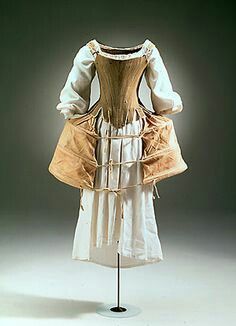
[Her mother] Susan Digot wouldn’t likely recognise her child-as-was, all gussied up in a flowered jacket-bodice and a worn silk skirt buoyed out by a pair of improvers. Mary looked like a woman of the town, these days. She smelled different, even, with the mouth-watering lemony reek of Hungary water.
What a fool Susan Digot had been, to think everyone in gold braid her better, and the wider the skirt, the higher the breeding! Mary had seen commoners walk as queens on the stage in Drury Lane. Doll was opening Mary’s eyes to all life’s shortcuts, back alleys, gaps in the walls. In these uncertain times, Mary was learning, a duchess was sometimes just a stroller who’d picked the right honourable cully.
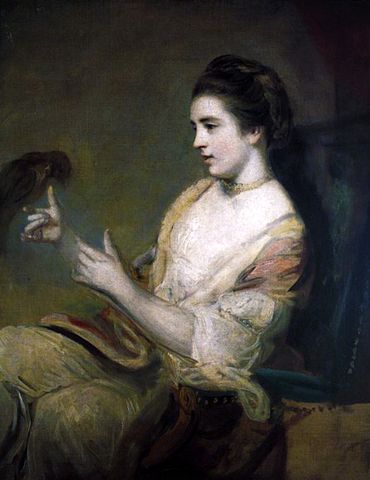
Kitty Fisher by Joshua Reynolds
In a four-story house in Golden Square lived a lady who’d once been known in the trade as Angel Arse. On the corner of Hyde Park was a new mansion the Duke of Kingston was building for Miss Chudleigh, who’d been his mistress for a dozen years already and he still hadn’t tired of her. The famous Kitty Fisher was said to be about to swap all her lordly lovers for a rich husband from the Lower House. A bit of loveliness, a bit of luck; that’s all a girl needed.
On long bright evenings, Mary sat on the grass in Lamb’s Conduit Fields behind Holborn and watched the courting couples meander by. The air was full of the sounds of leisure: the archers’ arrows hitting the target, the click of balls on the bowling green, or the distant roars of a dogfight or wrestling match. She was reading again for the first time since school. She bought crack-backed romances and memorised all the long words, in case she’d ever need them. The History of Pamela Andrews was her favourite. The crafty wench, to fend off her master all those times, then squeeze a proposal of marriage out of him in the end! She’d swapped her maid’s apron for bridal satins and ended up as good a lady as any other, hadn’t she? It all went to show, Mary thought. If a girl had her wits about her, nowadays, she could rise as high as she wanted, as sure as cream through the milk. Anything was possible. – Slammerkin p247 (Emma Donoghue 2002)
About Mary’s interpretation of Pamela – well! Astute doesn’t begin to describe it. No wonder social blowhards began to condemn the reading of novels by gels.
The word for the loose gown, a slammerkin, came to be used for the women who wore them. On the word slammerkin, from one etymological dictionary:
There is a group of North Sea Germanic words in sl- that mean “sloppy,” and also “slovenly woman” and, less often, “slovenly man,” and that tend to evolve toward “woman of loose morals.” Compare slattern, also English dialectal slummock “a dirty, untidy, or slovenly person” (1861), variant of slammacks “slatternly woman,” said to be from slam “ill-shaped, shambling fellow.” Also slammakin (from 1756 as a type of loose gown; 1785 as “slovenly female,” 1727 as a character name in Gay’s “Beggar’s Opera”), with variants slamkin, slammerkin. Also possibly related are Middle Dutch slore “a sluttish woman,” Dutch slomp, German schlampe “a slattern.”
This knowledge came to me during regular posts/tweets entitled Today’s word for a Bad Woman. There are way way way too many of them, and almost any negative meaning deteriorates sooner or later into promiscuity and prostitution – beginning with sl- or not.
Efforts to save migrants and sex workers also appear in ordinary fiction (by which I mean not melodramas produced by moral crusaders) and some authors have a fine-tuned sense of irony. In Magdalen Nabb’s Some Bitter Taste (2002), Marshal Guarnaccia, a policeman in Florence, helps an Albanian woman escape from her pimp, who is sent to jail. The woman goes to live with a nice man, Mario, but after a time she visits Guarnaccia in his office to tell him his effort to help her has failed.
You’re the only person who’s ever been nice to me… so I wanted to tell you because if I don’t somebody else will. You’re bound to find out. I’m going back on the game.
– What? You’re what? And Mario?
– Oh, Mario… Jesus… I mean, he trotted off every morning at a quarter to eight and I was supposed to clean up his crumbs and wipe the floor over and then he’d come trotting back again and I was supposed to have the water boiling for his pasta and then it was one long whinge – there are no clean shirts, have you seen the fluff under this bed? Where’s the other sock to this? You’ve forgotten to get milk again… No, no, I couldn’t stand the boredom. So I upped and offed.
– Back to Ilir?
– Why not? He’s out now and he wants me back. Nobody ever earned him as much as me and he kept me in style. We ate in a restaurant every night. I like a good time and I get clients who give me a good time, you know what I mean? I like champagne and a few presents. I’m not spending the rest of my young life washing the floor of some poky little kitchen for a boring spotty clerk who thinks he’s earned the right to have his socks washed for a lifetime because he’s been good enough to save me from the streets.
– But what about when you’re not young anymore?
– Well, it’s all over then, isn’t it? Get it while you can, I say. I just… I wanted to tell you myself. It’s not that I’m not grateful to you. I know you meant well. Are you pissed off with me? You are, aren’t you?
-No, no…
– You’ve every right to be. I’d better go. I’m sorry. Because of you, I mean, not that little prick Mario, only because of you. I know you did your best.
Carve it on my tombstone, thought the marshal, watching her leave through a skein of cigarette smoke.- p 309
It’s good commentary on the institution of couplehood: the marriage model in which woman has a domestic capacity. Some would say all would change if they were to have children, but, after all, she still wouldn’t be able to eat in restaurants every night. And the presumed debt to saviours sounds awful: a side-effect of Rescue rarely addressed.
Funny how she comes to thank the policeman but calls the husband-man a little prick.
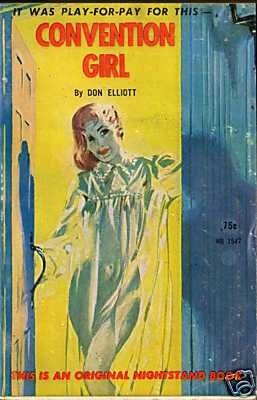
A typical paperback cover from the heyday of pulp fiction makes convention girls look carefree and glamorous. Some might have been and still be, but picking clients up at bars where convention-attendees hang out may be the sex work of everyday women, sometimes opportunist and unplanned.
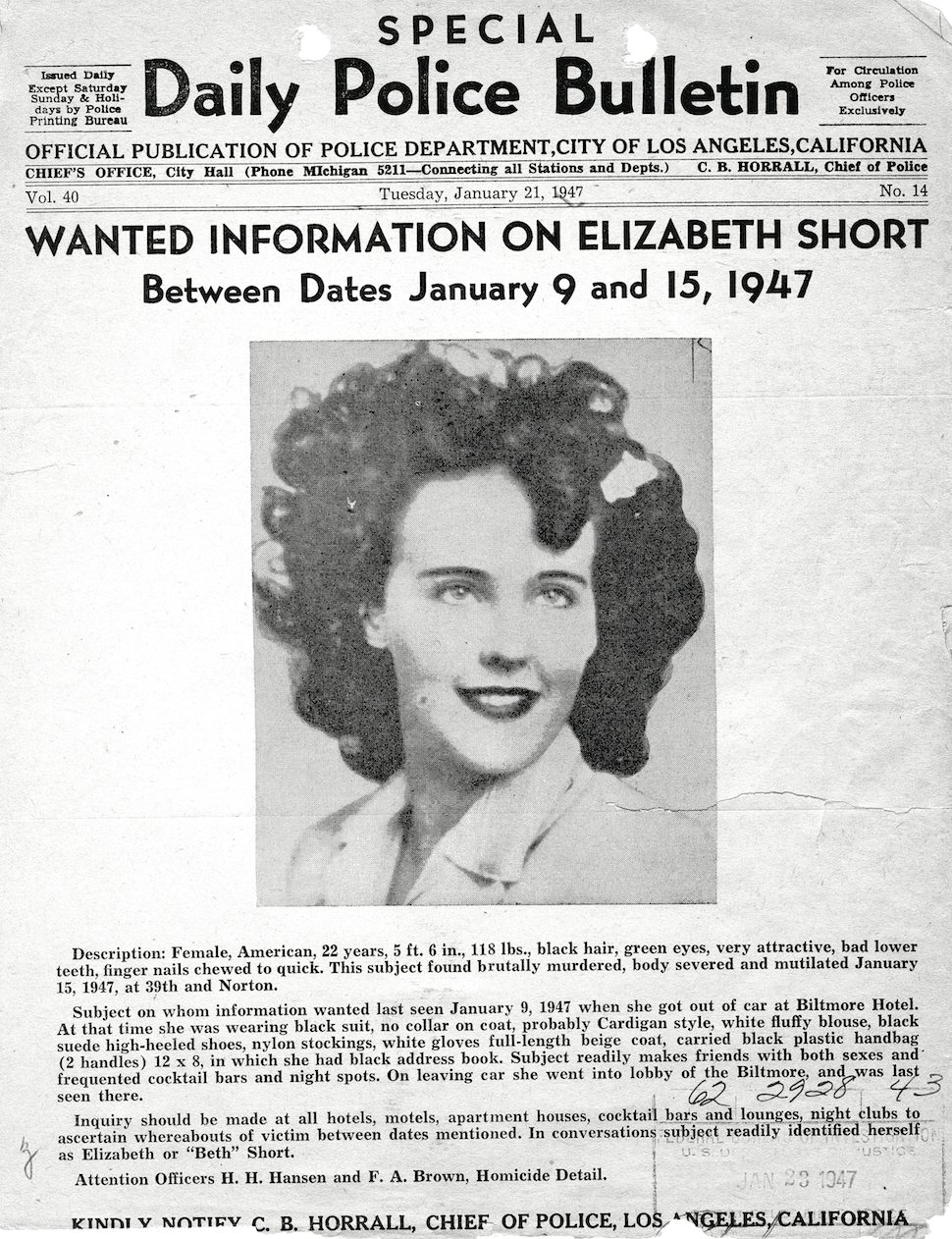
It seems that Elizabeth Short was such a woman, looking to get ahead in postwar Hollywood. James Ellroy memorialised her in his novel The Black Dahlia (1987), which draws on the actual police investigation as well as the author’s feelings about his own mother’s murder. In Ellroy’s snappy 1940s cop-lingo, women under scrutiny are described:
Together, we questioned fifty-odd people, mostly men, about their association with Elizabeth Short. We heard predictable stories of them meeting Betty in bars and buying her drinks and dinner, listening to her fantasies of being the bride or widow of war heros, bedding or not bedding her. A number of the men did not even know the notorious Dahlia–they were “friends of friends,” their names passed on out of pussy hound camaraderie.
Of our parcel of names, sixteen of the guys were what Fritzie labeled “Certified Dahlia Fuckers.” They were mostly lower-echelon movie minions: agents, talent scouts and casting directors who hung out at Schwab’s Drugstore chasing gullible would-be starlets, empty promises on their lips, Trojan “value packs” in their pockets. They told proud or shamefaced casting couch stories every bit as sad as Betty’s tales of bliss with studs in uniform. Finally, the men in Elizabeth Short’s little black book had two things in common–they got their names in the LA dailies and they coughed up alibis that eliminated them as suspects. And word filtered back to the squadroom that the publicity eliminated more than a few of them as husbands.
The women–just pals–girl talk acquaintances, fellow cocktail lounge cadgers and aspiring actresses heading nowhere. A dozen or so were hookers and semi-pro B-girls, instant soulmates that Betty met in bars. They gave us leads that petered out on follow-up investigation–basically, the word that Betty sold herself freelance to conventioneers at several lower-class downtown hotels. They hedged that Betty rarely peddled it, and could not identify any of her tricks by name; Fritzie’s canvassing of the hotels got him an angry zero.– The Black Dahlia
Pussy-hounds: marvellous. B-girls are bar girls, if you didn’t know. But hanging out waiting for an opportunity leads to terms like semi-pro. What if you have sex with someone who might give you a part in a film, apart from buying you dinner tonight? Did the crime against Betty the Dahlia occur because she was having sex or because she was an opportunist or because it was LA or because there was a sadistic killer at large? To blame it on prostitution is — limiting.
Lawrence Block is a successful mainstream writer whose plotlines often include sex workers, in a normalising way (call girls, mostly). Matthew Scudder, the detective protagonist in one of Block’s series, has a long-term, friendly, sex-for-favours relationship with a call girl that eventually turns into marriage. The woman invests her money in property, allowing her to retire gracefully. Block doesn’t avoid portraying the dangers and problems inherent in the lives of women who sell sex, but he gives other sides of the picture, too, particularly refreshing given the usual police view of vice and prostitutes.
In Eight Million Ways to Die (1982) one New York call girl explains her lifestyle.
This is something different, she said. The johns who come here, they don’t think they’re johns. They think they’re friends of mine. They think I’m this spacey Village chick, which I am, and that they’re my friends, which they are. I mean, they come here to get laid, let’s face it, but they could get laid quicker and easier in a massage parlor, no muss no fuss no bother – dig? But they can come up here and take off their shoes and smoke a joint, and it’s a sort of a raunchy Village pad, I mean you have to climb three flights of stairs and then you roll around in a waterbed. I mean, I’m not a hooker. I’m a girlfriend. I don’t get paid. They give me money because I’ve got rent to pay and, you know, I’m a poor little Village chick who wants to make it as an actress and she’s never going to. Which I’m not, and I don’t care much, but I still take dancing lessons a couple mornings a week and I have an acting class every Thursday night, and I was in a showcase last May for three weekends. We did Ibsen, and do you believe that three of my johns came? (p 145)
I was living in New York the year this was published, and my friend Mona lived the same way Block’s character does. Mona also didn’t call herself a prostitute or anything else. Using a casual feminist analysis of the time, we thought she was doing what a lot of wives do, in a careful, selective way and without ceremony. In a context in which rents were sky-high and lots of people were trying to make it in demanding professions, Mona’s choice was sensible. She got to take her lessons and audition for parts, and, in the rare case that she got one, she was free to accept it. I don’t know whether she would have advertised GFE as a service had the term or the Internet been available, but that’s what she was offering.
Mona’s lifestyle illustrates how sex-for-money occurs in casual ways that are part of normal life in informal economies. If you recall the obsessive quality of hustling culture that John Rechy conveyed so well, this Village chick sounds serene (or spacey). But her way of looking at things is also common. In order to bring out more of these situations, I proposed a field called the cultural study of commercial sex. Scholarship without moralising. In my view, in fact, if you are moralising you are not a scholar.
Part of a series on sex work in fiction: scroll back a few days, then again, then again. [First published 19 January 2009]
I’m a girlfriend, they’re my friends: GFE is nothing new Lawrence Block is a successful mainstream writer whose plotlines often include call girls and prostitution, in a normalising way. Matthew Scudder, the detective protagonist...
You know how it is when you are staying at someone’s house and you finish your own book and have to look around the alien shelves for something you’ll like? That’s how I wound up re-reading John Rechy’s City of Night, published in 1963. I first read it decades ago and had completely forgotten the intensity of his descriptions of cruising and hustling and the symbiosis of human relationships in one kind of sex work.
Here’s an example from the Los Angeles section:
This is clip street, hustle street – frenzied-nightactivity street: the moving back and forth against the walls; smoking, peering anxiously to spot the bulls before they spot you; the rushing in and out of Wally’s and Harry’s: long crowded malehustling bars.
And here too are the fairyqueens – the queens from Everywhere, America – the queenly exiles looking for new ‘husbands’ restlessly among the vagrant hustlers with no place to stay, and the hustlers will often clip the queens (if there is anything to clip), and the queens will go on looking for their own legendary permanent ‘Daddies’ among the older men who dig the queens’ special brand of gone sexplay, seldom finding those permanent connections, and living in Main and Spring Street holes: sometimes making it (employed and unemployed, taking their daddies and being taken by the hustlers) – sometimes, hardly, sometimes not at all.
And the malehustlers live with them off and on, making it from bar to lonesome room, bragging about the $50 score with the fruit from Bel Air who has two swimming pools, jack, and said he’d see you again (but if he didn’t show, you don’t say that), and you’re clinching a dime and a nickel for draft beer at Wally’s or Harry’s or the 1-2-3 or Ji-Ji’s so you can go inside and score early, and make it with one of the vagrant young girls to prove to yourself you’re still All Right.’
There’s a good interview with Rechy in The Independent, in which he recounts what his life was like after City of Night was a success:
In the 1970s, when I was teaching at UCLA, I’d finish my evening classes, then change my clothes somewhat and go down to hustle on Santa Monica Boulevard. One night, a student saw me down there and said ‘Good evening, Professor Rechy. Are you out for an evening stroll?’.
It would be difficult to find a more appealing sex work story than that! But also see Rechy’s other books on his website.
And a final thanks to the friend with the bookshelf – he knows who he is.
[Post first published 11 November 2008]
Part of a series on sex work in fiction (scroll to a few days ago and a few days before that.)
In today’s shrill anti-trafficking culture any differences in forms of facilitating prostitution/ sex work are practically erased. I’m not talking about whether anything is fair or gender-equal or exploitative here but about the many ways humankind has evolved for making money through commercial sex. In James Lee Burke’s Cadillac Jukebox (1996) one swindle involving sex work in New Orleans is described: the Murphy scam.
Vice had identified the hooker as Brandy Grissum, a black twenty-five-year-old heroin addict who had done a one-bit in the St John the Baptist jail for sale and possession.
She worked with three or four pimps and Murphy artists out of the Quarter. The pimps were there for the long-term regular trade. The Murphy artists took down the tourists, particularly those who were drunk, married, respectable, in town on conventions, scared of cops and their employers.
It was an easy scam. Brandy would walk into a bar, well dressed, perhaps wearing a suit, sit at the end of the counter, or by herself in a booth, glance once into the john’s face, her eyes shy, her hands folded demurely in front of her, then wait quietly while her partner cut the deal.
This is the shuck: ‘My lady over there ain’t a reg’lar, know what I’m sayin’? Kind of like a schoolgirl just out on the town.’ Here he smiles. ‘She need somebody take her ’round the world, know what I’m saying’? I need sixty dollars to cover the room, we’ll all walk down to it, I ain’t goin’ nowhere on you. Then you want to give her a present or something, that’s between y’all.’ — p 24, Cadillac Jukebox
The Murphy scam is robbery by a couple who lure a client to a room to have sex (in exchange for seemingly reasonable, non-professional fees). After client and woman are in bed the other partner rushes in posing as a jealous husband (or whatever). The client leaves in a hurry and the Murphy artists collect his belongings and money.
In Burke’s description Brandy works with several pimps as well as with Murphy artists, so even though she’s an addict she is not anyone’s slave. We aren’t told what proportion of the takings she gets, so we don’t know how bad a deal she has. The scam is interesting in offering a kind of commercial sex palatable to clients who cannot see themselves as clients and thus lend themselves to being scammed. A different kind of ‘demand’ – that now over-used, less-meaningful-than-ever term. A man who can be ‘lured’ – not much of a monster. More on different kinds of pimping in Nesbø’s Blood on Snow and in my own The Three-Headed Dog.
This is part of a series of posts about sex work in fiction. The other day it was Doris Lessing’s turn.
The Four-Gated City was published in 1969 by Doris Lessing. The passage quoted below describes a single young woman walking west on the Bayswater Road in 1950. The woman is Martha Quest, recently arrived in London from southern Africa, a migrant from colonies considered peripheral observing life in the presumed cosmopolitan centre. Her route takes her from a middle-class dinner held east of Marble Arch to a poor squat in Notting Hill. The photo above shows another part of London at the same period; the photo below the young Lessing.
Note the absence of moral comment and that the job of the police is to make sure the marketplace functions peacefully.
Now she slowed, almost stopped in surprise at a cool hard getaway look from a young woman who stood with her back to a hedge. Of course, she had passed another invisible boundary. From here until Queensway, the pavements were lined with prostitutes, standing singly or in pairs, dozens of them, along the pavements. But Martha was freer here than she had been in that other territory she had only just left, whose boundary was simply a bisecting street. She was protected precisely by the line of girls for sale, who knew she wasn’t one of their trade union and because their hostile warning faces that said go away, you shouldn’t be here, kept her safe from being accosted. Three kinds of animal here. The women, standing with their backs to the hedges, on sale. The ordinary traffic of the pavement – but a slight traffic, mostly couples hurrying past the marketplace, keeping close under the lights, looking embarrassed, as if they were here by mistake, yet glancing furtively at the buying and bargaining.
The customers, men of all ages, walking slowly past the women, or standing under the trees smoking, making choices. And across the street, policemen, spaced out with twenty or thirty yards between each couple, not looking directly at the haggling and dealing, but observing it sideways to make sure that it went on without incident. Martha walked more slowly than she had had to walk in the part of the street she had left. All the way down the street, by lit airy trees, they stood. Although it lightly drizzled, they wore summer dresses, bare necked, bare shouldered; and high thick sandals with bared insteps; and sometimes they held a jaunty umbrella. But there was no elegance here either. They weren’t well-dressed. They shared the national disposition towards gracelessness.
There has been a war on. Suppose one of these men who was making up for the starvation of the war… approached one of the girls saying: I’d like you to wear … whatever was his fantasy, would she snap back: There’s been a war on, you know? Yes, very probably … Martha found herself imagining rooms where furniture, curtains, objects had charm, had flair, and a girl with charm, flair, undressed slowly to show off wittily charming underclothes – a man’s fantasy? Perhaps in all this city it was only these girls’ rooms where there was anything attractive, gay, rightly made? Well, not from the way they were dressed as they stood on the pavement.
The Rescue Industry has entered the lexicon and now has its own song:Rescue Two-Step, described as ‘an anti-criminalization anthem dedicated to sex workers everywhere’. Listen and watch, it’s a great song, and if you set it to full screen you’ll see lyrics displayed at the bottom.
Written and produced by Savannah Sly
Starring Bella Robinson, Andorra Andrews, Rick Berlin, Joe King and Savannah Sly
Performed by Savannah Sly & The Fun Boys
Sound Engineering by Fast Eddy
LYRICS:
I gotta bunch of rubbers
I gotta burner number
I gotta hotel, ads on Backpage
and I’m settin’ up shop
comin’ to your town
yeah come and get me while you can boys, let’s get down
I got the Internet
I’m really into it
I’m postin’, screenin’, bookin’
weedin’ out the dickheads and cops
It’s a full time job
I swear these online classifieds reduce my harm
Well now, don’t go telling’ me that
using my body to
make my money ain’t a right god gave me, now
you wanna help me?
great, well you could start by
callin’ off your laws and cease assailing me The Rescue Industry, it wants to RESCUE me! and take away the tools I use to stay safe sayin’ they’re helpin’ me well I disagree all of this white knight savior shit is killing me
Well now, don’t go telling’ me that
using my body to
make my money ain’t a right god gave me, now
you wanna help me?
great, well you could start by
askin’ how I want it and I’ll tell you for myself
don’t do tellin’ me that
using by body to
make my money ain’t a right god gave me, now
you want to save me?
Great, pray tell me now,
do you plan to pay my rent?
feed kids and spay my cat?
and call off all the debt collectors
and tell the judge to clear my record
so I can work forever and ever and ever and ever and ever…
at dead end jobs for minimum wage
that barely cover the day-to-day
assuming that they’d hire me
some folks don’t like the look of me
could you create a policy
to put an end to bigotry?
or better yet
create a net
to catch me?
don’t go telling’ me that
using my body to
make my money ain’t a right god gave me, now
you wanna help me?
great, well you could start by
askin’ how I want it and I’ll tell you for myself
don’t go telling’ me that
using my body to
make my money ain’t a right god gave me, now
you wanna save me?
great, well start by callin’ off your dogs
and quit behavin’ like you’re trying to choke me out!
It’s time to propose the term Rescue Industry for next editions of the big dictionaries, eh? Someone should make a wiki for it. Meanwhile there’s a a whole category for it on this blog.
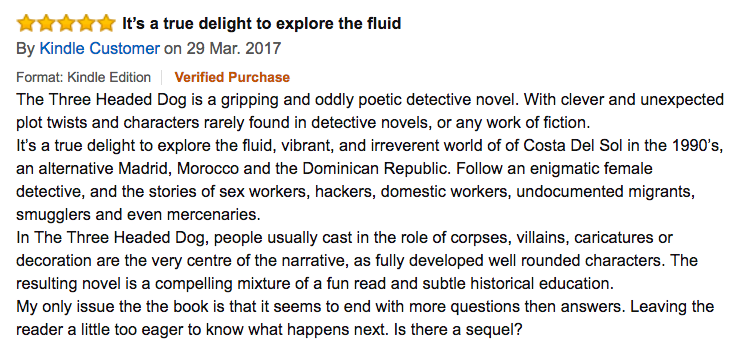
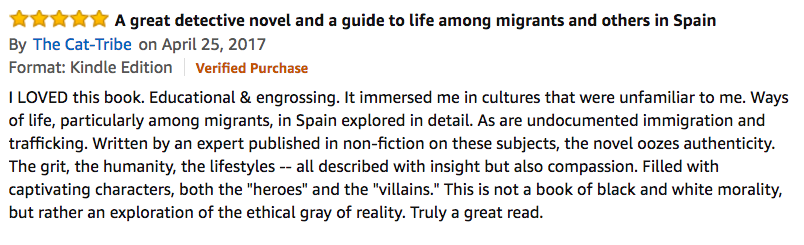
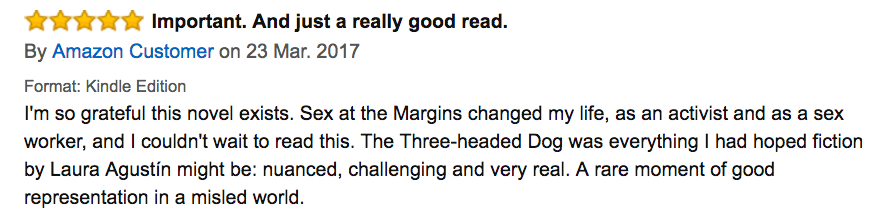
I love the customer reviews posted on The Three-Headed Dog‘s Amazon page and wish there were a reply-function so I could talk with the writers.
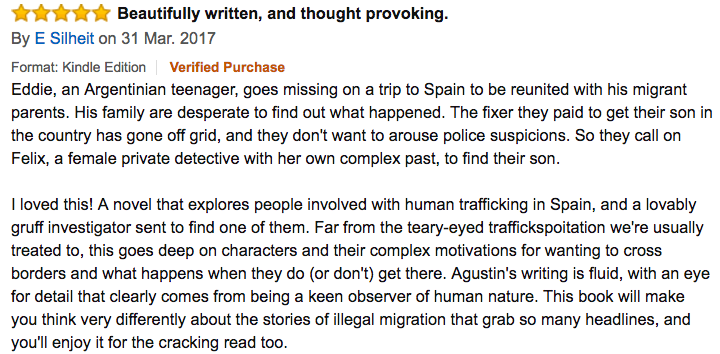
Take E Silheit, whose review coins a new term appropriate to the excessive production of heart-rending stories of sex-trafficked victims – trafficksploitation.
‘Oddly poetic: Follow an enigmatic female detective, and the stories of sex workers, hackers, domestic workers, undocumented migrants, smugglers and even mercenaries’.
Imagine a book where interesting characters are refugees and immigrantsm and on style and accessibility: ‘It’s like the author is chatting you up in the bar!’
Cat-tribe proves that what I aimed for is possible: Education Through Fiction, the discovery of lives mainstream media omits via descriptive story-telling. Hurrah.
So page-turning she missed her tube stop!
On authenticity, according to sex worker-migrants: ‘A rare moment of good representation’.
Belle de Jour: ‘Fab!’
Perhaps you don’t think you like ‘European crime fiction’?
More than one reviewer refers to wanting a sequel. Fair enough, next installment in the works now.
Reminder: you don’t need to own a kindle-object to read a kindle file. Little free apps sit right there where you buy the book, to be used on any old device. I myself don’t own a kindle!
The modern sculpture Cerberus pictured at the top guards an entrance in Stockholm.
Reader reviews of The Three-Headed Dog Reviewers of The Three-Headed Dog have been showing they get it: The detective-narrator is a woman with a complicated and...

 I’ve been invited to speak at the Human Trafficking Center of the Josef Korbel School of International Studies at the University of Denver, Colorado. The talk is called Sex at the Margins: Beyond Binaries in Trafficking & Sex Work. In the 10th-anniversary year of Sex at the Margins I’ll be reflecting on the oceanic changes that have taken place since I first thought about the issues. Beyond Binaries is right: Flee from all attempts to reduce migration and sex-work questions to black and white. What I say is pretty much the opposite of everything seen and said now on the subjects in the media, by politicians and by Rescue Industry participants.